Compare Top Used Car Warranty Providers or Buy a Hand Inspected Car
An extended warranty makes sense for a used car that's older, high-mileage, or lacks any factory coverage left, especially if you don't have savings set aside for a surprise repair bill. If you're shopping, start your comparisons with Endurance, Olive, Toco, Carchex, and CarShield. Before you sign anything, get three quotes, ask each provider for a sample contract, and compare it against a hand-inspected car with a clean history report.
TL;DR:
- Extended warranties are most beneficial for high-mileage, older used cars or owners without sufficient repair savings, especially if factory coverage has expired.
- Providers like Endurance, Premier Auto Protect, and Carchex offer options tailored to specific needs such as high mileage or month-to-month coverage, requiring careful comparison of claims processes and eligibility rules.
- It’s important to request sample contracts, clarify claim procedures, and compare coverage and costs based on your car’s age, mileage, and expected ownership length.
- Many plans exclude routine maintenance, preexisting conditions, modifications, and damage from floods or hail, making reading the fine print crucial.
- Buying a fully inspected, documented used car from a reputable dealership like Clearwater Largo Automotive often offers lower overall repair risk than relying solely on extended warranty coverage.
Table of Contents
- Extended Warranty for a Used Car: Ranking the Top Providers
- How Do You Choose the Right Extended Warranty?
- What Does an Extended Warranty Actually Cover?
- What Does an Extended Warranty Cost, and How Do You Calculate Real Value?
- How Do You Vet a Provider's Reputation and Claims Process?
- Buying a Better Car Beats Buying a Bigger Warranty
- Can You Cancel an Extended Warranty and Get a Refund?
- What Fine-Print Traps Void Coverage?
- Why We'd Rather Sell You a Car You Don't Need a Warranty For
- Skip the Premium, Start with a Car That Earns Your Trust
- Sources
- FAQ
Extended Warranty for a Used Car: Ranking the Top Providers
Picking a provider isn't about finding the "best" name in the industry. It's about matching a plan's eligibility rules, pricing structure, and claims process to your specific car and how long you plan to keep it. We looked at seven providers that show up again and again in editorial comparisons, and each one earns its spot for a different reason.
Endurance stands out for owners with higher-mileage vehicles who worry about getting shut out of coverage. Some of its plans carry no published mileage cap, according to editorial reporting from NerdWallet, which matters if your car has already crossed 100,000 miles and most competitors start turning you away. That flexibility comes with tiered plans, so you'll want to read the fine print on what "exclusionary" versus "stated component" actually covers on your specific tier.
Olive built its whole model around the online buying experience. You can get a quote, adjust your deductible, and in some cases start coverage without the waiting period that trips up buyers who need a repair fast. If you're the type who wants to handle everything from your phone without a sales call, Olive fits that pattern better than most brokers on this list.
Toco keeps things simple with month-to-month coverage tied to mileage bands rather than long-term contracts. That structure suits an owner who isn't sure how long they'll keep the car or who wants the option to cancel without fighting a multi-year commitment. The tradeoff is that simplicity sometimes means fewer add-on options compared to a fuller bumper-to-bumper plan.
Premier Auto Protect targets the exact buyer that most warranty companies avoid: someone with an older, high-mileage vehicle. Its per-mile pricing tends to stay more competitive for cars that other providers price aggressively or decline outright, based on editorial coverage of its plans. If your car is past the sweet spot most warranties are built for, this is worth a serious look.
Carchex operates differently from the others here. It's a broker, not a direct administrator, which means it shops your policy across multiple third-party administrators and hands you the options. That can work in your favor if you want to compare several backing companies without requesting quotes from each one individually. It also offers month-to-month plans for buyers who don't want a long lock-in.
CarShield is probably the name you already recognize from television and radio ads. Its brand recognition comes with broad vehicle eligibility and multiple coverage tiers, which makes it a reasonable starting point if you want a well-known name and a wide net of eligible vehicles. Familiarity isn't a substitute for reading the contract, though.
American Dream Auto Protect tends to show up in roundups because of its promotional pricing. If a discount or limited-time offer is the deciding factor for you, it's worth a quote, but treat any promotional price the same way you'd treat a dealer's "special financing": read what happens once the promotion ends.
And if you'd rather sidestep the whole warranty question, Clearwater Largo Automotive takes a different approach: every used car we sell gets a hand inspection and a documented history report before it ever hits our lot in Clearwater, FL. For a buyer who wants lower repair risk baked into the purchase itself rather than bolted on afterward with a monthly premium, that's a meaningfully different starting point than any third-party contract on this list.
A few practical moves before you commit to any of these:
- Request a sample agreement in writing, not a verbal summary, before you pay a dime. Cars treat sample-contract availability as one of the strongest transparency signals a provider can offer.
- Ask specifically what happens to your claim if the repair shop isn't in the provider's network. A "direct-pay" network beats a reimbursement model where you front the repair cost and wait for a check.
- Get the cancellation and transfer terms in writing before you sign, not after.
- Compare at least three providers against the same repair scenario (say, a transmission replacement) so you're comparing real numbers, not marketing copy.
How Do You Choose the Right Extended Warranty?
The right plan depends less on brand reputation and more on your specific car and your specific finances. Run through this before you request a single quote:
- Check your car's age and mileage against each provider's eligibility. A car with 130,000 miles will get quoted very differently by Endurance than by a provider with a hard mileage cutoff.
- Be honest about your repair savings. If you already have $2,000 to $3,000 set aside for unexpected repairs, a service contract is protecting you against a smaller risk than it would for someone with no cushion.
- Look at the car's reliability record. A vehicle with a documented history of costly repairs on that specific model justifies coverage more than one with a clean track record.
- Decide how long you're actually keeping the car. A three-year plan on a car you're selling in 18 months is money you'll never recoup.
Once you've narrowed your reason for buying, dig into the contract itself:
- Ask about preexisting condition rules. Most contracts exclude anything the provider can argue existed before coverage started, which is why a pre-purchase inspection report matters.
- Confirm the waiting period. Many contracts won't pay a claim in the first 30 days or first 1,000 miles, so don't assume coverage starts the moment you sign.
- Find out which repair shops are authorized. A plan that only pays out at specific facilities isn't worth much if none of them are near you.
- Nail down the deductible and reimbursement limits. A $200 deductible sounds fine until you learn the plan pays "up to" a capped labor rate that's below what your local shop charges.
- Read the cancellation and transfer clause before you need it. You want to know now, not during a dispute later.
On the negotiation side, the FTC's guidance on vehicle service contracts makes a point that's easy to forget at the dealership: buying a service contract is optional, and buying it later, off-site, often gets you a better price and keeps the premium out of your loan, where it would otherwise accrue interest for years.
Pro Tip: Call two providers who aren't affiliated with your dealership and ask them to quote the exact same coverage tier. If the dealer's price is 40% higher for the same protection, that's your leverage to walk away or ask for a lower number.
Don't let anyone rush you into signing at the finance desk. A legitimate provider's quote will still be valid next week.
What Does an Extended Warranty Actually Cover?
Coverage tiers vary more than most buyers expect, and the tier name tells you almost everything about what you're actually protected against.
- Powertrain coverage protects the engine, transmission, and drivetrain components, the parts most likely to cause a car-ending repair bill, but it stops there. A failed air conditioning compressor or infotainment screen is on you.
- Stated-component coverage lists out specific covered parts, often expanding on powertrain to include some electrical or suspension components. Read the list line by line; anything not named isn't covered.
- Exclusionary (bumper-to-bumper style) coverage covers everything except what's specifically excluded, which flips the burden onto the exclusions list rather than an inclusions list. This tier costs more but leaves fewer gaps.
Across every tier, a few exclusions show up almost universally. Routine maintenance items like oil changes, brake pads, and tire rotations are never covered, since they're wear-and-tear, not mechanical failure. Preexisting conditions get excluded too, and the FTC notes that service contracts don't carry the same consumer protections as a manufacturer warranty. Environmental damage, like flood or hail, generally falls to your auto insurance instead.
Watch for add-ons sold separately: key and fob replacement, tire and wheel protection, and high-tech electronics coverage often aren't bundled into a base plan, even an exclusionary one.
What Does an Extended Warranty Cost, and How Do You Calculate Real Value?
Extended car warranties typically run between about $900 and $2,000 per year, according to Cars.com's provider comparisons, with the exact number swinging based on your car's age, mileage, and the coverage tier you pick. A five-year-old sedan with a powertrain plan sits toward the bottom of that range. A ten-year-old SUV with an exclusionary plan sits toward the top, sometimes above it.
The sticker price on a quote hides the real math. Convert it yourself: take the total contract price, divide by the number of months you plan to keep the car, then divide again by your expected monthly mileage. That per-mile figure is what actually lets you compare a $1,600 three-year Toco plan against a $2,200 four-year CarShield plan on equal footing.
| Cost Factor | What to Check |
|---|---|
| Lump sum vs. monthly | Financing the premium into your loan adds interest over the loan term |
| Deductible structure | Per-visit vs. per-repair deductibles change your real cost significantly |
| Reimbursement vs. direct-pay | Reimbursement means you front the repair bill and wait to be paid back |
| Towing and rental caps | Many plans cap rental reimbursement at $30 per day |
| Inspection or admin fees | Some contracts tack on a fee just to file the claim |
How Do You Vet a Provider's Reputation and Claims Process?
A provider's real test isn't the sales call. It's what happens when you actually file a claim. A healthy process shows a few consistent signs: a sample contract you can read before buying, a direct-bill network so you're not fronting repair costs, a clear pre-authorization step, and a stated turnaround time for approval.
Check reputation through sources with actual enforcement teeth rather than star ratings alone. The FTC's consumer guidance on warranties is a good starting point, along with your state's consumer protection office and the Better Business Bureau's complaint history for the specific provider.
The FTC warns that robocalls and cold-call offers pushing vehicle service contracts are frequently fraudulent or at least worth serious skepticism, and recommends buying only from a recognized provider or the manufacturer directly.
A few red flags should end the conversation immediately: a provider who won't send a sample contract before you pay, a dealership markup that inflates the same plan well above its direct price, or a cancellation clause buried in language designed to make backing out difficult.
Buying a Better Car Beats Buying a Bigger Warranty
The most reliable way to lower your repair risk isn't a monthly premium. It's buying a car that's already been checked for the problems a warranty exists to cover. A thorough pre-sale inspection catches the failing components before they become your expense, and a documented vehicle history report tells you what the car has already been through.
That's the model behind how Clearwater Largo Automotive prices and inspects every car we sell: transparent pricing with no hidden fees, a documented inspection before listing, and a real person handling your questions instead of a call center script. If you're weighing a warranty purchase, a few habits help either way:
- Request a pre-sale inspection report before you buy, from any dealer, not just ours.
- Ask for a copy of both the inspection and the vehicle history report, not a summary.
- Compare the warranty's asking price against the actual repair costs your specific model tends to need.
Can You Cancel an Extended Warranty and Get a Refund?
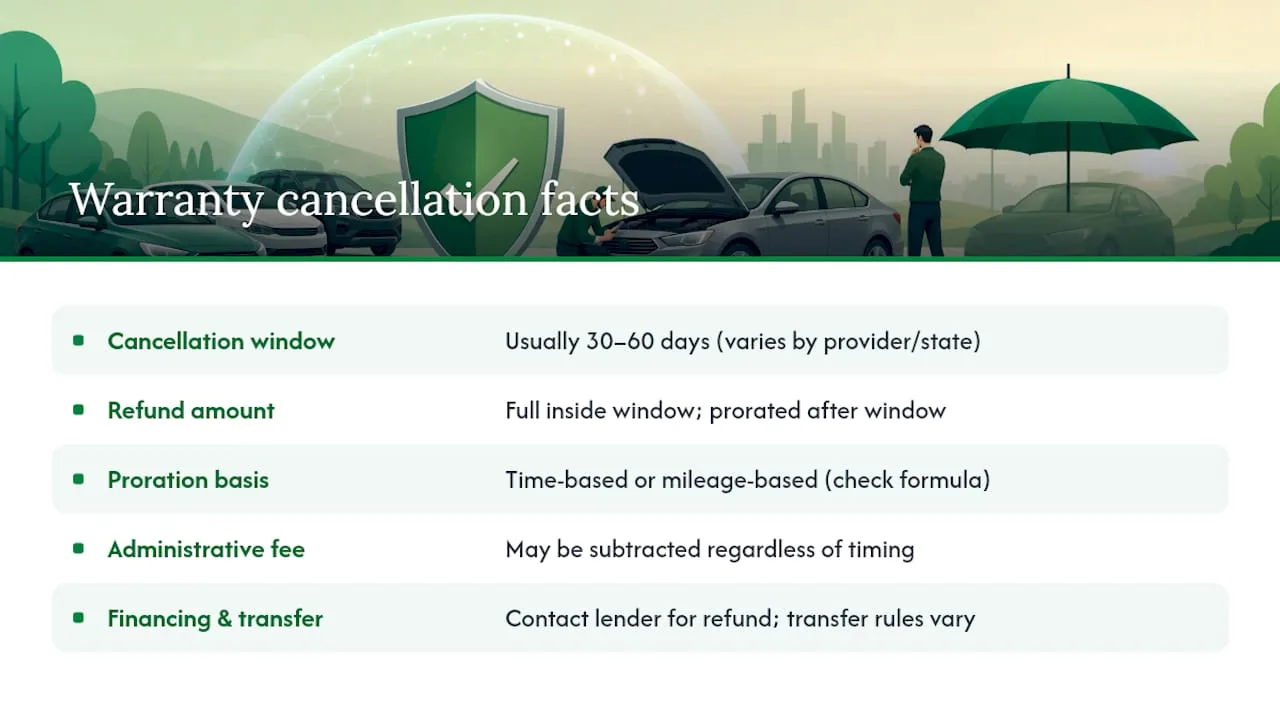
Most extended warranty contracts include a cancellation window, often 30 to 60 days from purchase, during which you can cancel for a full or prorated refund, though the exact terms vary by provider and state. Outside that window, you can typically still cancel, but you'll usually get a prorated refund based on time elapsed or miles driven, minus an administrative fee that some providers subtract regardless of when you cancel.
Read the refund formula before you sign, not after. Some contracts calculate your refund based on the number of months remaining; others use mileage. If you drive well above average, a mileage-based refund formula can shortchange you compared to a time-based one.
If you financed the warranty into your car loan, canceling doesn't automatically remove it from your loan balance. You'll need to contact your lender directly to apply the refund against your principal, and skipping that step means you keep paying interest on a warranty you no longer have.
Transferability matters here too. If you sell the car before the contract ends, some providers let the next owner take over remaining coverage, which can be a genuine selling point when you list the car. Others don't allow transfer at all, or charge a transfer fee that eats into whatever value the "transferable" label was supposed to add. Confirm this in writing at the time of purchase, since it's much harder to negotiate after the fact.
What Fine-Print Traps Void Coverage?
The gap between what a warranty promises in its marketing and what it actually pays out usually lives in a handful of recurring fine-print traps. Learn these before you sign, not after a denied claim.
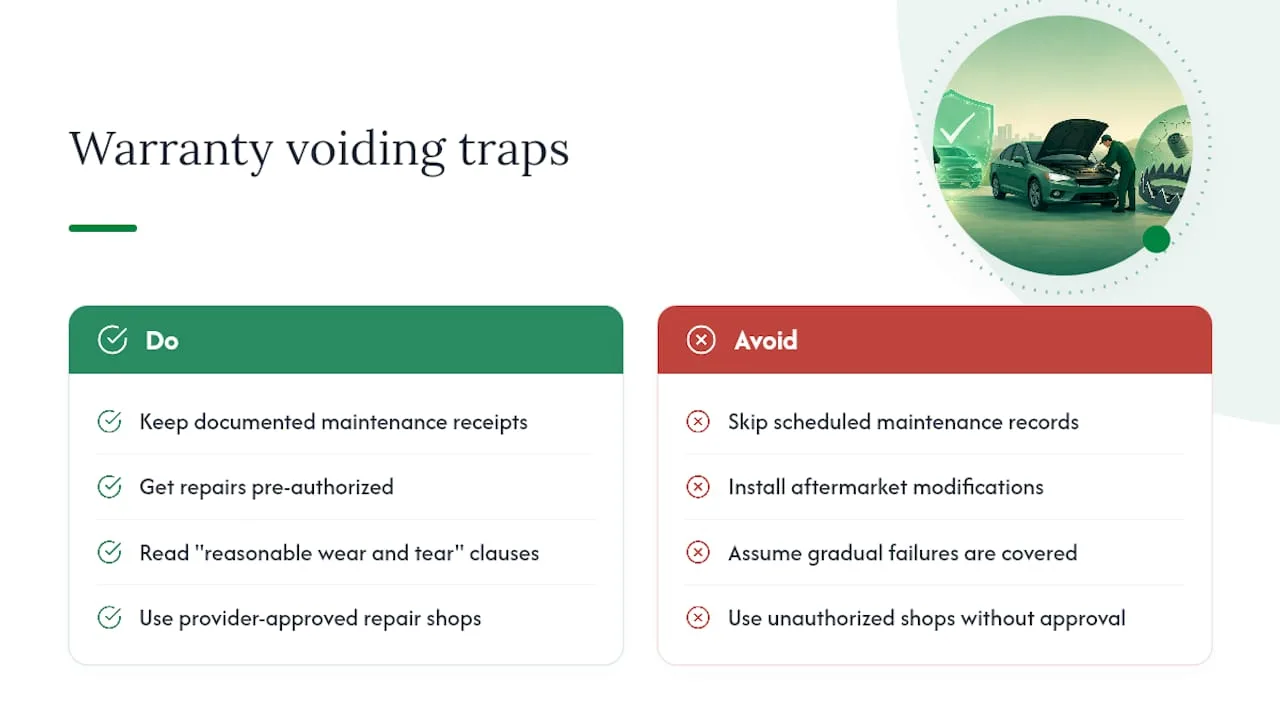
Maintenance records are the most common trigger for a denied claim. If your contract requires documented oil changes and other services on a specific schedule, and you can't produce receipts, the provider can deny a related claim entirely, even if the failure had nothing to do with the missed service.
Modifications void coverage fast. Aftermarket parts, performance tuning, or even certain suspension changes can void an entire contract, not just the affected component, depending on how the exclusion is written.
"Reasonable wear and tear" is a phrase worth reading twice. Providers use it to deny claims on parts that fail gradually, like seals or gaskets, by arguing the failure was gradual degradation rather than a sudden mechanical breakdown.
Unauthorized repair shops are another trap. Getting emergency repairs done at a shop outside the provider's network, even when it's the only shop open, can leave you paying the full bill yourself if you didn't get pre-authorization first.
Industry data on warranty loss ratios, the share of premiums that actually get paid back out in claims, commonly falls in a moderate range, meaning many contracts pay out less in claims than premiums collected. That gap is exactly why reading exclusions matters more than reading the coverage highlights.
Why We'd Rather Sell You a Car You Don't Need a Warranty For
We inspect every car before it's listed because we'd rather you never need to file a claim in the first place. Transparency isn't a slogan for us. It's why we show the price up front and hand you the inspection report without you having to ask twice. If you're deciding whether a warranty makes sense for a car you're considering, bring us the sample contract. We'll walk through it with you honestly, even if the answer is that you don't need it.
— CL Auto
Skip the Premium, Start with a Car That Earns Your Trust
There are real reasons to consider a plan from Endurance, Olive, Toco, Carchex, CarShield, Premier Auto Protect, or American Dream Auto Protect, especially on an older or high-mileage vehicle. But Clearwater Largo Automotive offers a different starting point: a car that's already been through a hand inspection and comes with its history report disclosed before you ever ask, so you're not betting on a contract's fine print to protect you.
Every listing on our lot shows its price, and every question you send is answered by a real person, not a script. If you're hunting for a specific make, model, or mileage range, our vehicle sourcing service finds it for you instead of making you sift through inventory that doesn't fit. And if you're already holding a warranty quote and want a second opinion before you sign, bring it to us. We'll help you read it honestly.
Ready to see what's actually on the lot right now? Browse our current inventory or reach out directly, and let's find the car that fits what you need.
Sources
For deeper reading on your rights and typical costs, the FTC's guidance on auto warranties and service contracts covers the legal basics, while Consumer Reports' analysis breaks down whether the math works in your favor. Cars.com's provider comparisons and NerdWallet's used-car warranty guide both list current provider eligibility rules. For general coverage context, Gently Used RVs' explainer on extended warranty coverage is a useful reference point. Your state's consumer protection office can confirm whether a specific provider has an open complaint history, and any legitimate provider should hand you a sample contract on request, before you pay anything.
- Auto warranties and auto service contracts | FTC
- Cars
- Best extended car warranty companies for used cars in 2026 | NerdWallet
FAQ
Is It a Good Idea to Buy an Extended Warranty on a Used Car?
It depends on the car and your finances: it tends to make sense for older, high-mileage vehicles or buyers without repair savings, and tends to make less sense for a well-maintained car you won't own long or if you already have a repair fund set aside.
What Is the Best Extended Warranty for a Used Car?
There isn't one universal best option. Endurance suits high-mileage cars with fewer eligibility restrictions, Olive fits buyers who want fast online activation, and Toco works for owners who want month-to-month flexibility instead of a long contract.
How Much Is a Typical Extended Warranty on a Used Car?
Extended car warranties typically cost between $900 and $2,000 per year, according to Cars.com, with the price varying based on your car's age, mileage, and coverage tier.
Is an Extended Warranty a Rip-Off?
Not automatically, but Consumer Reports found that many owners pay more in premiums than they ever recover in claims, which is why comparing the contract price against your car's likely repair costs matters more than the sales pitch.
Does a Used Car Actually Need an Extended Warranty?
Not always. A hand-inspected used car with a documented history report already carries lower repair risk than an unknown vehicle, which is one reason to weigh the purchase itself as carefully as any warranty you're considering.