
Pre-Approve First and Save: Credit Union vs Dealer Financing in Clearwater

For most buyers, a credit union pre-approved loan will cost less than dealer-arranged financing. Credit unions typically post lower APRs and cleaner terms across the board. Dealer financing only wins in narrow cases, like manufacturer 0% promos or when your credit is too thin for outside approval. Either way, get pre-approved before you walk into a dealership.
TL;DR:
- Dealer financing often includes a markup called dealer reserve, which can increase the total interest paid by thousands over the life of the loan.
- Pre-approval from a credit union provides a fixed rate and maximum loan amount before shopping, giving buyers leverage and transparency.
- Dealer 0% promotional rates are rare and usually require perfect credit and specific vehicle conditions, making outside financing often the better option.
- Comparing offers based solely on monthly payments can be misleading; buyers should focus on APR, total loan cost, and repayment terms.
Table of Contents
- Credit Union vs. Dealer Financing: Rates, Fees, and Timing
- How Dealership Financing Actually Works
- How Credit Union Financing Works and Where It Falls Short
- How to Compare Loan Offers the Right Way
- When Dealer Financing Can Actually Win
- Get Pre-Approved and Close Without Overpaying
- Our Take: What Buyers Get Wrong About Financing
- Compare Financing With a Real Person, Not a Script
- Sources
- FAQ
Credit Union vs. Dealer Financing: Rates, Fees, and Timing
The gap between these two paths usually comes down to who profits from the interest rate. A credit union lends its own members' money and has no incentive to mark up your rate. A dealer, on the other hand, often submits your application to several lenders and can add a "dealer reserve," a markup on top of the rate the lender approved, before quoting you a number.
Here's how the two typically stack up:
- Rates: Market summaries put average new car APRs around 5.2% at credit unions versus roughly 6.5% for dealer-arranged loans, for well-qualified buyers.
- Fees: Credit unions tend to disclose fees upfront; dealer contracts more often bury origination charges or add-on costs inside the payment.
- Timing: Credit union pre-approval usually takes minutes online, before you shop. Dealer financing gets arranged in the finance office, after you've already picked a car and lost some leverage.
- Convenience: Dealer financing wins on speed and one-stop shopping. Credit unions win on total cost for almost everyone with decent credit.
The savings are not theoretical. A 0.5 to 1.5 percentage point dealer markup can add hundreds, sometimes thousands, of dollars in interest over a five or six year loan.
How Dealership Financing Actually Works
Dealer financing is really a brokering arrangement. The finance manager takes your application and sends it out to a network of lenders, banks, credit unions, and captive finance arms tied to the manufacturer. Whichever lender approves you sets a base rate, and the dealer is often allowed to add a markup on top of it before presenting the number as "your rate." That markup, known as dealer reserve, becomes profit for the dealership, and it's legal as long as it's disclosed in your contract.
Manufacturer promotional rates, the 0% APR deals you see in commercials, run through this same channel but come from the captive lender directly. They're real, but they usually require excellent credit, specific trim levels, and shorter loan terms. Taking the 0% rate often means giving up a cash rebate that a credit union loan would have let you keep.
Watch for these common dealer practices:
- Rolling in extended warranties, GAP coverage, or paint protection as part of the loan instead of a separate purchase.
- Steering the conversation toward "your monthly payment" instead of the APR or total interest.
- Stretching the term to 72 or 84 months to shrink the payment while quietly growing the interest paid.
- Presenting only one financing option instead of multiple lender offers.
Pro Tip: Ask the finance manager for a printout showing every lender who approved you and at what rate. If they hesitate, that's usually a sign there's a markup on the table.
How Credit Union Financing Works and Where It Falls Short
Credit unions are nonprofit, member-owned institutions. Every dollar of interest that isn't needed to keep the institution running gets returned to members through lower rates, lower fees, or both. That structure is why credit union APRs consistently undercut dealer-arranged loans, and why the NCUA exists specifically to regulate and back these member-owned institutions.
The real advantage isn't just the rate. It's the order of operations. Apply for pre-approval before you shop, and you walk onto the lot with a locked-in rate and a maximum loan amount already in hand. That number becomes your leverage. Credit unions like Connexus even offer an auto express check you can hand directly to a dealer, turning your financing into cash-equivalent negotiating power. A prequalification like this separates the loan conversation entirely from the price-of-the-car conversation, which keeps the dealer from blending the two to your disadvantage.
Credit unions also tend to keep optional add-ons, like extended warranties, separate line items rather than baking them into the loan principal, where they'd quietly accrue interest for years.
Where they fall short: membership eligibility. Most require you to join, sometimes through an employer, location, or a small association fee, before you can borrow. That's a minor hurdle, but it does mean a few extra minutes of paperwork compared to walking straight into a dealership.
- Rates driven by member benefit, not profit margin.
- Pre-approval gives you a fixed number before you negotiate the car.
- Fees and add-ons are typically itemized, not bundled.
- Requires membership, which can take a day or two to set up if you are not already eligible.
How to Compare Loan Offers the Right Way
Comparing a dealer quote to a credit union quote by monthly payment alone is how buyers lose money without realizing it. The FTC recommends comparing APR, loan term, and total cost, not just what shows up on the sticker each month, because two loans with identical payments can carry wildly different total interest depending on the term length.
Run through these steps with every offer you receive:
- Match the term. Compare APRs only across identical loan lengths, since a 72 month dealer loan will always look cheaper monthly than a 60 month credit union loan even if it costs more overall.
- Ask for an itemized contract. Request a breakdown showing the amount financed, any add-ons, origination fees, and documentation fees separately from the vehicle price.
- Verify the four numbers in writing. Amount financed, finance charge, APR, and the payment schedule should all be spelled out before you sign anything.
- Use your pre-approval as the floor. If a dealer wants your business, they need to match or beat that number in writing, not just say they will.
Extending a loan term is the most common way payments get quietly inflated, since industry calculators show that a longer term lowers the monthly bill while raising the total interest paid, sometimes by thousands of dollars over the life of the loan. That's the number that matters, not the one printed in bold on the payment sticker.
When Dealer Financing Can Actually Win
Dealer financing isn't always the losing hand. Manufacturer 0% APR promotions are real savings for buyers with strong credit who don't need the accompanying cash rebate, since credit union guidance itself acknowledges these offers can beat outside financing, provided you check the eligibility fine print.
A dealer that matches your credit union pre-approval, in writing, is also a legitimate win, since you get dealership convenience without paying a markup premium.
- 0% or near 0% captive lender promos on specific trims and model years.
- A dealer willing to match your outside pre-approval rate exactly.
- Buyers with thin or damaged credit who may not clear a credit union's approval threshold and need a workable, if pricier, option.
Get Pre-Approved and Close Without Overpaying
- Gather your documents first. You'll need a photo ID, proof of income, proof of insurance, and basic vehicle details if you already know what you want. Our guide on proof of income for a car loan covers exactly what lenders accept.
- Apply to two or three lenders within a short window. Credit bureaus typically treat multiple auto loan inquiries made within about 14 days as a single soft inquiry, so shop your rate without tanking your score.
- Bring your best offer to the dealer and ask them to match it in writing. Say it plainly: "Here's my approved rate and term. Can you match or beat this in writing, with no add-ons rolled in?"
- Refuse bundled add-ons at signing. If the finance manager tries to fold a warranty or protection plan into the loan, ask for it priced and paid separately, or ask to skip it entirely.
- Check the contract line by line before signing. Confirm the APR, term, total finance charge, and that any optional products appear as their own line, not buried in the principal.
Pro Tip: Print your pre-approval letter and physically hand it to the finance manager. A number on paper is harder to talk around than one you mention verbally.
Our Take: What Buyers Get Wrong About Financing
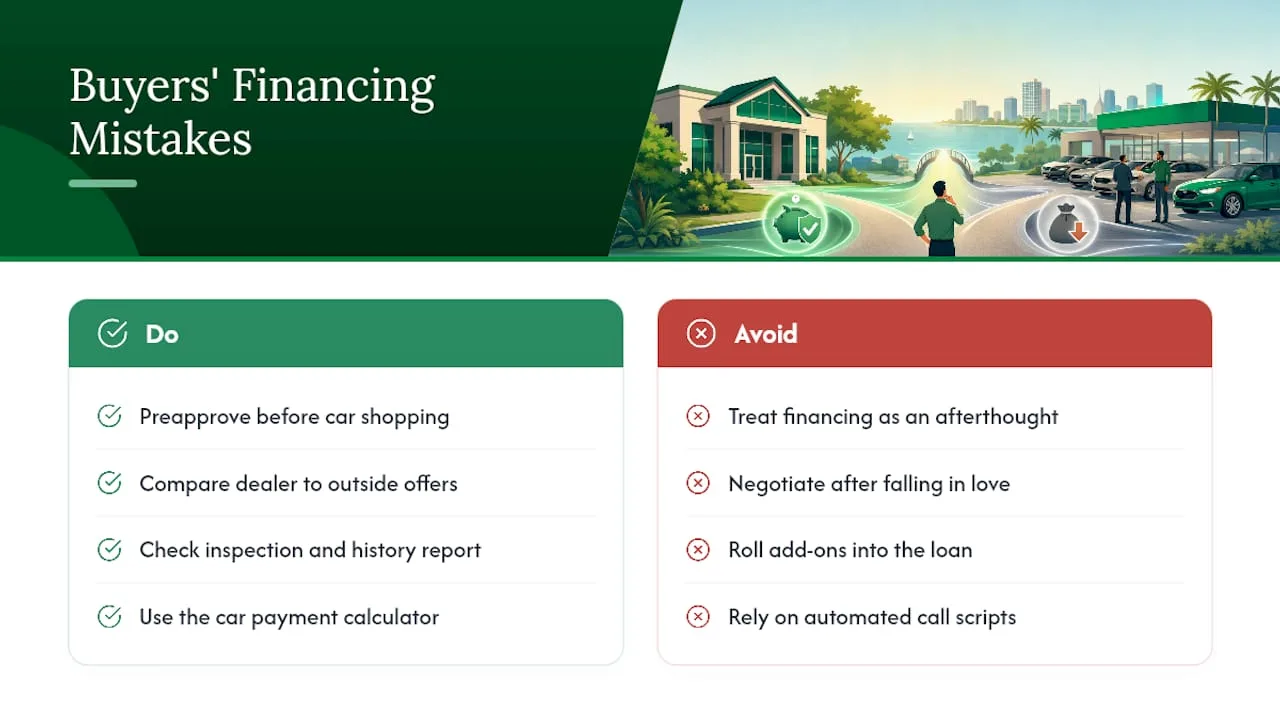
Most car buying advice treats financing as an afterthought, something to sort out after you've picked the car. That order is backwards, and it's exactly why so many buyers overpay. The moment you fall in love with a specific vehicle on a specific lot, your negotiating leverage on the loan collapses, because the dealer knows you're emotionally past the point of walking away.
Every vehicle is listed with a transparent price and thorough inspection and history report. A car payment calculator is available to help buyers compare a dealer quote against outside offers before committing to anything. Optional add-ons are kept priced separately from the loan amount. Inquiries are handled personally rather than by automated call center scripts.
— CL Auto
Compare Financing With a Real Person, Not a Script
This dealership provides a transparent price on every vehicle before financing discussions, keeping loan and car price conversations separate. Rather than focusing on monthly payments alone, they assist buyers in comparing pre-approval offers against lender options to show total cost differences clearly.
Use our car payment calculator to model your loan before you ever step onto the lot, then browse our current inventory to see transparent pricing with no hidden fees attached. If you're weighing a credit union pre-approval against what we can offer, or you need help sourcing a specific vehicle, visit Clearwater Largo Automotive or reach out to talk with a real person about your financing options today.
Sources
For firsthand guidance rather than secondhand summaries, start with the FTC's consumer advice on financing or leasing a car, which lays out your rights and what dealers must disclose. The NCUA explains how credit unions are structured and regulated. For rate benchmarking, Bankrate's comparison of bank versus dealer loans is a solid, regularly updated reference point.
- Financing or Leasing a Car | Consumer Advice (FTC)
- Best Ways to Finance a Car in 2026: Dealer vs Bank vs Credit Union (ApolloRadar)
- Dealer vs Credit Union Financing (FinCalcs)
- Credit Union vs. Dealership Car Loans: What You Need to Know Before You Buy (Chevron FCU)
FAQ
Is It Better to Use Dealer Financing or a Bank or Credit Union?
For most buyers, a bank or credit union offers a lower APR and clearer terms, since dealer financing often includes a rate markup called dealer reserve.
What Is the Downside of Using a Credit Union?
The main downside is membership eligibility. You may need to join through an employer, location, or association before you can apply, which adds a small step outside financing doesn't require.
Is It Smart to Finance a Car Through a Dealership?
It can be smart if you qualify for a manufacturer 0% promotion or if a dealer matches your outside pre-approval in writing. Outside of those cases, it usually costs more.
Do Dealers Make More Money if You Finance Through Them?
Yes, dealers can earn a dealer reserve, a markup added to the rate a lender approves, which becomes profit on top of the vehicle sale itself.
How Much Can Dealer Markups Actually Cost Me?
A markup of just 0.5 to 1.5 percentage points can add hundreds or thousands of dollars in interest over a typical loan term, depending on the amount financed and length of the loan.