Florida requires every registered car to carry at least $10,000 in Personal Injury Protection (PIP) and $10,000 in Property Damage Liability (PDL). That is the whole legal minimum for most drivers. It does not include bodily injury liability, which surprises a lot of people moving here or buying their first car. If you are about to buy a used car in the Clearwater and Largo area, line up your insurance before you pick up the keys, and read the rest of this page so you know what that minimum does and does not pay for.
We are an independent used car dealership in Clearwater, and insurance comes up in nearly every conversation about a first purchase. This guide gives you the rules, a worked example, and the order to do things in.
TL;DR
- Florida requires $10,000 PIP and $10,000 PDL on any registered vehicle with four or more wheels.
- PIP pays your own medical bills and lost income no matter who caused the crash. PDL pays for damage you cause to someone else's property.
- The minimum does not pay for injuries you cause to other people or for damage to your own car.
- Letting coverage lapse can cost you your license plate and registration, with reinstatement fees up to $500.
- If you finance, your lender may ask for more than the state minimum.
Table of Contents
- What Florida actually requires
- PIP: what it pays and the deadline you need to know
- PDL: what it pays
- What the minimum leaves out
- How much more than the minimum should you carry?
- What happens if you go without
- Buying a used car: the insurance order of operations
- Why we talk about insurance before the sale
- Find the car, then the coverage
- FAQ
- Sources
What Florida actually requires
The Florida Department of Highway Safety and Motor Vehicles (FLHSMV), the agency that handles registration and licenses, says owners of vehicles with at least four wheels that are registered in the state must maintain PIP and PDL, generally $10,000 each. Two details trip people up:
- The requirement follows the registration, not the driving. Coverage has to continue while your Florida registration is active, even if the car sits in the driveway. FLHSMV also says a registered vehicle must keep Florida insurance wherever it is located, with a possible exception for certain military members stationed out of state or country.
- Self-insurance exists but is not a shortcut. FLHSMV allows a qualifying self-insurance certificate. Florida Statutes section 324.022 lists self-insurance and other qualifying security as alternatives for the property damage requirement. For nearly every buyer we meet, a standard policy is the practical route.
If you are new to the state, the plain version is this: you need a policy from an insurer, in your name, active on the day you register the car.
PIP: what it pays and the deadline you need to know
Florida is a no-fault state. That means your own policy pays your injuries after a crash, whoever was at fault. FLHSMV says PIP pays 80% of necessary and reasonable medical expenses for covered injuries regardless of fault.
The Florida Department of Financial Services (DFS), the state's consumer insurance office, adds more detail in its personal auto overview:
- PIP also pays 60% of lost work income.
- It includes a separate $5,000 death benefit.
- Covered expenses include medical, surgical, X-ray, dental, rehabilitation, ambulance, hospital and nursing services.
Then come the two rules that matter most if you are ever hurt. The DFS Automobile Insurance Toolkit says:
- You must get initial medical care within 14 days of the crash for PIP medical benefits to apply.
- Benefits depend on the type of condition. PIP medical benefits are limited to $2,500 for non-emergency treatment. If a provider determines you had an emergency medical condition, reimbursement can go up to $10,000.
In practice: if you are in a crash, even a minor one, see a doctor or urgent care within two weeks. Waiting because you feel fine on day one is the most common way people lose PIP benefits they paid for.
A quick example
Say you are rear-ended on US-19 and your medical bills come to $6,000 after an emergency medical condition is confirmed. PIP pays 80% of necessary and reasonable expenses, so $4,800 of that is covered, and you owe the rest or your health plan picks it up. If you missed the 14-day window, PIP medical benefits would not apply at all. That is why the deadline matters as much as the dollar amount.
PDL: what it pays
Property Damage Liability covers damage you cause to other people's property. FLHSMV says it pays for damage to another person's property caused by you or someone else driving your insured vehicle. DFS describes it as paying for damage to or destruction of another person's tangible property, including loss of use, for which you are legally liable.
Think of the other driver's bumper, a mailbox, a fence, a storefront. Now think about what a newer SUV costs to repair. A $10,000 limit gets used up quickly in a crash with a late-model vehicle. The limit is the legal floor, not a prediction of what a crash will cost.
What the minimum leaves out
The Florida minimum is built around your own injuries and other people's property. Several things are not part of it. DFS lists these as optional coverages:
- Bodily injury liability: pays for injuries you cause to other people.
- Uninsured/underinsured motorist: helps when the other driver has little or no coverage.
- Medical payments: extra medical coverage on top of PIP.
- Collision: repairs your own car after a crash.
- Comprehensive: covers theft, flood, hail and other non-crash damage to your car.
On the Gulf Coast, comprehensive is worth a hard look. Flood and storm damage are part of life here, and the legal minimum pays nothing toward your own vehicle.
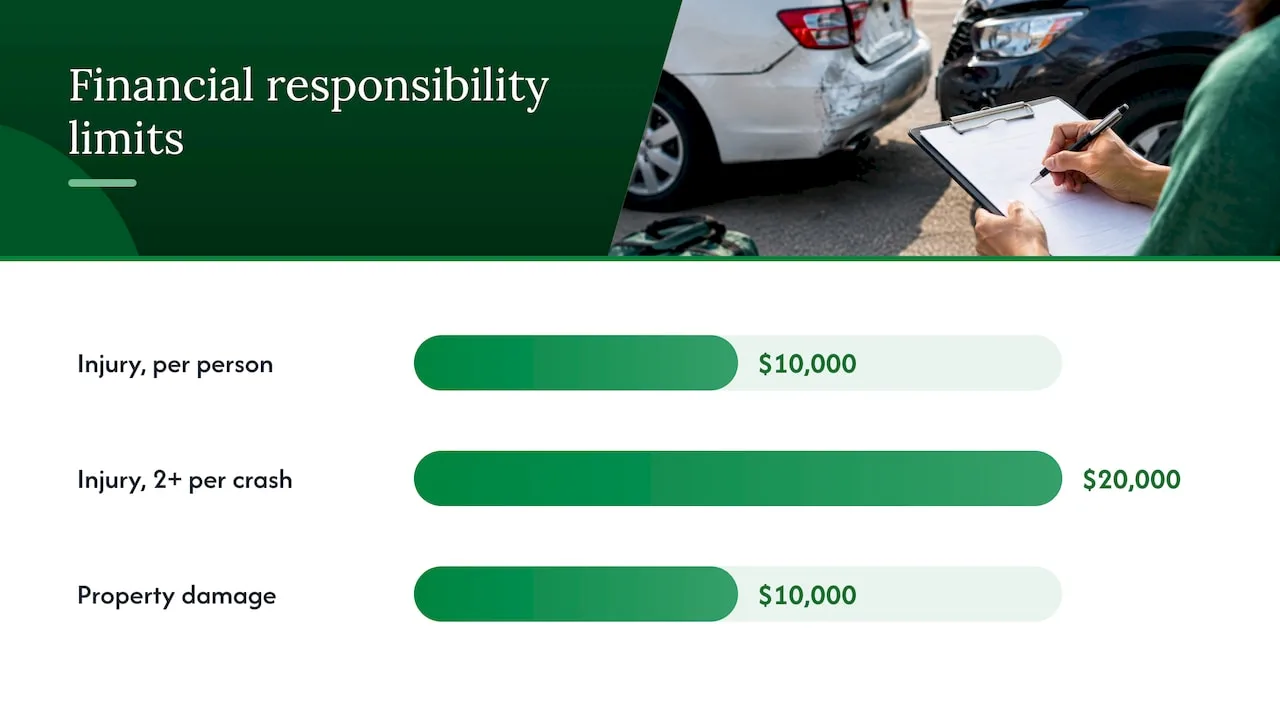
There is also a related set of numbers you may see. Under Florida's financial responsibility law, section 324.021 sets proof limits of $10,000 bodily injury per person, $20,000 for two or more people in one crash, and $10,000 property damage, for the cases that statute governs. In plain terms, after certain crashes or violations the state can require proof of those higher limits. It is one more reason many drivers choose bodily injury coverage from the start.
Certain vehicles have their own rules. FLHSMV says taxis registered in Florida must carry bodily injury liability of $125,000 per person, $250,000 per occurrence, and $50,000 in PDL. If you plan to drive for hire, check the requirements for that use before you buy.
How much more than the minimum should you carry?
The law sets a floor. How far above it you go depends on what you could lose. A law firm's buying guide recommends at least 100/300 bodily injury limits, which means $100,000 per person and $300,000 per crash, and suggests considering umbrella coverage if you own a home or have savings. That is advice, not a legal requirement.
The University of Florida's extension service makes the same point for newer drivers: consumers may choose coverage above the state minimum to protect assets and reduce the risk of being sued, and lenders may require broader coverage on a financed vehicle.
Here is how we suggest you think about it:
- Add up what you own. Savings, a home, a steady paycheck that could be garnished. The more there is, the more a higher bodily injury limit protects.
- Check your loan terms. If you finance, expect to carry collision and comprehensive. Ask your lender for its exact requirements in writing.
- Think about your drive. Daily I-275 or Gulf to Bay traffic is a different risk than a short run to the grocery store.
- Price the steps up. Get quotes at the minimum and at a higher level, and compare the gap.
The Florida Office of Insurance Regulation runs a free CHOICES rate comparison tool that shows example premiums for minimum PIP-plus-property-damage coverage next to broader selections, which is a good way to see the cost of moving up. We also wrote a walkthrough on how to estimate car insurance cost before you buy, so the number does not surprise you after you pick a car.
What happens if you go without
This is the part to take seriously. FLHSMV says failing to maintain the required insurance may lead to suspension of your driving privileges and your license plate or registration for up to three years, with reinstatement fees up to $500. It also says there is no temporary or hardship driver license for an insurance-related suspension.
Two practical lessons follow:
- Do not cancel insurance first. FLHSMV advises turning in the plate before you cancel coverage on a car you are no longer using. Selling or scrapping a car? Handle the plate, then the policy.
- Do not let a policy lapse between cars. A gap of even a few days on a registered vehicle can trigger the problem.
If you are selling, our sell car paperwork guide covers the forms to file so the car stops being your responsibility.
Buying a used car: the insurance order of operations
Most first-time buyers ask when to call the insurance company. Before you drive off. Here is the sequence we walk people through:
- Pick the car and get the VIN. The vehicle identification number is the 17-character code on the dashboard and door jamb. Insurers quote against it.
- Get quotes. Compare at least the minimum and one higher level of coverage. Some insurers also look at the vehicle's condition, and a car insurance inspection matters for your coverage in ways worth knowing before you commit.
- Ask your lender what it requires if you are financing.
- Start the policy for the day you take the car. Have proof of insurance ready for registration.
- Handle tag and title on time. Our guides on the Florida temporary tag, plate transfers and the 30 day title transfer show the steps and fees.
Two more situations come up often. If you are test driving, find out who covers you and when. If you are bringing a car from another state, our out-of-state buying checklist covers what changes once the car is registered in Florida.
If you finance, also look at gap insurance and run your loan numbers before you sit down at the finance desk. Gap coverage is separate from the state minimum and matters when you owe more than the car is worth.
Why we talk about insurance before the sale
Our view from the dealership
A first-time buyer usually budgets for the car payment and forgets that the insurance bill arrives the same week. We would rather you hear about it from us before you fall for a car than discover it at the counter.
Our approach is built on showing the price on every listing, with no hidden fees, and on inspecting each vehicle and pulling a history report before we list it. We think insurance deserves the same openness. Know the legal minimum, know what it leaves uncovered, and decide with real numbers.
Every inquiry we get is answered by a real person, not a call center. If you tell us your budget and what you can afford each month, we will help you think through the whole cost of owning the car, not only the sticker. And if the car you want is not on the lot, we will find it for you, so you only see vehicles that match what you asked for.
CL Auto
Find the car, then the coverage
When you shop with us, you see the price on every listing, and every car is hand-inspected with its history report in hand before it is listed. That gives you the facts an insurer will ask about, the VIN, the mileage and the history, before you request quotes. Browse our used cars in Clearwater, FL to start, or tell us what you need through vehicle sourcing and we will look for it.
If you plan to finance, we work with multiple lenders through our financing page, so you can learn what coverage a loan will require while you are still choosing the car. Selling your current vehicle first? See we buy cars.
FAQ
Is car insurance required in Florida?
Yes, for any registered vehicle with four or more wheels. You must carry at least $10,000 in PIP and $10,000 in PDL. The requirement lasts as long as the registration is active, even if the car is parked.
Does Florida require bodily injury liability?
Not for most drivers. The standard minimum covers PIP and property damage only. Bodily injury liability is optional coverage that pays for injuries you cause to others, and some situations, such as certain financial responsibility cases or a lender's requirements, can call for more.
How long do I have to see a doctor after a crash to use PIP?
The DFS says initial medical care must happen within 14 days of the crash for PIP medical benefits to apply. Non-emergency care is limited to $2,500 in PIP medical benefits, while a confirmed emergency medical condition allows up to $10,000.
What is the penalty for driving without insurance in Florida?
FLHSMV says you can lose your driving privileges and your plate or registration for up to three years, with reinstatement fees up to $500. There is no temporary or hardship license for an insurance-related suspension.
Do I need insurance before I buy a car?
Yes, in practice. Set up the policy to start the day you take the car, and keep proof of insurance for registration. If you are financing, ask the lender what coverage it requires too.
Sources
- Florida Insurance Requirements, FLHSMV
- Chapter 324, Section 022, 2026 Florida Statutes
- Chapter 324, Section 021, 2026 Florida Statutes
- Personal Automobile Insurance Overview, Florida DFS
- Automobile Insurance Toolkit, Florida DFS
- Purchasing Car Insurance: What College Students Should Know, UF/IFAS
- CHOICES: Auto Rate Comparison Tool, Florida OIR
- How to Buy Auto Insurance in Florida (2026), SOUD Law Firm