How to Negotiate a Used Car Price in Florida
You can negotiate a used car, and most buyers should. The way to do it is to research what similar cars sell for, make a realistic first offer, settle the out-the-door price before you talk about payments or trade-ins, and be ready to walk away. This guide walks through each step in order, with Florida-specific details on fees and taxes that change what you actually pay.
TL;DR
- Research the market value first, then open with an offer that is believable, not a lowball.
- Negotiate the out-the-door price (car, tax, title, registration, dealer fees), never the monthly payment.
- Handle price, trade-in and financing as three separate conversations.
- Get an independent inspection and a vehicle history report, and put every promise in writing.
- Florida dealer fees are high, so review each line of the itemized quote. Your willingness to walk away is your best leverage.
Table of Contents
- Is there room to negotiate on a used car?
- Step 1: Do your homework before you talk price
- Step 2: Check the car before you check the price
- Step 3: Ask for the out-the-door price
- Step 4: Keep price, trade-in and financing separate
- Step 5: Make your first offer
- Step 6: Know what to say, and what to skip
- Step 7: Questions to ask any used car dealer
- Step 8: Get every promise in writing
- Step 9: Be ready to walk away
- Our perspective: why we put the price on the listing
- When we can help
- FAQ
- Sources
Is there room to negotiate on a used car?
Usually, yes. Used car prices are not fixed the way a grocery price is. A dealer sets an asking price based on what the car cost, what it needed to get it sale-ready, and what similar cars are listed for nearby. Some of that price has give in it, and some does not.
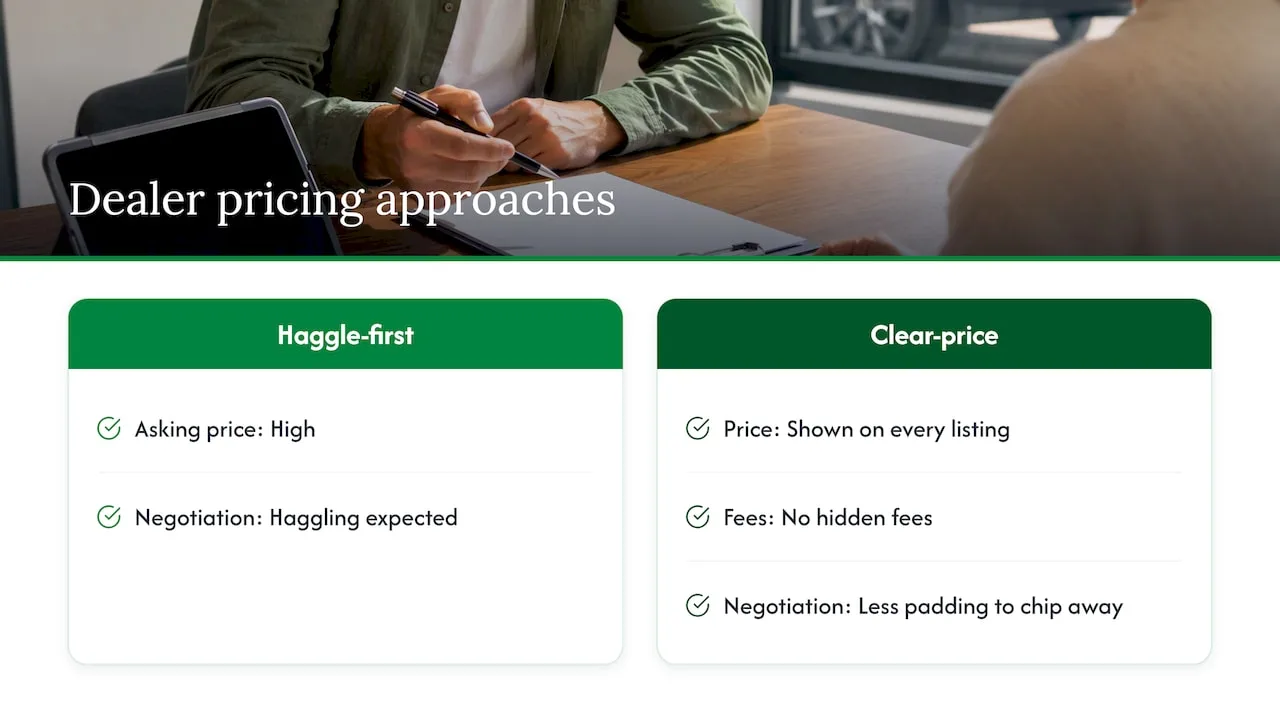
How much give depends on the seller. Some dealers list high and expect to haggle. Others, like us, put one clear price on the listing from the start. At Clearwater Largo Automotive we show the price on every car and don't add hidden fees, so there is less padding to chip away. If you want to know where a number can move, ask us directly. A real person answers, not a call center.
Either way, the steps below keep you in control. They work at a traditional lot, a small independent dealer or an online seller.
Step 1: Do your homework before you talk price
The biggest mistake we see is walking in with a feeling instead of numbers. A feeling that a car is "a bit pricey" gives you nothing to say. A comparison does.
- Pick two or three specific cars. Same year range, same trim, similar mileage. Check how many are listed within 50 miles of Clearwater. Tampa Bay has a big used market, so you have real comparisons.
- Look up market value. Edmunds advises researching values before you visit so you know whether a price is fair or a great deal, and so your first offer rests on evidence. Kelley Blue Book and similar tools do the same job.
- Note what is different. A car with 20,000 fewer miles, one fewer owner or newer tires is worth more than the one next to it. A car that needs brakes or has a cosmetic flaw is worth less. Write these down.
- Decide your ceiling. Choose the highest out-the-door number you will pay, before you step on the lot. Do not share it.
The goal is credibility. Edmunds' guidance is to stay in the ballpark of market value. An offer far below it tends to end the conversation instead of starting one.
Step 2: Check the car before you check the price
Condition is your strongest negotiating point, because it is factual and hard to argue with. But you only get to use it if you know the condition.
- Read the Buyers Guide. The FTC's Used Car Rule requires dealers to display a Buyers Guide in each used car. Florida's highway safety agency explains that it tells you whether the car is sold with a warranty or as-is, and that an as-is car means repairs are on you. The same page notes that Florida's Lemon Law covers only new or demonstrator vehicles, so there is no lemon law for a used car.
- Get a vehicle history report. Use the VIN. Look for accidents, flood or salvage branding, title problems and mileage records. We run history reports and inspect every car before we list it, so you can see them up front. At any dealer, ask.
- Get an independent inspection. The FTC says a vehicle history report is not a substitute for an independent inspection. A dealer's own inspection focuses on safety and saleability. A mechanic you choose works for you. If a dealer won't let the car leave the lot, ask about a mobile inspector who comes to the dealership. If they refuse that too, the FTC's guidance points toward walking away.
- Test drive on varied roads. The FTC suggests hills, highways and stop-and-go traffic. In Pinellas County that means a stretch of US-19 and a bridge or two, plus a cold start.
- Check the odometer. NHTSA estimates that odometer fraud affects hundreds of thousands of vehicles each year. Compare the title mileage with the dashboard, look at service records and oil change stickers, and check pedal wear. Worn pedals on a car showing very low miles are a red flag.
Every problem you find becomes a specific, polite request: "The inspection shows the rear brakes are at the minimum. Can we adjust the price or have them replaced before I buy?" That is a stronger position than "can you do better?"
Step 3: Ask for the out-the-door price
The sticker price is not what you pay. The out-the-door price is: the car, sales tax, title and registration fees, and any dealer fees. This is the only number worth negotiating.
Ask for it in writing, itemized, early. Florida Department of Revenue guidance says sales tax, plus any discretionary sales surtax, is due on motor vehicles sold in Florida. The surtax applies to the first $5,000 of the price. Dealer-charged fees such as preparation or closing fees are generally taxable, while state-mandated titling and registration charges are not.
Here is what a clean quote should look like, with a placeholder example so you can see the structure:
| Line item | What to check |
|---|---|
| Vehicle price | Matches the listing and your agreed number |
| Sales tax and surtax | Calculated on the right county rate |
| Title and registration | State-set charges, not marked up |
| Dealer or doc fee | Is it listed on the ad? Can it come down? |
| Add-ons (coatings, etch, warranties) | Optional. Ask to remove anything you didn't request |
| Out-the-door total | The number you compare across dealers |
For a deeper walk-through of building this number yourself, see our guide to calculating and negotiating your out-the-door total.
Florida doc fees deserve a second look
Florida is unusual here. CarEdge reports that as of October 2026 the average dealer doc fee in the state is $970, the highest of any state it tracks and well above its national average of $404. Those figures come from the company's own collected quotes, so treat them as a guide, not a rule.
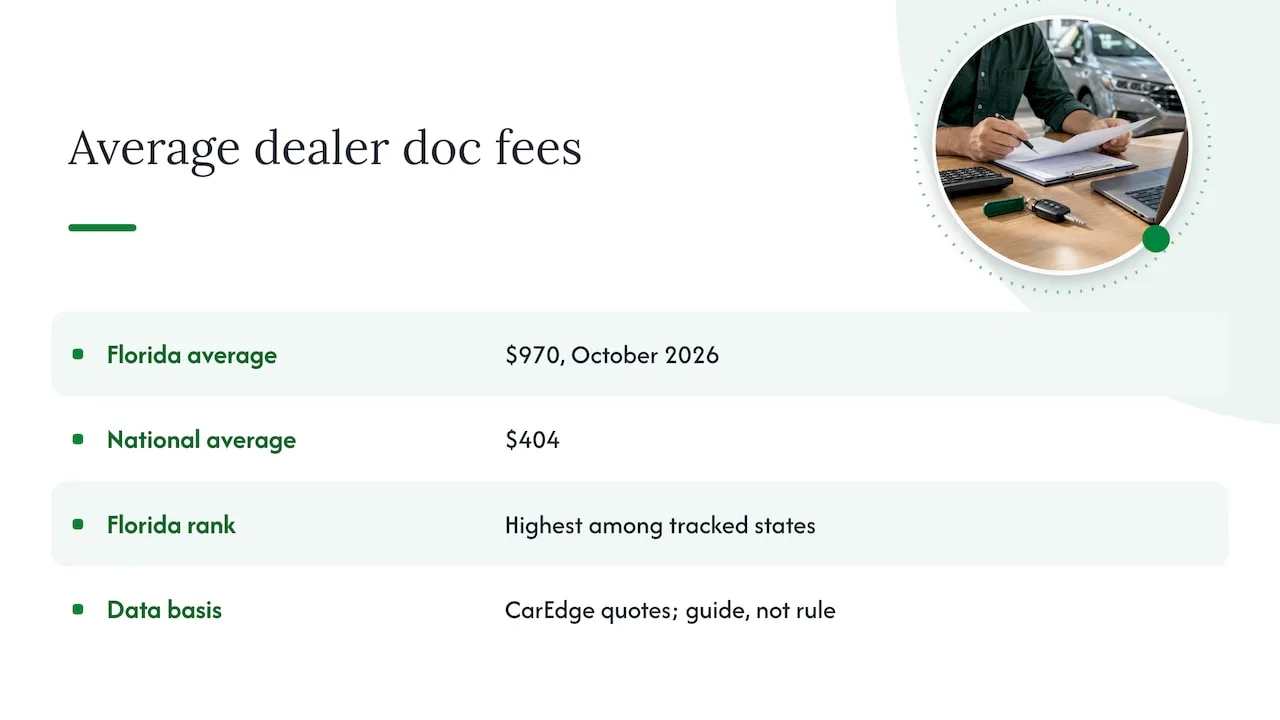
What that means for you: a doc fee is often where the price quietly grows. Compare the fee across the dealers you are considering, and count it as part of the price. A $500 discount on the car means little if the doc fee is $500 higher than the next lot's. We explain how these fees work and what you can push on in our doc fee guide, and in this piece on beating hidden fees.
Step 4: Keep price, trade-in and financing separate
This is the part dealers hope you skip. The FTC-based guidance is to treat the purchase price, your trade-in and your financing as separate negotiations. Mix them and it gets easy to move money from one place to another so that one number looks good while another gets worse.
- Price first. Agree on the car's price and the out-the-door total before anything else.
- Trade-in second. Know what your car is worth before you walk in. You can get offers from other buyers, including us. We buy cars directly from individuals, and our page on selling your car explains how. If you are weighing the options, read when to trade in and when to sell.
- Financing last. Shop for a loan before you visit. The FTC notes that financing adds interest to the total cost and that comparing loan offers can get you a better APR.
If you have a loan on your current car, that adds a step. Our seller's guide to selling a car with a loan covers the payoff process.
Never answer "what monthly payment do you want?"
It sounds friendly. It is not. A payment can be made to look low by stretching the loan term or raising the interest rate, which raises what you pay in total. The FTC advises you keep the conversation on the full price. If you are asked about payment, say: "I'm focused on the out-the-door price right now." Repeat it as often as needed.
Once you have the price, you can test different loan lengths on our car payment calculator and see how much interest each one adds.
Step 5: Make your first offer
Now you have data, condition findings and a ceiling. Here is how to open.
- Open with a reason. "Similar cars within 30 miles are listed from X to Y. This one has more miles than the cheapest and needs tires. I can do Z out the door." Reasons make an offer feel fair instead of aggressive.
- Be realistic. On a fairly priced used car, expect to move by a few hundred dollars to a few percent, not thousands. On a car priced well above market, there is more room. Your comparison data tells you which case you are in.
- Make the offer once, then stop talking. Silence is uncomfortable. Let the other person fill it.
- Concede in small steps. If you move, move less each time. It signals you are near your limit.
- Ask for non-price value. If the price won't move, ask for new tires, an oil change, a second key, a repair completed, or a fee reduction. These count too.
Be polite throughout. You are not fighting the salesperson. You are trying to reach a number you both can accept. People give better deals to buyers they like.
Step 6: Know what to say, and what to skip
A few phrases help. A few hurt.
Useful:
- "What is the out-the-door price, itemized?"
- "Which of these fees are optional?"
- "Can I take the car to my mechanic, or have one come here?"
- "Can you put that in writing?"
- "I'm comparing a couple of cars. I'll decide by Friday."
Avoid:
- Your maximum budget or monthly payment.
- "I love this car." Enthusiasm is information you just gave away.
- That you need a car this week.
- That you plan to finance through them before you have the price.
Step 7: Questions to ask any used car dealer
These are the questions that surface problems and sometimes reduce the price. Ask them at any lot, ours included.
- Is the car sold as-is or with a warranty? Check the Buyers Guide on the window.
- Can I see the vehicle history report and service records?
- Has it had any accident or paint work?
- How many owners, and where was it from? A car from a flood-prone area or another state deserves extra checking. Our out-of-state buying checklist explains what to verify.
- What reconditioning was done, and what is still needed?
- Can I get an independent inspection?
- What fees are in the price, and which are added later?
- What happens with title and registration, and how long does it take? Our guide to the 30-day Florida title transfer shows the timing to watch.
Step 8: Get every promise in writing
A verbal promise on the lot is hard to enforce afterward. The FTC says that promises such as a future repair or a condition guarantee should be documented in writing. If a seller won't write it into the contract, treat it as if it was never said.
Before you sign:
- Read every line of the contract and compare it to the itemized quote.
- Confirm the total matches what you agreed.
- Check the VIN on the paperwork against the car.
- Check the odometer statement. For model year 2011 and newer vehicles, federal rules require an odometer disclosure at every transfer of ownership for 20 years.
- Make sure nothing optional was added, like a service contract or protection package. Florida treats vehicle protection agreements as service warranties, not part of the vehicle's sale price, so they are a separate purchase you can decline.
Bringing the right paperwork also makes the day smoother. Here are six documents to bring to a dealership if you want to drive home the same day.
Step 9: Be ready to walk away
This is your strongest move. The Harvard Program on Negotiation stresses that willingness to walk away is a buyer's biggest asset. Signs it is time:
- The dealer won't give an itemized out-the-door price.
- Fees appear that were not in the ad.
- You are told the price is only good today.
- They won't allow an independent inspection.
- A promise won't go into the contract.
- You feel rushed or worn down.
Walking away does not have to be dramatic. Say thanks, leave your number and go. Sometimes you get a call with a better offer. Sometimes you find a better car elsewhere. Both are fine outcomes.
Our perspective: why we put the price on the listing
We started Clearwater Largo Automotive because the usual process wears people down. Buyers come in tired of surprise fees, vague answers and pressure. So we do the opposite where we can. Every listing shows its price. We inspect each car and pull a history report before we list it, so you are not the first person to find out what's wrong with it. And when you call or message, a real person answers.
That changes how negotiation works. When the price is clear and the fees are disclosed, you spend less time defending yourself and more time deciding whether the car is right. We would still tell you to compare, to get your own inspection and to read the contract. A dealer worth buying from will not mind.
If you are a first-time buyer, the process can feel like a test you didn't study for. It isn't. Ask plainly, expect plain answers, and leave if you don't get them.
— CL Auto
When we can help
If you would rather skip the haggling hunt, we can do the searching for you. Browse our hand-picked used cars, or tell us what you want through vehicle sourcing and we will look for cars that match your specifications. If you need a loan, our financing page explains how we work with multiple lenders. Buying for a teenager? See our page on a first car in Clearwater and Largo.
FAQ
Is there negotiation on used cars?
Usually, yes, though how much depends on the dealer and on how the car is priced against the market. Check comparable listings first. If the car is priced at or below market, expect a small move. If it is above, you have more room.
What should I not say to a car dealer?
Don't share your budget ceiling, your monthly payment target or how much you love the car. Don't say you need it right away. Keep the conversation on the out-the-door price and the facts about the car.
How do I politely ask for a lower price?
Give a reason and a number: "Comparable cars nearby are listed lower, and this one needs tires. Could you do X out the door?" Stay friendly, make the offer once, then let them respond.
Should I negotiate the price or the monthly payment?
The price, specifically the out-the-door total. Negotiating a payment lets the loan term and rate hide the real cost. Settle the price first, then compare financing offers separately.
Do Florida dealers have to give a warranty on a used car?
No. Florida's highway safety agency states that used vehicles are not required to have a warranty, and the Buyers Guide on the window shows whether the car is sold as-is. That is why an independent inspection matters before you sign.
Sources
- FTC: Buying a Used Car From a Dealer
- FTC: Buying a Used Car (PDF)
- FTC: Buying a Used Car From a Dealer (PDF, 2023)
- NHTSA: Odometer Fraud
- NHTSA: Changes to Odometer Disclosure Requirements
- Florida Department of Revenue: Sales and Use Tax on Motor Vehicles
- Florida Department of Revenue: Vehicle protection agreements
- Florida HSMV: Buying from a Licensed Dealer
- Edmunds: How to Negotiate Car Prices
- Harvard Program on Negotiation: So You Want to Buy a Car
- CarEdge: Florida Dealer Fee Report