Cash vs. Financing a Car: How to Decide in 2026
Paying cash is cheaper than financing, as long as it doesn't drain the savings you need for emergencies. If paying cash would leave you thin, financing a smaller, reliable car at a fair rate is usually the safer move. The right answer depends on three things: the interest rate you'd pay, what your cash could do otherwise, and how much cushion you'd have left.
We sell used cars in Clearwater, so we see both kinds of buyers every week. Here is how we'd think it through if you were standing in our office.
TL;DR
- Cash means no interest, no monthly payment and no lender. Financing means you pay extra for the loan, but you keep your savings.
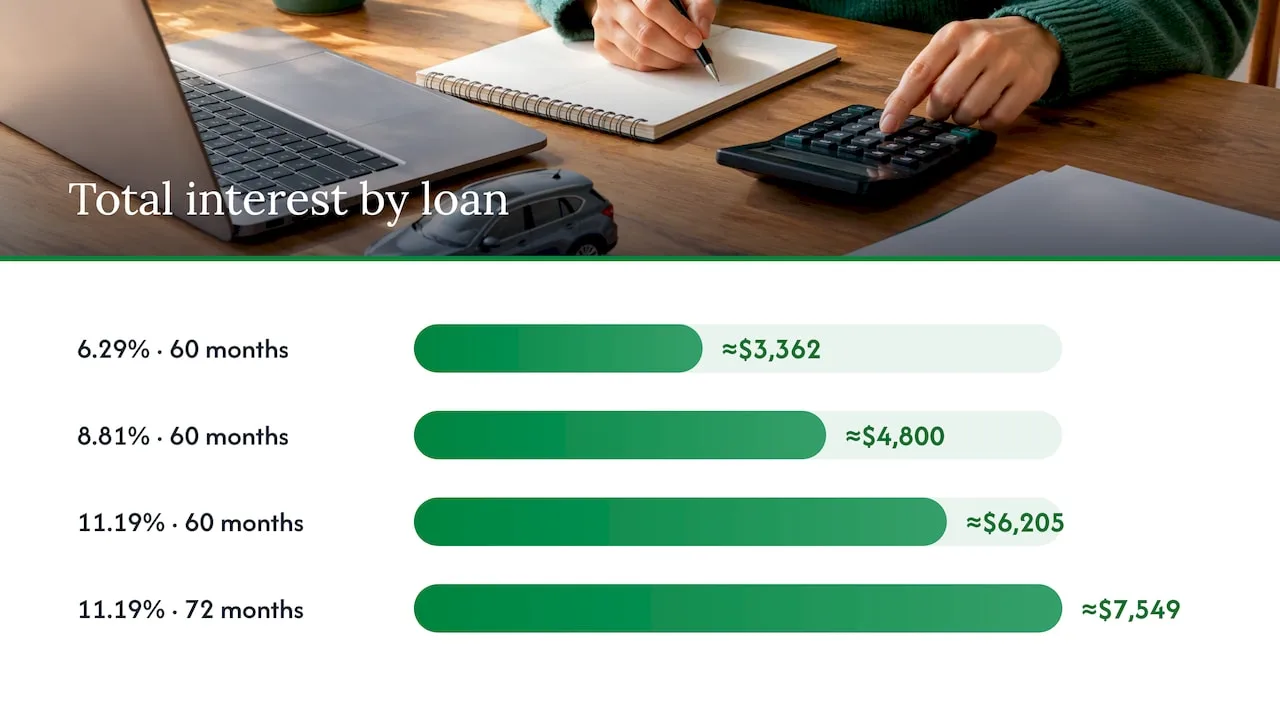
- On a $20,000 used car, a 60-month loan at the current average used-car rate costs about $6,205 in interest. Your rate decides everything.
- Don't drain your emergency fund. A common guideline is to keep 3 to 6 months of basic living expenses in reserve.
- Get a loan quote from a bank or credit union before you shop, then compare it to any dealer offer.
- Compare the total cost of the loan, not just the monthly payment.
Table of Contents
- What paying cash really means
- What financing costs on a used car
- When paying cash is the smarter move
- When financing makes more sense
- The middle path: finance, then pay it off early
- Do dealers prefer cash or financing?
- Costs that apply either way
- How to pay cash safely
- Protect yourself before you pay anything
- Our perspective: what we tell buyers at the lot
- A simple way to decide
- If you're trading in a car with a loan
- Shopping with us in Clearwater
- FAQ
- Sources
What paying cash really means
Paying cash means you pay the full price up front, usually by cashier's check, wire or debit transfer from your own money. You don't need a loan, so there's no interest, no monthly payment and no risk of repossession. You own the car outright on day one.
The cost is the money itself. A large cash outlay is money that can't cover a surprise medical bill, a job gap or a home repair. That is the real trade you're making.
The FTC's used-car guide frames it the same way: you have two choices, pay in full or finance over time, and financing raises the total cost because you're also paying for credit.
What financing costs on a used car
Financing lets you spread the cost out, but you pay for that. The question is how much. According to Experian's Q2 2026 report, the average used car loan rate is 11.19%. That average hides a wide range by credit score:
| Credit tier | Average used-car APR |
|---|---|
| Super prime (781-850) | 6.29% |
| Prime (661-780) | 8.81% |
| Near prime (601-660) | 13.93% |
| Subprime (501-600) | 19.10% |
| Deep subprime (300-500) | 21.62% |
Those are Experian's averages, not a quote. Your rate depends on your credit, your down payment, the car and the lender. If you want to see where yours might land, our post on what counts as a good car loan rate walks through it.
A worked example: a $20,000 used car
We ran the standard loan math on a $20,000 balance with no down payment, to show how much the rate and term matter. These figures are our own calculation using the Experian rates above.
| Rate | Term | Monthly payment | Total interest |
|---|---|---|---|
| 6.29% | 60 months | $389.36 | about $3,362 |
| 8.81% | 60 months | $413.33 | about $4,800 |
| 11.19% | 60 months | $436.75 | about $6,205 |
| 11.19% | 72 months | $382.63 | about $7,549 |
Look at the last two rows. Stretching the loan to 72 months drops the payment by about $54 a month, but adds roughly $1,300 in interest. That is how a low payment can hide a high cost. The CFPB's advice is to compare the total cost of the loan, not just the monthly payment.
Want to test your own numbers? Our car payment calculator lets you change the price, down payment, rate and term.
When paying cash is the smarter move
Cash tends to win in these situations:
- Your savings earn less than the loan costs. Financial education sources say it's cheaper to pay cash when the interest you earn on savings is lower than the after-tax cost of borrowing. A savings account paying a few percent can't beat a loan at 11%.
- Your credit would land you a high rate. If you'd be offered 14% or more, every month of that loan is expensive. Paying cash, or putting down a much larger amount, saves real money.
- You'd still have a full emergency fund afterward. Cash only makes sense if the purchase leaves your reserve intact.
- You want a simpler budget. No payment means more room for insurance, fuel and repairs, which every used car eventually needs.
- The car is modest. A $9,000 car paid in cash is a very different decision from a $35,000 one.
When financing makes more sense
Financing is not a failure. It's a reasonable choice in these cases:
- Cash would wipe out your safety net. The same source that says cash is cheaper also stresses that you should avoid draining your emergency fund and keep 3 to 6 months of basic expenses.
- You can get a low rate. With strong credit, the cost of borrowing is smaller and your cash may do more elsewhere.
- You're building credit. If you're a first-time buyer with a thin file, an auto loan paid on time can help establish your history. U.S. News makes a similar point, noting that financing and paying it off early can help build credit with less interest cost.
- You have other debt that costs more. If you're carrying credit card balances at a higher rate, cash is better spent there first.
There's also a middle path: put down a large chunk, and finance the rest on a short term. Our guide on how much to put down on a used car covers how to pick that number.
The middle path: finance, then pay it off early
Many people assume they must choose one or the other. You don't. If you take a loan with no prepayment penalty, you can make extra payments and cut the interest. Before you sign, ask the lender whether early payoff carries a fee. We explain how to check in can you pay off a car loan early without a penalty.
Do dealers prefer cash or financing?
It's a fair question, and the honest answer is that it varies. Some dealers make part of their profit from arranging loans, so a cash buyer can look less valuable to them. The CFPB notes that dealer-arranged financing can cost more than a loan direct from a bank or credit union, because dealers may add a markup to the lender's rate.
What that means for you:
- Negotiate the price of the car first, as its own number.
- Then talk about how you'll pay.
- Bring a pre-approval from a bank or credit union so you have something to compare.
We lay out the local options in pre-approve first and save: credit union vs. dealer financing in Clearwater.
Costs that apply either way
Whether you pay cash or finance, the sticker price isn't the whole bill. In Florida, you'll owe a 6% state sales tax plus a county surtax that applies only to the first $5,000 of the price, according to one Florida tax guide. You'll also pay tag, title and registration, and any dealer fees.
This is why we show the price on every listing and disclose fees up front. Ask any dealer for the out-the-door price in writing before you decide how to pay. Our 6 steps to estimate your car payment and verify out-the-door costs shows how, and how U.S. car buyers beat hidden fees covers the traps.
How to pay cash safely
Carrying a large amount of physical cash is a risk, and many dealers and sellers won't accept it. A cashier's check or a bank transfer is the usual route. If you're deciding how to move a large sum, this explainer on cashier's check versus cash covers the safety trade-offs from the seller's side, which helps you see what the other party may ask for.
A few practical habits:
- Meet at a bank or the dealership during business hours.
- Get a written bill of sale and a receipt that shows the amount paid.
- Don't hand over funds until the title is ready to transfer.
Protect yourself before you pay anything
The way you pay does not change the car's condition. Paying cash makes a bad car a bad car with no loan attached, so inspect first.
- Get a vehicle history report using the VIN. The FTC recommends not relying solely on a dealer's word about history or condition.
- Check for open recalls on NHTSA's site. Some air bag inflators have caused deaths, and NHTSA says that if your vehicle has one, you should not drive it until it is replaced.
- Watch for odometer fraud. NHTSA estimates more than 450,000 vehicles are sold each year with false readings.
- Have an independent mechanic look at it. It's the best money you'll spend.
- Ask about the return policy, in writing. There's no federal cooling-off period for used cars, so get any return policy in writing.
This matters more with cash. Once it's gone, you have little leverage if something turns up.
Our perspective: what we tell buyers at the lot
We don't push anyone toward a loan, and we don't push anyone toward cash. We care about one thing: that you leave with a car you can afford and a total cost you understand.
Here's what we see. Budget-conscious shoppers often feel they should pay cash because debt feels bad. Sometimes that's right. But we've seen buyers empty their savings for a car and then struggle when the first repair came. A used car needs money set aside for maintenance, so a small, well-priced loan with a cash cushion is often healthier than a cash purchase that leaves nothing.
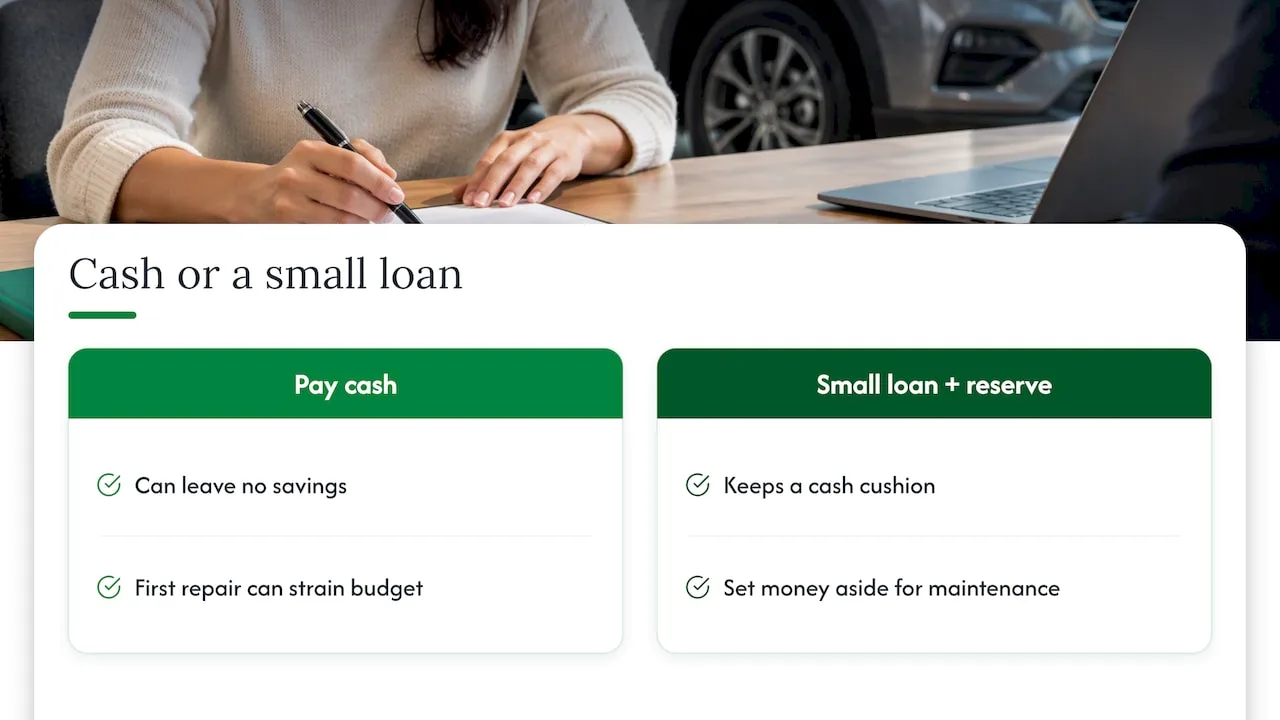
On the other side, we also see buyers accept a long, high-rate loan because the monthly number looked friendly. That's the one we try hardest to prevent. If a payment only works at 72 months or more, the car may cost too much. A cheaper car is usually the better answer.
Our approach is simple: show the price on every listing, inspect each car and share its history report before we list it, and have a real person answer your questions. If you're unsure whether cash or financing is right, ask us to walk through your numbers. There's no pressure, and we'd rather you wait than overextend.
— CL Auto
A simple way to decide
Work through these steps in order:
- Set a budget. Our used car budget guide helps you work out what share of your pay a car should take.
- Check your emergency fund. If paying cash would leave you under 3 months of expenses, don't.
- Get a pre-approval. Ask a bank or credit union for a quote. The CFPB says only about 50 percent of consumers comparison shop for an auto loan, and shopping around can save hundreds or thousands of dollars.
- Compare total interest. Use the calculator with your real rate and term.
- Decide on the gap. If the interest cost is small and your cash would be better kept liquid, finance. If the rate is high and you can pay cash and stay safe, pay cash.
- Pick the shortest term you can afford if you finance.
For reference, Experian reported average monthly payments of $742 for new cars and $525 for used cars in Q4 2024. If your planned payment sits well above that for a used car, take a second look.
If you're trading in a car with a loan
If you still owe money on your current car, you may have negative equity. Rolling it into the next loan means you're financing the old car and the new one at once, which makes the loan far more expensive. In that case paying cash for the next car is rarely realistic, so look at our guide to selling a car with a loan first.
Shopping with us in Clearwater
If you're buying in the Clearwater, Largo or Dunedin area, you can browse our hand-inspected used cars with the price shown on every listing. If you're financing, our financing page explains how we work with multiple lenders. And if you don't see what you want, we'll find the specific car you ask for, so you only see cars that match.
FAQ
Is it better to pay cash for a car?
It's better if your savings earn less than the loan would cost, and you'd still have a healthy emergency fund afterward. It's worse if it drains your reserves. Look at your rate, your cushion and your other debts before you decide.
What is the smartest way to pay for a car?
For most buyers, it's getting a pre-approval from a bank or credit union, negotiating the car's price separately, and choosing the shortest loan term you can afford. Put down as much as you can without touching your emergency fund. Then compare the total cost, not just the monthly payment.
Do dealerships prefer cash or financing?
It depends on the dealer. Some earn money by arranging loans, so they may push financing. Ask for the out-the-door price in writing first, and bring your own pre-approval so you can compare.
Can I finance a car even if I have the cash?
Yes. Some buyers finance a car at a low rate and keep their cash for emergencies or higher-return uses. It only makes sense if the rate is low enough, and you should check that the loan allows early payoff without a penalty.
Sources
- Should I Pay Cash for a Car? (Experian)
- The Latest Used Car Loan Interest Rates for 2026 (Experian)
- Take control of your auto loan: A step-by-step guide (CFPB)
- Dealer-arranged vs. bank financing (CFPB)
- Buying a Used Car (FTC)
- Should I finance or pay cash for a vehicle? (myFICO)
- Should I Pay Cash for a New Car? (U.S. News)
- Florida Vehicle Sales Tax & Fees 2026
- Deadly Air Bag Inflator Replacements (NHTSA)
- Odometer Fraud (NHTSA)