What Counts as a Good Car Loan Rate Right Now
The right way to judge any car loan offer is by its APR, not its monthly payment. A good APR generally falls in the low single digits for excellent credit, climbs into the high single digits or low teens for good and fair credit, and can run higher for poor credit or used vehicles. Your loan term and whether you use dealer financing or your own preapproval will shift that benchmark too.
TL;DR:
- The most accurate way to compare car loan offers is by their APR, which varies significantly based on credit score, vehicle age, and loan term.
- Used cars generally carry higher APRs than new cars across all credit tiers, with the difference widening for lower credit scores, impacting total interest paid.
- A larger down payment and shorter loan term can lower your APR and total cost, while longer terms increase overall interest even if monthly payments seem cheaper.
- Preapprovals from banks or credit unions offer concrete figures and negotiating leverage, so getting multiple quotes before visiting a dealer is essential.
- Always compare complete loan terms and total repayment figures, not just monthly payments, and ensure dealer offers include the actual buy rate in writing beforehand.
Table of Contents
- Typical Car Loan Rates by Credit Tier and Vehicle Type
- How Your Credit, Down Payment, and the Car Itself Change the Math
- Where to Get Quotes Before You Ever Talk to a Dealer
- Turning Quotes Into an Apples-to-Apples Comparison
- How a Straightforward Dealership Makes Rate Comparisons Easier
- Why the Monthly Payment Is the Wrong Question
- Financing Made Transparent at Clearwater Largo Automotive
- Sources
- FAQ
Typical Car Loan Rates by Credit Tier and Vehicle Type
Lenders love to advertise rates that sound low, but those numbers usually come with fine print. Navy Federal's own auto rate tables show "as low as" APRs that vary by loan term and by whether the car is new or used, and the footnotes are clear that those lowest rates assume excellent credit and specific eligibility. If your credit profile does not match that description, the rate you get quoted will land higher up the table.
Experian's rate data confirms something that trips up a lot of buyers: used-car APRs run higher than new-car APRs across every credit tier, and that gap widens the further down the credit spectrum you go. So a "good" rate for a used car is simply not the same number as a good rate for a new one. Comparing your used-car quote against a new-car benchmark will make a fair offer look bad, or a mediocre one look fine.
Rough tiers to keep in mind when you're evaluating an offer:
- Excellent credit: expect rates near the bottom of a lender's table, whether new or used.
- Good credit: still competitive, but noticeably higher than the top tier, especially on used vehicles.
- Fair credit: expect a real jump in APR, with used-car loans pricier than new.
- Poor credit: rates climb steeply, and shopping multiple lenders matters more than ever.
A four-percentage-point APR difference on a typical car loan term can add several thousands of dollars in total interest, according to how Experian frames the used-versus-new rate gap. That is the real cost of assuming your rate is fine just because the payment fits your budget.
The takeaway: always match your benchmark to your actual situation. New versus used, your credit tier, and the term you're financing over all move the number that counts as "good."
How Your Credit, Down Payment, and the Car Itself Change the Math
Lenders price risk, and your FICO score is their main tool for measuring it. A borrower with excellent credit represents less risk of missed payments, so lenders reward that with lower APRs. Drop down a tier and the math changes, not because you're a worse person, but because the lender's historical data says more loans in that band go delinquent.
Your down payment matters just as much as your score. A bigger down payment lowers your loan-to-value ratio, meaning the lender is financing less of the car's worth. That smaller exposure often earns a better rate, and it protects you from being upside down on the loan if the car depreciates faster than you pay it off.

Term length is where a lot of buyers get misled. A longer term lowers your monthly payment but generally increases total interest paid, since you're borrowing the same amount for more months.
A few things worth checking before you sign anything:
- Ask whether a longer term raises your quoted APR, not just your total interest.
- Compare loan-to-value at different down payment amounts to see the rate impact.
- Check the vehicle's age and mileage: older, higher-mileage cars often carry rate premiums.
Pro Tip: Run the same loan amount through a 48-month and 72-month scenario side by side. The payment difference will look tempting, but the total interest gap is usually the number that should decide it.
Used vehicles carry their own premium beyond just the new-versus-used gap Experian documents. Older cars and higher-mileage vehicles are seen as riskier collateral, so don't be surprised if two used cars at the same price come back with different rate quotes based on age alone.
Where to Get Quotes Before You Ever Talk to a Dealer
Shopping around is the single most useful thing you can do before walking into any dealership. Here's a practical order to work through:
- Start with your bank or credit union. Credit unions in particular often offer lower APRs to members, since they're not-for-profit and tend to price loans more conservatively.
- Check online lenders. They move fast and give you a real number to compare, often within minutes.
- Get at least two preapprovals. A preapproval is not a guarantee, but it gives you a firm number and real negotiating leverage.
- Save the dealer's financing offer for last. As the CFPB explains, dealer-arranged financing usually starts with a buy rate from a lender, and the dealer may add a markup on top. Walking in with outside preapproval gives you something concrete to compare it against, and something to ask the dealer to beat.
On timing: don't stretch your shopping over weeks. The CFPB notes that rate shopping within a short window has little to no impact on your credit score, since multiple auto loan inquiries in that window are typically treated as one. Get your preapprovals done in a few days, not a few months.
Turning Quotes Into an Apples-to-Apples Comparison
Once you have a couple of offers in hand, the real work is making sure you're comparing the same thing twice. The CFPB's auto loan guide recommends getting every offer in writing with these figures spelled out:
- APR and finance charge, not just the monthly payment.
- Amount financed and total of all payments over the life of the loan.
- Out-the-door price, including every fee the dealer plans to add.
If you're working with a dealer, ask directly what the buy rate is and whether they've marked it up. The FTC's guidance on dealer advertising warns that headline rates often apply only to the most qualified borrowers, so ask in writing whether any restrictions, required down payment, or fees apply to your quote specifically. Our breakdown of dealer doc fees walks through which charges are negotiable and which typically aren't.
To compare true cost, normalize every offer to the same vehicle price, the same term, and the same add-ons like GAP coverage or extended warranties, then look at the total of payments, not the payment amount. Our guide to calculating your out-the-door price covers this step by step.
Pro Tip: If a dealer won't put the buy rate and final APR in writing before you sign, that's your signal to walk away and finance elsewhere.
How a Straightforward Dealership Makes Rate Comparisons Easier
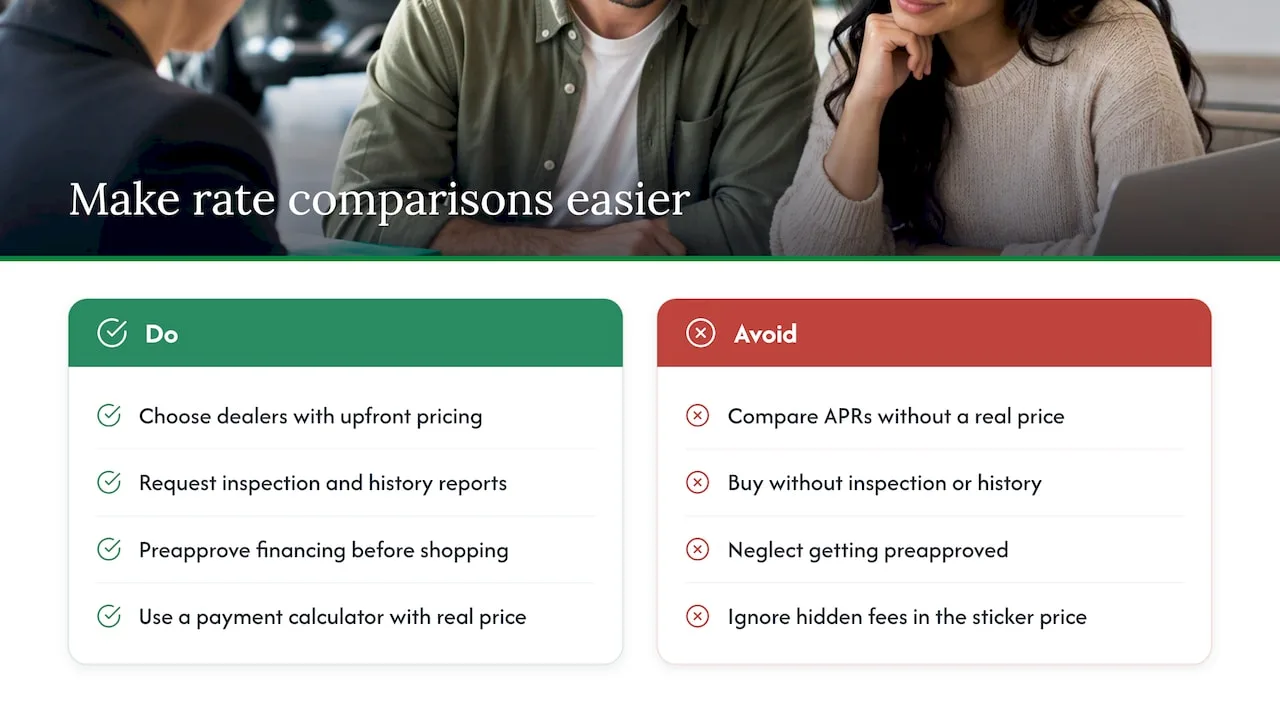
A lot of the confusion around car loan rates comes from not knowing the real price of the car in the first place. When the sticker price hides fees, or the vehicle's condition is a mystery until you're already at the table, comparing loan offers becomes guesswork.
Some dealerships show their price upfront, with no hidden fees added later, and provide inspection and history reports before listing their vehicles. That removes one whole layer of uncertainty: you know the actual price you're financing before you start comparing APRs.
Our payment calculator lets you test different APRs and terms against a real vehicle price before you ever step onto the lot, so you can see how a preapproval from your bank stacks up against dealership financing options. And if you're looking for a specific make, model, or feature set, our vehicle sourcing service can track it down, which pairs well with getting your financing preapproved ahead of time so you're negotiating from strength on both the price and the rate. Buyers weighing large online sellers against local options sometimes compare Carvana alternatives too, and the same preapproval strategy applies wherever you end up buying.
Why the Monthly Payment Is the Wrong Question
Most car loan advice fixates on getting the lowest possible payment, and that's exactly backward. The payment is the last number you should optimize, because it can be manipulated by stretching the term, and a low payment on a seven-year loan can cost you thousands more than a higher payment on a shorter one.
What actually matters is total cost, and total cost is a function of APR and term together, not either one alone. The conventional advice to "shop around" is correct but incomplete: shopping around only works if you're comparing the same vehicle, the same term, and the same fees across every quote. Most people skip that step and end up comparing a 60-month dealer quote against a 72-month bank quote and drawing the wrong conclusion.
If you take one thing from this, prioritize getting a preapproval before you ever discuss financing with a dealer. It gives you a real number, a real deadline, and a real reason for the dealer to compete for your business instead of the other way around.
— CL Auto
Financing Made Transparent at Clearwater Largo Automotive
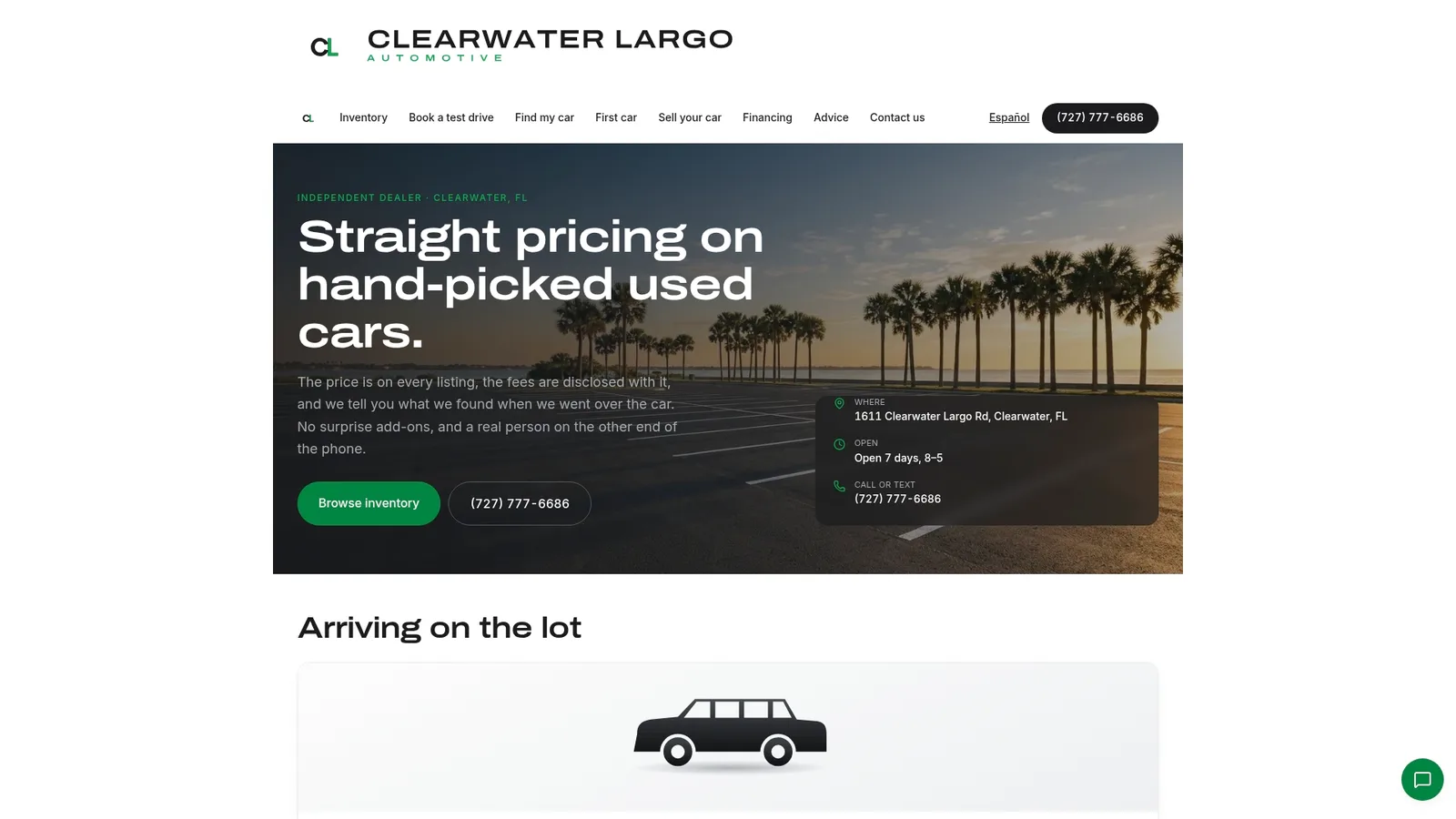
Comparing loan offers is a lot easier when the car's price isn't a moving target. Every vehicle at Clearwater Largo Automotive is listed with its full price upfront, backed by an inspection and history report, so the number you're financing is the number you actually pay.
Here's how we make the process easier once you're ready to compare financing:
- Browse hand-picked used cars with transparent pricing and no surprise fees at the counter.
- Explore our financing options and work with a real person, not a call center, to find a rate that fits.
- Test different loan terms and rates on our payment calculator before you ever visit.
- Ask us to track down a specific vehicle through our vehicle sourcing service if you know exactly what you want.
Bring any preapproval offer you've already collected. We'll compare it against what we can arrange and tell you plainly which one actually costs less.
This article is general information, not a substitute for advice from a qualified financial advisor. Consult a qualified financial professional about your own circumstances before acting on anything here.
Sources
- Auto loan rates & financing | Experian
- Can I negotiate the interest rate on an auto loan with the dealer? | CFPB
- Take control of your auto loan: A step-by-step guide | CFPB
- Car dealer ads and promotions: Know before you go | FTC
- Auto Loan Rates for New & Used Cars | Navy Federal
FAQ
Is a 2.9 Interest Rate Good for a Car?
A low single-digit APR is generally considered a strong rate and typically requires excellent credit, according to the kind of "as low as" tiers lenders like Navy Federal publish. Whether it's genuinely good for you depends on whether it applies to a new or used vehicle and matches your credit tier and loan term.
Is 7% a High Interest Rate for a Car?
An APR in the high single digits can be on the higher side for buyers with excellent or good credit, but it can be reasonable for fair-credit borrowers, especially on a used vehicle, since Experian's data shows used-car APRs consistently run above new-car APRs. Compare it against quotes for the same vehicle type and term before deciding.
Is a 5.5 Interest Rate Good for a Car Loan?
If you have excellent credit, you may be able to find a lower rate through a credit union or preapproval, so it's worth comparing before accepting.
Is a 4.99 Interest Rate Good for a Car Loan?
Confirm whether it applies to new or used, since used-car APRs tend to run higher than new-car APRs at every credit level.
Does Getting Multiple Auto Loan Preapprovals Hurt My Credit?
Shopping multiple lenders for preapproval within a short window typically has little to no meaningful impact on your credit score, since the CFPB notes that multiple auto loan inquiries in that period are usually counted as one. Aim to complete your preapproval shopping within a few days to stay inside that window.