

The Buyers Guide is the sticker on a used car's window that tells you one thing above all: whether the dealer is offering a warranty or selling the car "as is." Federal rules require it on most used cars a dealer sells. It is also a promise on paper, so what it says should match what you sign. Here is how to read it, what it leaves out, and what to check before you pay.
TL;DR
- The Buyers Guide is the federally required used-car window form. It states whether the car comes with a dealer warranty or is sold "as is."
- "As is" means the dealer offers no warranty. A warranty box spells out how long it lasts, what percentage of repairs the dealer pays, and which systems it covers.
- The sticker does not replace a vehicle history report or an inspection. It points you to both.
- If you negotiate warranty changes, make sure the final Buyers Guide reflects them and that you get a copy.
- Maine and Wisconsin dealers follow their own similar state rules instead of the federal form.
Table of Contents
- What the Buyers Guide window sticker is
- Which cars need one, and where it goes
- How to read the sticker, step by step
- What the Buyers Guide does not tell you
- Two sample cars, two different conversations
- Before you sign: match the paperwork to the sticker
- If the sticker is missing or the contract disagrees
- Shop with the paperwork in plain sight
- FAQ
- Sources
What the Buyers Guide window sticker is
Walk onto any used car lot and you will see a sheet in the window of nearly every vehicle. That is the Buyers Guide. It comes from the Federal Trade Commission's Used Car Rule, which has been in place since 1985. Its purpose is simple: before you talk price, you should know what protection, if any, comes with the car.
It is not the same sheet you see on a new car. A new-car label describes how the car was built and equipped. The Buyers Guide says nothing about options or trim. It is a warranty disclosure, and that is its whole job.
The form is standardized on purpose. The FTC's regulation sets the format, including black ink on white stock, a minimum size of 11 inches by 7 1/4 inches, and exact required wording. That consistency helps you. A Buyers Guide in Clearwater reads the same as one in Cleveland, so once you know where to look, you can scan any of them in a minute.
You may also see a second sheet in the window, with the dealer's own price, features and notes. That one is the dealer's design, not a federal form. Do not mix them up. The Buyers Guide is the one with the warranty boxes.
Which cars need one, and where it goes
The rule covers most dealers. According to the FTC's Dealer's Guide to the Used Car Rule, a dealer who sells or offers to sell more than five used vehicles in a 12-month period has to display a Buyers Guide. Qualifying light-duty vans and trucks, demonstrators and program cars are covered too, not only ordinary used sedans.
Placement matters as well. The same guidance says the sticker must sit in a prominent, conspicuous spot on the vehicle, such as a side window, under a windshield wiper or hanging from a mirror, and both sides must be easy to read. If you are standing at a car and cannot find the sheet, or it is folded so you can only read one side, ask for it right away. That is a reasonable request, and an honest dealer will hand it over without fuss.
What about Maine and Wisconsin?
The federal rule applies nationwide with two exceptions. Dealers in Maine and Wisconsin are exempt because those states have similar rules of their own. If you are shopping in Florida, as most of our customers are, the federal Buyers Guide is the form you will see.
How to read the sticker, step by step
The form is short. Read it in this order.
Find the warranty box that is checked. The top of the form shows whether the car is sold "as is" or with a warranty. Everything else on the page depends on this one choice.
If it says "as is," take it literally. An "as is" disclosure means the dealer offers no warranty. If something fails after you leave the lot, the repair bill is yours unless you bought a separate service contract or another protection. That does not make the car a bad one. It does mean the inspection you do before buying carries more weight. We go deeper on this in our piece on buying an as-is car with a hand inspection.
If it shows a warranty, read the three details. The FTC says warranty disclosures specify the duration, the percentage of repair costs the dealer will pay, and the covered vehicle systems. A warranty that covers 50 percent of repairs for a short period on a few components is very different from one that covers more of the bill on more systems. Ask which parts are covered by name.
Check the list of major systems. The form lists major systems and common problems. Use it as a prompt for questions: frame, engine, transmission, brakes, electrical and so on. If the dealer says a system is covered, find that system on the sheet and see whether it is included.
Find the complaint contact. The form includes dealer complaint contact details. Note who that is. It tells you where to go if a problem comes up after the sale.
Read the line about history reports and recalls. The sticker directs buyers to get a vehicle history report and check for open safety recalls using the vehicle's VIN. That is advice from the government, printed on the car. Follow it.
What the Buyers Guide does not tell you
This is where buyers get tripped up. The sticker is a disclosure about warranty coverage. It is not a condition report, and it does not vouch for the car.
The FTC's guidance is clear that the Buyers Guide is not a substitute for a separate written warranty. If a dealer promises something about the car, such as "we'll fix the A/C if it acts up", that promise belongs in writing, not just in a sales conversation.
The sticker also does not tell you:
- Whether the title is clean or branded.
- Whether the car has been in an accident.
- How many owners it has had or how it was maintained.
- Whether tires, brakes and belts are near the end of their life.
For the first two, pull a vehicle history report by VIN. Our walkthrough of five NMVTIS-backed steps to verify a clean title shows how. For the rest, you need a hands-on look and a test drive, and ideally a longer one. Some dealers will let you take a car overnight if you ask.
Maintenance records help too. If the seller has receipts, read them. A good way to think about what to look for is this guide on how to document car repair history, which explains why a paper trail matters for warranty questions and resale value alike.
Two sample cars, two different conversations
Here is how the same sticker changes what you do. These are illustrations, not real listings.
Car A is marked "as is." You like it, and the price fits. Your next steps: ask for the history report, have your own mechanic look it over if you can, check the tires and fluids, and decide whether a separate service contract makes sense for your budget. The sticker did not hide anything. It told you the risk is yours, so you plan for it.
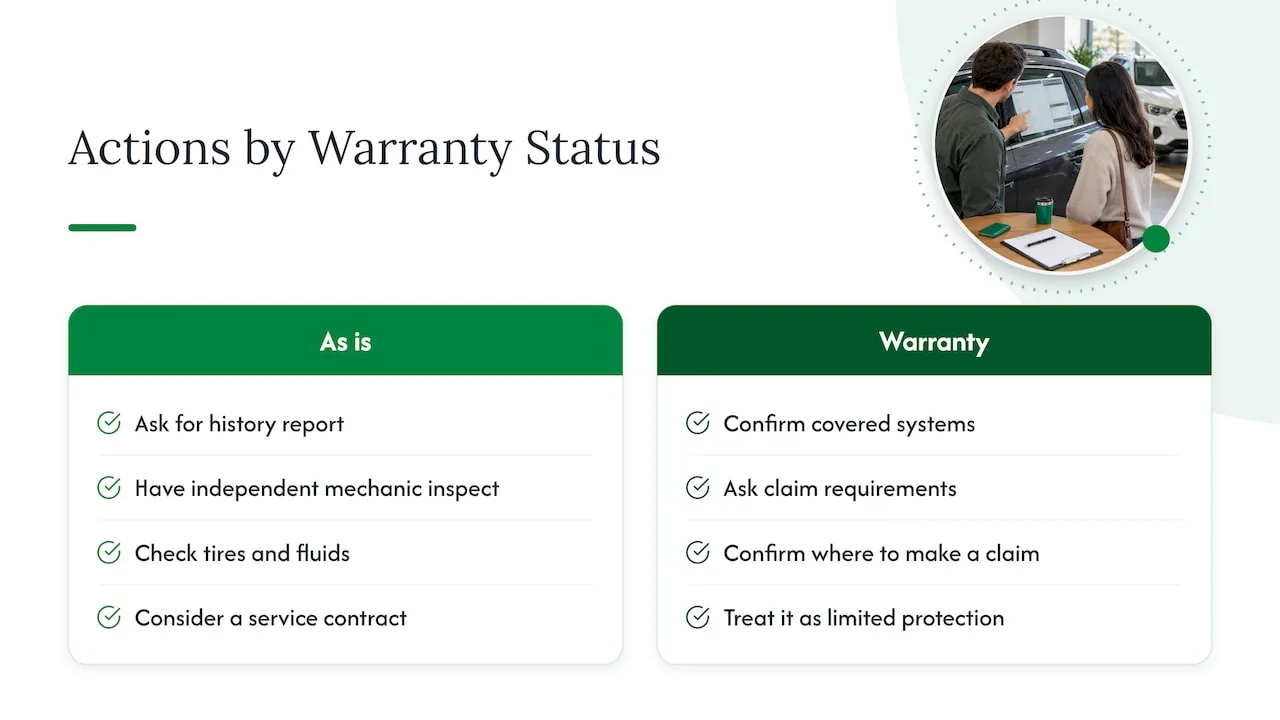
Car B shows a warranty. Read the box. If it covers a limited share of repair costs for a short period on a short list of systems, treat it as a small cushion, not full protection. Ask the dealer to point to the covered systems on the page, and ask what you would need to do to make a claim and where.
In both cases, the sticker starts the conversation. It does not end it.
Before you sign: match the paperwork to the sticker
Negotiation can change the warranty terms. If you and the dealer agree on something different from what the sticker shows, the FTC says the Buyers Guide should reflect the final negotiated warranty changes, and you should receive the original or a copy at the sale. If the form has a signature line, sign the version that reflects those changes.
Before you put pen to paper, run through this list.
Compare the sticker to the contract. Does the contract say "as is" when the sticker shows a warranty, or the other way around? Any mismatch is a stop sign. Ask for it to be fixed in writing.
Confirm the VIN on every page. The VIN on the Buyers Guide, the contract and the title paperwork should be the same as the number on the car.
Get your copy. Take the Buyers Guide copy home with the rest of your documents. If you are unsure what else to bring and keep, our list of six documents to bring to a dealership covers it.
Ask about added fees. The sticker does not list them. Look at the itemized price and ask about every line. Our article on how buyers beat hidden fees explains what to question.
Read anything you are asked to sign. If a line says something you were not told, stop and ask. If you are not satisfied with the answer, walk away.
Keep it all. Store the Buyers Guide, contract, history report and repair records together. You will want them for service, for resale, and for any dispute.
If you are weighing a legal claim down the road, the Buyers Guide can be a key document. We cover that in seven steps for used-car lemon law claims.
If the sticker is missing or the contract disagrees
This is the part where you rely on common sense and a calm tone.
No sticker on the car. Ask the salesperson for it before you discuss numbers. Most used cars at a dealership should have one, and a missing form is worth a question. A dealer who is organized will have it on hand. If you get vague answers, that tells you something about how the rest of the deal may go.
The contract conflicts with the sticker. Do not sign on the promise that "we'll fix it later." Ask for the contract or the Buyers Guide to be corrected before you sign, and keep a copy of the corrected version. A verbal promise is hard to prove.
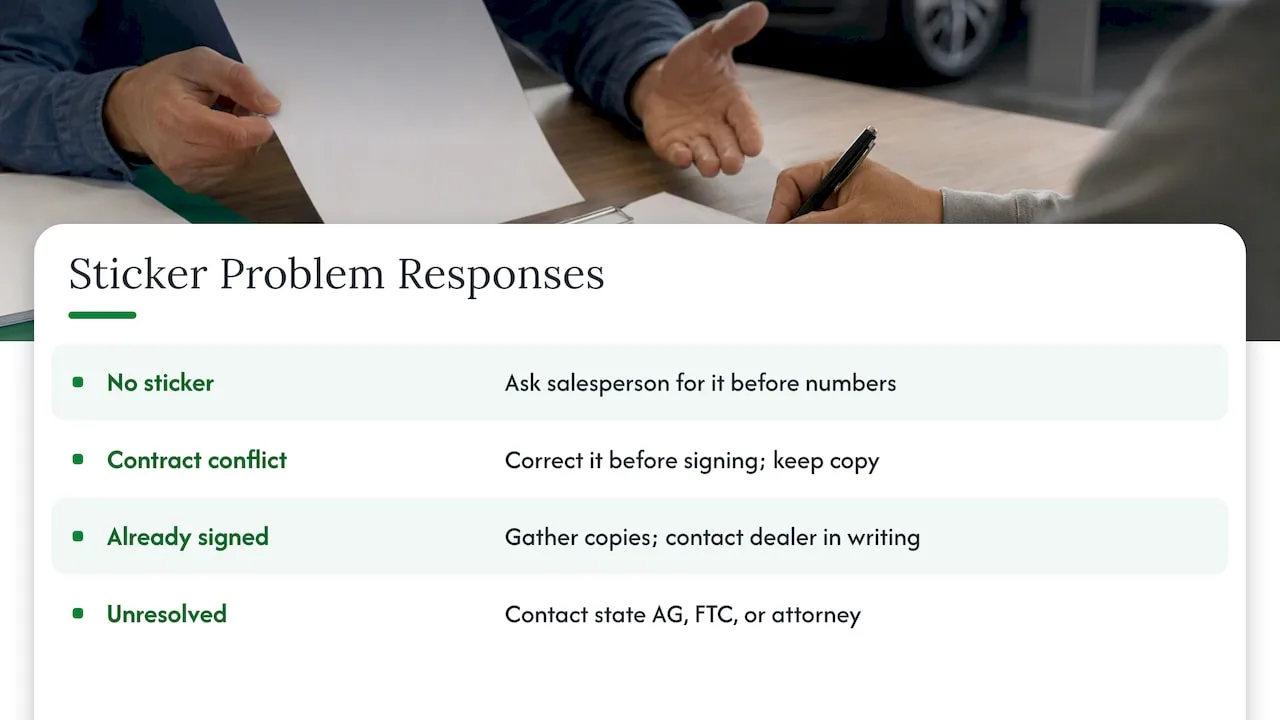
You already signed and found a mismatch. Gather your copies of the sticker and contract, write down what was said and by whom, and contact the dealer in writing. The Buyers Guide lists a complaint contact for the dealer. If you cannot resolve it, your state attorney general's consumer protection office and the FTC are places to take a complaint, and a consumer attorney can advise you on your rights in your state.
The simplest protection is to check before the sale, not after.
Our perspective: a sticker should be the start of the story
We are an independent dealer in Clearwater, and we see the Buyers Guide as the minimum, not the goal. It tells you the warranty status of a car. It does not tell you whether someone has looked under it, read its history, or checked that the price you see is the price you pay.
That is why we hand-inspect our cars and review a vehicle history report before a car is listed. We show the price on every listing, and we do not add hidden fees. When you ask a question, a real person answers it, not a call center.
Our advice to any buyer, at our lot or anyone else's: read the sticker first, then ask for the history report, then compare the contract line by line. If we cannot answer a question about a car, we say so and find out. And if the car you want is not on our lot, we will search for it by your specifications so you only look at cars that fit.
CL Auto
Shop with the paperwork in plain sight
If you want a used car where the price is on the listing, the inspection and history have been done before you walk up, and the person you talk to is a real person, start with our hand-picked used cars. We will walk you through the Buyers Guide on any car you are interested in.
Cannot find the right car? Tell us what you need through vehicle sourcing and we will look for it. If you are working out how to pay, see our financing options, which are arranged with multiple lenders. And if you have a car to sell, we buy cars directly from local owners. For more checklists, browse buying advice from a Clearwater dealer, including our guide to nine things to check before you pay.
FAQ
Is the Buyers Guide the same as a Monroney sticker?
No. The Buyers Guide is the FTC's used-car warranty disclosure. It covers whether a warranty comes with the car and which systems it covers. It does not describe the car's equipment the way a new-car label does.
Does "as is" mean the car is bad?
No, it means the dealer is not offering a warranty. The FTC describes "as is" as the dealer offering no warranty. A car sold that way can be a good one, but you should inspect it, read its history report and budget for repairs before you buy.
Can I negotiate the warranty on the sticker?
Yes, you can ask. If you reach a different deal, the Buyers Guide should be updated to reflect it, and you should get the original or a copy. Review the final version before you sign.
Does every dealer have to display a Buyers Guide?
Most do. Dealers who sell or offer more than five used vehicles in a 12-month period must display one, with exceptions for Maine and Wisconsin, which have their own similar rules. The FTC's dealer guidance explains the details.
What should I do after reading the sticker?
Run the VIN through a history report and check for open safety recalls, as the form itself advises. Then have the car inspected and compare the contract with the sticker before you sign.
Sources
- FTC: Used Car Rule
- FTC: Dealer's Guide to the Used Car Rule
- FTC: Used Car Buyers Guide (English, plain language PDF)
- eCFR: 16 CFR 455.2, Consumer sales window form
- Document car repair history: warranty and resale checklist