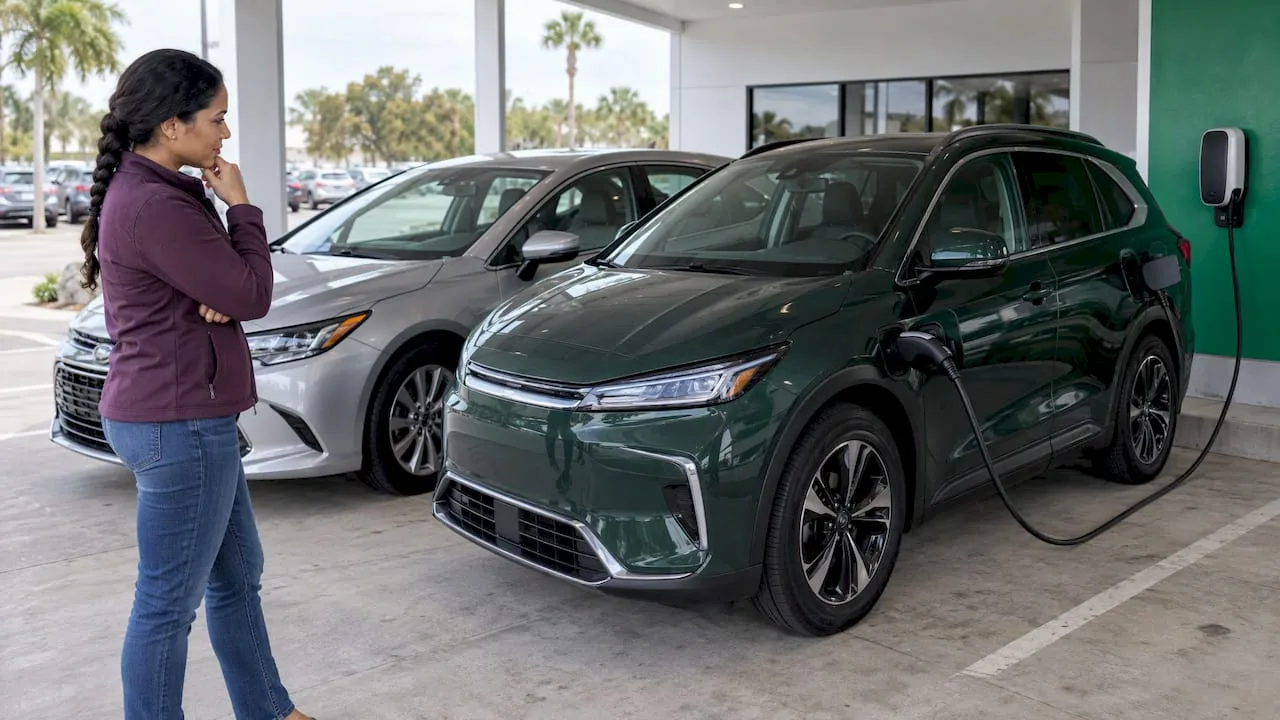
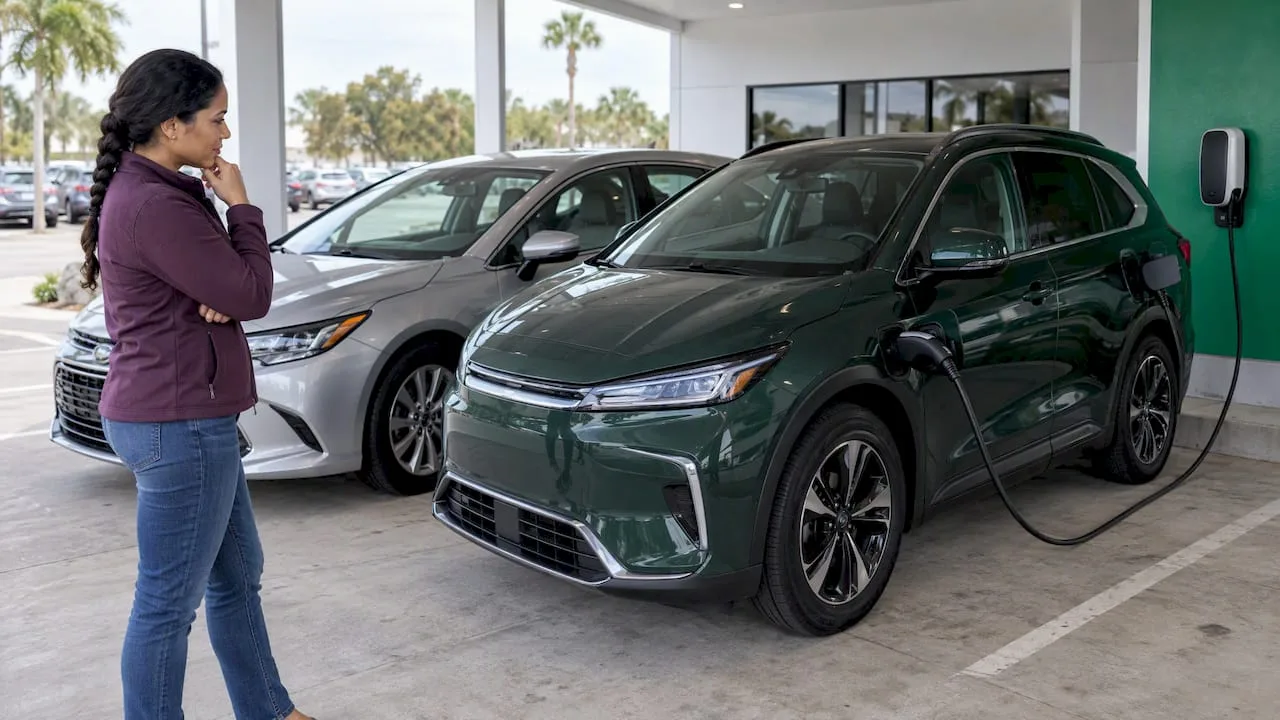
A regular hybrid is the better pick if you can't plug in at home or you want the lowest price. A plug-in hybrid (PHEV) is the better pick if you can charge every day and your commute is about as long as its electric range. That is the short answer. The rest of this guide shows how to test it against your own driving, what each type costs, and what to check if you buy one used.
We sell used cars in Clearwater, so we hear this question from buyers who want better fuel economy without a big risk. We'll keep it practical.
TL;DR
- A hybrid never needs a plug. A PHEV has a bigger battery you charge from an outlet for 20 to 40 miles of electric-only driving.
- Hybrids cost $0 to $3,000 more than comparable gas cars. PHEVs cost $1,300 to $14,000 more.
- A PHEV only pays off if you plug it in. Without charging, some get worse mileage than a gas car.
- Used buyers should ask for service records, a battery health test, and the battery warranty terms before signing.
Table of Contents
- How a hybrid and a plug-in hybrid actually differ
- Hybrid vs. PHEV side by side
- What each one costs to own
- Which one fits your life
- The downsides of a plug-in hybrid
- Buying a used hybrid or PHEV: what to check
- Signs of hybrid battery trouble
- Our perspective: start with the plug, not the badge
- Find the right hybrid at Clearwater Largo Automotive
- FAQ
- Sources
How a hybrid and a plug-in hybrid actually differ
Both types pair a gas engine with an electric motor and a battery. The difference is the size of the battery and where its energy comes from.
A conventional hybrid blends a gas engine, a small battery and an electric motor and doesn't need to be plugged in. The car charges its own battery by recovering energy when you brake and coast. You fill the tank, drive, and the system does the rest. The electric motor mostly helps at low speeds and in stop-and-go traffic.
A PHEV has a much larger battery that you can charge from an outlet. It can run on electricity alone for 20 to 40 miles. Once that charge is used up, the gas engine kicks in and the car drives like a hybrid. If you want a wider look at how each power layout works, vehicle power options explained covers the basics.
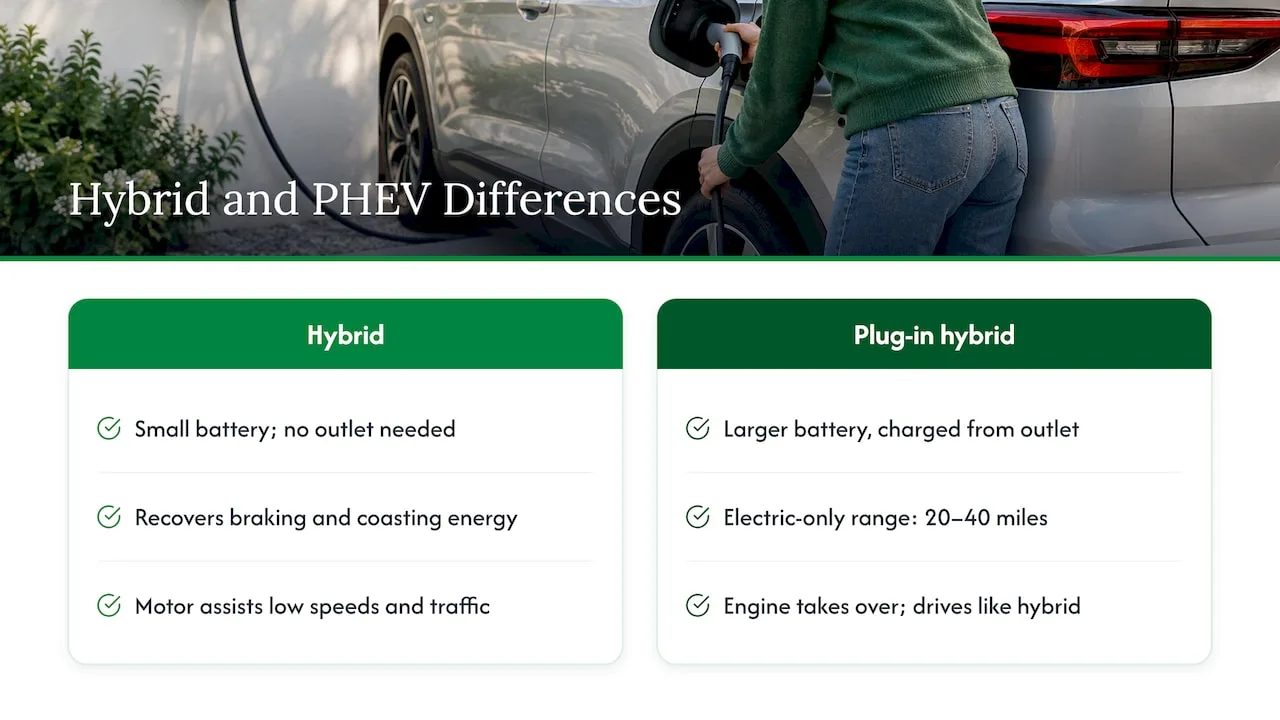
A simple way to remember it: a hybrid is a more efficient gas car. A PHEV is part gas car and part small electric car that you have to keep fed.
Hybrid vs. PHEV side by side
| Conventional hybrid | Plug-in hybrid (PHEV) | |
|---|---|---|
| Plug required | No | Optional, but it is the whole point |
| Electric-only driving | Low speeds, short stretches | 20 to 40 miles |
| Price vs. a similar gas car | $0 to $3,000 more | $1,300 to $14,000 more |
| Yearly fuel savings vs. gas | $300 to $800 | Depends on how often you charge |
| Complexity | Lower | Higher |
| Best for | No home charging, tight budget | Daily charging, short commute |
The cost and fuel figures come from Consumer Reports' hybrid and EV buying guide. Prices are for new vehicles, so a used car will land lower. The gap between the two types still holds, and it tends to carry over to the used market.
What each one costs to own
The sticker price is only the start, so look at three costs.
Purchase price. A PHEV costs more because of the larger battery pack and more powerful electric motor. That premium is real money, and it takes time to earn back.
Fuel. A hybrid saves you fuel with no effort on your part. A PHEV's savings depend on your habits. Charge it every night and short trips can run on electricity. Skip charging and you are hauling a heavy battery around for nothing. Some PHEVs get worse mileage than gas-powered cars when they aren't plugged in.
Repairs. More parts means more that can go wrong. NerdWallet notes that some maintenance and repairs may cost more on a PHEV because of its mechanical complexity. Consumer Reports goes further and says PHEVs can be significantly more complex than traditional hybrids, with about 80 percent more problems on average than gas-only cars. That is a strong reason to be careful with used PHEVs.
If you are weighing a hybrid against a plain gas car first, our cost-first hybrid vs. gas comparison walks through that math.
Which one fits your life
Run through these five questions in order. Most buyers know their answer by number three.
Can you charge at home or work every day? If not, buy a hybrid. A PHEV you can't charge is an expensive hybrid with a heavy battery.
How far do you drive in a typical day? If your round trip is close to the PHEV's electric range, you may use almost no gas on weekdays. If you drive far every day, the electric range runs out early and the savings shrink.
What outlet do you have? PHEVs can charge from a 120-volt household outlet or a faster 240-volt Level 2 home charger. A regular outlet is slower, so check that an overnight charge fits your daily miles before you count on it. A Level 2 charger is an added cost.
How tight is your budget? Edmunds' guidance is that a conventional hybrid makes sense if you lack charging access or have a tight budget. A PHEV suits drivers who can charge daily, have a commute about as long as its electric range, and can afford the higher price.
How much do you want to think about it? A hybrid asks nothing of you. A PHEV rewards routine. If plugging in every night sounds like a chore you will drop in a month, be honest about that.
For most first-time buyers and budget shoppers we talk to, the answer is a hybrid. If you are a busy professional with a garage, a short commute and a few extra thousand to spend, a PHEV deserves a look.
The downsides of a plug-in hybrid
People ask why PHEVs aren't more popular. The reasons are fairly simple.
Higher upfront cost. They cost more than hybrids and gas cars, and the range of premiums is wide.
They depend on your habits. Fuel savings only show up when you plug in.
More complexity. Two power systems and a large battery mean more to inspect and more to repair.
Charging logistics. Apartment living, street parking or a shared driveway can make daily charging hard.
None of that makes a PHEV a bad car. It makes it a car that fits some routines far better than others.
Buying a used hybrid or PHEV: what to check
A used hybrid can be a smart purchase, but the battery is the part you can't see. Here is the order we would follow.
Read the service records. Review the vehicle's service records. Look for regular oil changes, cooling system work and any hybrid system repairs. No records is a reason to slow down.
Ask for a battery health test. Ask the dealer for one, and ask to see the result. We explain what a good report should show in what a battery health check should tell you.
Find out if the battery warranty transfers. Don't assume it does. WIRED advises you to check with the automaker whether the battery warranty carries over to a new owner, and for how long.
Run the VIN for recalls. Safety recalls can affect used hybrids. One example is the 2014-2015 Honda Accord Hybrid, where incorrect cell voltage sensor data could cause unexpected power loss. Ask whether any recall work was done.
Get an independent inspection. Consumer Reports recommends having any used vehicle thoroughly inspected by a professional mechanic before you buy. That applies to hybrids too.
Think about how the PHEV was used. WIRED points out that if a previous owner mostly ran a PHEV on gas and forgot to plug it in, its battery might be healthier than its age or mileage suggests. Mileage alone doesn't tell the story, so we look at both. Our piece on highway miles vs. city miles adds more on that.
Check the model's reliability record. Consumer Reports says its recommended used cars have had consistent above-average reliability for multiple years, based on member surveys. Pick a model with that kind of track record.
Signs of hybrid battery trouble
A warning light or a drop in mileage doesn't automatically mean the battery is dying. A scan and a proper diagnosis tell you what is going on.
The clearest documented example we can point to is the 2014-2015 Accord Hybrid recall. On affected cars, diagnostic trouble codes P0B3B or P0DA8 may be stored, and Honda's inspection procedure checks for them and diagnoses the high-voltage battery. Those codes are specific to that recall, so don't treat them as a universal checklist.
What you may notice on a car with a failing battery depends on the model. On those affected Accords, a fail-safe EV mode can limit speed to about 40 mph.
Can you still drive a hybrid if the battery dies?
It depends on the car. On the affected Accords, the same recall notice says that if the high-voltage battery fully discharges while the vehicle is operating, it may stall. Don't assume you can limp home. If a warning light comes on, have the car checked by a shop that works on hybrids.
Our perspective: start with the plug, not the badge
We don't push one type over the other. We ask where you park at night.
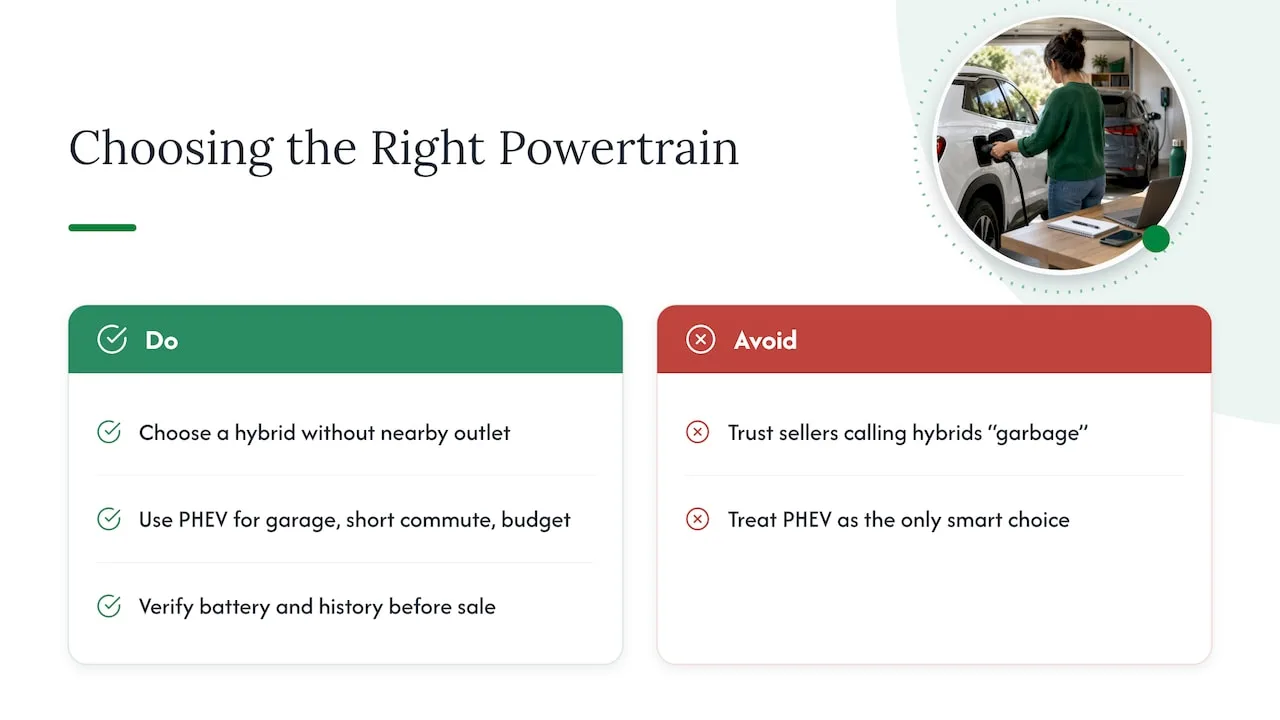
When a buyer tells us they have no outlet near their parking spot, the conversation is short: a hybrid is the right tool. You get better fuel economy and no new habits. When a buyer has a garage, a short commute and the budget, a used PHEV can be a good fit, as long as we have verified the battery and the history first.
That is why every car we list is hand-inspected and has a history report before it goes up, and why the price is on every listing with no hidden fees. Hybrids are where those checks matter most. A battery is expensive to find out about after the sale, so we want you to know before. If you are still deciding between powertrains, our write-ups on the 2026 Highlander vs. Pilot and the Civic vs. Corolla show the same trade-offs on real models.
Our advice: be skeptical of any seller who tells you a hybrid is "garbage" or that a PHEV is the only smart choice. Both are true for the wrong driver and wrong for the right one.
— CL Auto
Find the right hybrid at Clearwater Largo Automotive
If you know you want a hybrid or a PHEV, we can help you narrow it down without the pressure. Browse our hand-inspected used cars, each with the price shown and a history report. Every inquiry is answered by a real person, not a call center.

Can't find the exact car? Tell us what you want and we will track it down through our vehicle sourcing service, so you only see cars that match. If you need a loan, we work with multiple lenders on financing. Got a car to sell first? See how we buy cars directly from individuals.
FAQ
Is a hybrid or a plug-in hybrid better?
Neither is better for everyone. A hybrid is the safer choice if you can't charge at home or you want a lower price. A PHEV is better if you can charge daily and your trips fit within its 20 to 40 miles of electric range.
Should I buy a used hybrid?
Yes, if you verify it first. Review the service records, ask for a battery health test, and confirm whether the battery warranty transfers. Then have an independent mechanic inspect it, as Consumer Reports recommends for any used car.
What are the signs of hybrid battery failure?
Symptoms vary by model, and a warning light needs a diagnosis, not a guess. On the 2014-2015 Accord Hybrid, a recall describes stored codes and a fail-safe mode that can cap speed at about 40 mph. A shop that works on hybrids can test the battery and tell you what is actually wrong.
Why aren't plug-in hybrids more popular?
The main reasons are cost and convenience. They cost more up front, repairs can cost more, and the savings depend on plugging in. Drivers without easy home charging often get more value from a regular hybrid.
How long does a used hybrid battery last?
We can't give you a number that holds for every car, because it depends on the model, use and care. That is why we look at the battery test result and the service history instead of guessing from age alone. Ask the automaker what the battery warranty covers on the exact car you are considering.
Sources
- Hybrid and EV Buying Guide, Consumer Reports
- Hybrid vs. Plug-in Hybrid Cars: What's Right for You?, Edmunds
- Electric vs. Hybrid vs. Plug-In Hybrid Vehicles, NerdWallet
- WIRED's Guide to Buying a Used Plug-In Hybrid
- NHTSA recall notice, 2014-2015 Honda Accord Hybrid
- Should You Buy a Used Rental Car?, Consumer Reports
- How to Find a Safe and Reliable Used Car, Consumer Reports
- Vehicle Power Options Explained