

A soft pull lets a lender look at your credit file without hurting your score, so you can see an estimated rate and payment before you commit to anything. It is a preview, not an approval. The hard credit check still comes later, when you submit a real application for a specific loan. Here is how that works, what the numbers mean, and how to shop without wasting your credit.
TL;DR
- A soft pull (soft inquiry) does not affect your credit scores, and prequalification is typically done with one.
- Prequalification gives you an estimate of APR, term and borrowing limit. It does not guarantee approval or the final terms.
- A formal application triggers a hard inquiry. Auto-loan hard inquiries made within a short window are generally counted as one.
- Compare offers on APR, loan length, monthly payment and total cost, not on the payment alone.
- Soft-pull quotes are a good first step, but you want your real offer in writing before you sign.
Table of Contents
- What a soft pull actually is
- Soft pull, prequalification and preapproval: the terms people mix up
- What a soft-pull prequalification shows you
- How to prequalify with a soft pull, step by step
- Why the final offer can differ from the quote
- Does applying to several lenders hurt your credit?
- How to compare the offers you collect
- Soft pulls when you have thin or no credit
- Our view: use the soft pull as a map, not a contract
- Financing at Clearwater Largo Automotive
- FAQ
- Sources
What a soft pull actually is
When someone reviews your credit file, it gets logged as an inquiry. There are two kinds. The Consumer Financial Protection Bureau (CFPB) describes a soft inquiry as a review of your credit file for things like a lender's prescreening, an existing creditor's account review, employment screening, or your own request for your credit report. The CFPB also says soft inquiries do not affect your credit scores.
You have probably had dozens of them without noticing. Checking your own report is one. A credit card company deciding whether to send you a preapproved offer is another.
A hard inquiry is different. It happens when you apply for credit and a lender pulls your report to make a lending decision. Experian explains that a formal loan application leads to a hard inquiry, which can cause a small, temporary dip in your score.
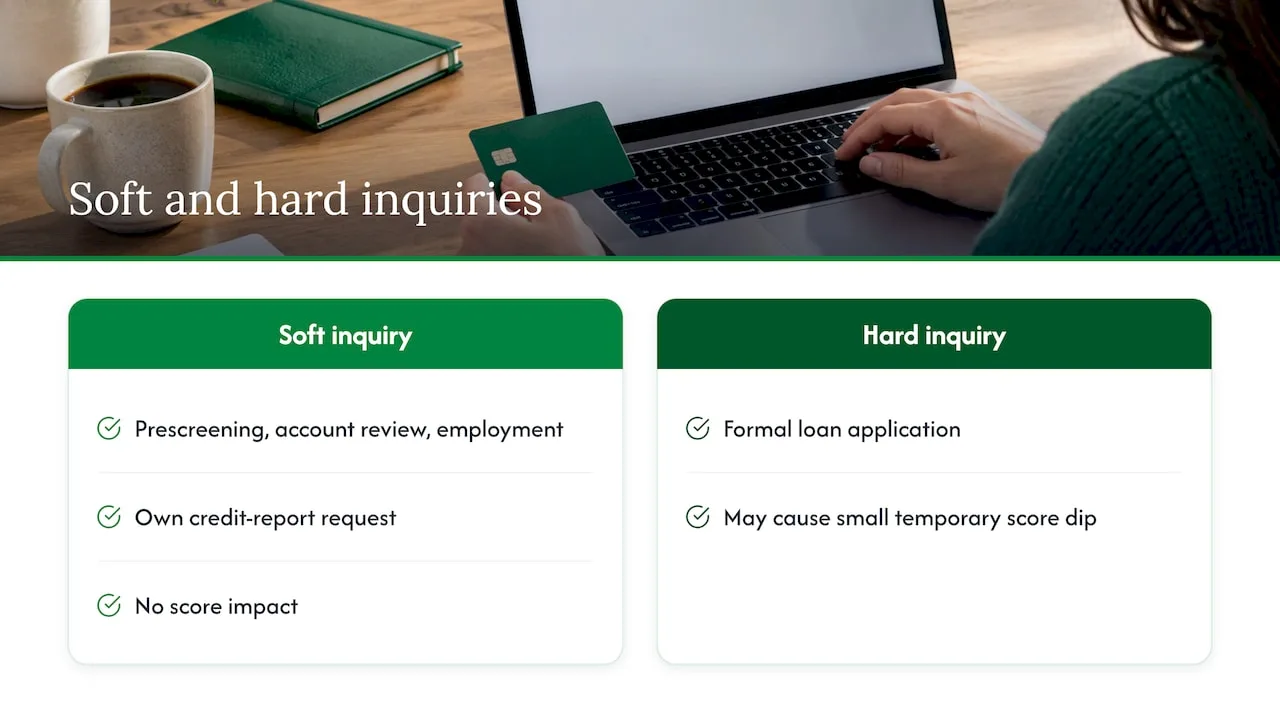
So the simple version: soft pull means looking, hard pull means deciding.
Soft pull, prequalification and preapproval: the terms people mix up
These words get used loosely, and dealers and lenders do not always use them the same way. Ask which one you are getting and whether it involves a hard pull. In general:
- Prequalification is a quick estimate. Per Experian's explanation, it is typically a soft inquiry, and what you see is an estimate of the kind of financing you might qualify for.
- Preapproval is a firmer step. Experian notes that a preapproval often leads to a hard inquiry, because the lender is doing a fuller review.
- Final approval comes when you submit a formal application for a specific loan on a specific car. That is a hard inquiry, and the terms are locked to what the lender verifies.
If you want a closer look at the second and third steps, we wrote about why a 30 to 60 day preapproval can beat prequalification at the dealer.
What a soft-pull prequalification shows you
NerdWallet's guidance says prequalification provides an estimate of possible interest rates, loan lengths and maximum financing amounts, but it does not guarantee final approval or terms. That matches what we see every week. A prequalification is useful for three things:
- Setting a realistic budget. You find out what a lender might be willing to loan before you fall in love with a car that is out of range.
- Seeing a rough APR. You get a ballpark of what borrowing will cost.
- Comparing lenders without scoring damage. Because it is a soft pull, you can check several lenders and nothing piles up on your report.
What it will not do is tell you the rate you will actually pay. Your final rate depends on your credit history, the amount financed, your down payment, the loan term and the vehicle itself. Change any one of those and the number moves.
How to prequalify with a soft pull, step by step
- Pull your own credit reports first. Checking your own report is a soft inquiry. Look for errors, accounts you do not recognize, and old collections. Fixing a mistake before you apply is cheaper than explaining it later.
- Decide your rough budget. Pick a monthly payment you can carry, then work backward. Our car payment calculator lets you try different prices, down payments and terms. Also see how your existing debts stack up with our guide to checking your debt-to-income ratio.
- Find lenders that offer prequalification. Many banks, credit unions and online lenders have a short form. Before you submit, look for wording that says the check will not affect your credit score. If the page is silent, ask.
- Fill out the short form. Expect basic personal details, your income and your employment status. Some forms ask for your Social Security number or the last four digits so the lender can find your file. A soft pull still needs to know who you are.
- Read the estimate carefully. Note the APR range, the loan term, the maximum amount and any conditions. Screenshot or save it so you can compare it later.
- Repeat with two or three lenders. Soft pulls do not stack up against you, so there is no reason to stop at one.
- Only then move to a formal application. When you have picked a car and a lender, you will complete the real application. That is the hard inquiry.
Why the final offer can differ from the quote
This is the part that surprises people. Capital One's Auto Navigator guidance cautions that a soft-pull quote rests on limited financial information, and it may change once a lender or dealer does a hard check to verify the application. That is not a bait and switch. It is simply how the process works: the prequalification was built on what you told the lender, and the final decision is built on what the lender can confirm.
Here are the usual reasons a number shifts:
- Income or employment could not be verified the way you entered it.
- The vehicle changed. Age, mileage and price all affect lending. A lender may like a three-year-old car more than a ten-year-old one.
- The down payment was smaller than the quote assumed.
- The term changed. A longer term may lower the monthly payment but cost more in total. Wells Fargo notes that car loans generally range from 36 to 72 months, with longer terms costing more over the life of the loan.
- Your credit file shows something new since the soft pull, such as a new account.
If a final offer lands well above the estimate, ask what changed. A straight answer is the minimum you should get. If you do not get one, walk away. Plenty of lenders will quote you again.
Does applying to several lenders hurt your credit?
This is the question behind "multiple auto loan applications." A soft-pull prequalification costs you nothing, but eventually you may want to compare real applications, and those are hard inquiries.
The good news: scoring models expect you to shop. The CFPB says credit scoring models are designed to recognize rate shopping, treating multiple hard inquiries for the same type of loan as a single inquiry when they fall within a set window. The CFPB advises limiting your auto-loan shopping to a period of 14 to 45 days.
Why the range? Experian explains that for most modern FICO scores the window is 45 days, while older FICO versions and VantageScore models often use 14 days. You usually do not know which version a given lender uses, so the safe move is to finish your shopping inside 14 days.
Two cautions:
- The grouping is for the same kind of loan. The CFPB notes that applying for different types of credit, such as an auto loan and a mortgage, can count as separate inquiries. Do not open a credit card the same week you apply for a car loan.
- Hard inquiries do not vanish right away. Experian says they can stay on your report for up to two years, though their effect on your score typically fades with time.
The practical plan: use soft pulls to narrow your list, then send your formal applications close together.
How to compare the offers you collect
A low monthly payment can hide an expensive loan. The CFPB's auto loan guide tells buyers to look at the total cost of the loan, including the amount financed and the finance charge, and to track the interest rate, loan length and monthly payment. Put every offer side by side:
| What to compare | Why it matters |
|---|---|
| APR | Includes the interest rate plus certain fees, so it gives a truer picture of borrowing cost |
| Loan term | A longer term lowers the payment but usually raises total interest |
| Amount financed | Check that it matches the price, taxes, fees and down payment you expect |
| Total cost | Payment times months, plus anything due at signing |
| Conditions | Income proof, vehicle limits, prepayment terms |
NerdWallet's educators recommend comparing APR rather than just the interest rate, since APR captures fees too. For a refresher on what counts as competitive, read what counts as a good car loan rate right now, and for current national averages by credit tier see these U.S. car loan APRs. Also check whether your loan is a simple interest loan and what that means for payoff.
The CFPB guide also points out that getting one or more quotes from a bank, credit union or other lender before you go to the dealership can put you in a better bargaining position and could save hundreds or thousands of dollars. If you are in the Tampa Bay area, we compared credit union and dealer financing in Clearwater in detail.
Soft pulls when you have thin or no credit
No credit score does not mean no loan, but it changes the picture. First-time buyers often ask whether a soft pull will even find a file. Sometimes it will not, or the file is thin, and the estimate may be wider or unavailable. A co-signer or joint applicant can help, and we explain what that means for both people in joint auto loan requirements. Our first time car loan playbook covers the rest.
Be careful with "no credit check" promises. The CFPB warns that borrowers with no or poor credit may run into buy-here-pay-here dealers that finance loans in-house, and those loans typically carry higher interest rates. Such dealers may also report late payments without reporting on-time ones, so the loan may not help you build credit. Ask directly whether the lender reports your payments to the credit bureaus.
For a deeper look at what lenders weigh, see auto loan approval factors and thresholds.
Our view: use the soft pull as a map, not a contract
We are an independent used car dealership in Clearwater, and we talk about financing with buyers every day. Here is what we believe after those conversations.
A soft pull is the most buyer-friendly step in the whole process. It costs nothing, it takes minutes and it answers the first question every shopper has: can I afford this? Use it freely.
But treat the number as a starting point. We have seen buyers anchor on an estimate, then feel cheated when the verified offer came in different. The fix is simple: ask early what the lender will verify, and ask which pull happens at which step. You should never be surprised by a credit check.
We also think the car should be priced and inspected before you talk about the loan. That is why every listing we post shows its price, with no hidden fees, and why we inspect each vehicle and check its history report before it goes up. When the car is a known quantity, the loan is the only variable left, and that makes comparing offers far easier.
And if you want a person on the other end, you will get one. Every inquiry we receive is handled by a real person, not a call center.
— CL Auto
Financing at Clearwater Largo Automotive
If you would like to talk through your options, our financing page explains how we work with multiple lenders to arrange auto loans. Tell us your budget and what you want to avoid, and we will walk you through the steps in plain language, including when a credit check happens.
Not sure which car fits? Browse our hand-inspected used cars, or let us find a specific vehicle for you through our vehicle sourcing service, so you only see cars that match your list.
FAQ
Does a soft pull auto loan check lower my credit score?
No. The CFPB says soft inquiries do not affect your credit scores. They are logged for your records but are not used in scoring. A hard inquiry, which comes with a formal application, can cause a small, temporary dip.
Is prequalifying for a car loan a soft pull?
Usually, yes. Auto loan prequalification is typically a soft inquiry and gives you estimated terms. Policies differ by lender, so look for a statement that it will not affect your credit score, or ask before you submit. Preapprovals more often involve a hard pull.
Does prequalification guarantee I will get the loan?
No. It estimates what a lender may be willing to loan based on basic information. You still need to submit a formal application, and the final rate, term and amount can change after the lender verifies your details.
How many auto loan applications can I submit without hurting my credit?
There is no magic number, but timing matters. The CFPB advises keeping your shopping within 14 to 45 days, during which similar auto loan inquiries are generally treated as one. To be safe, send all your formal applications within about two weeks.
Can I get a car loan with no credit score?
Often yes, but options and terms vary. Expect to show income and employment, and possibly a larger down payment or a co-signer. Be wary of lenders who promise no credit check, since those loans typically carry higher rates.
Sources
- CFPB: What is a credit inquiry?
- CFPB: How will shopping for an auto loan affect my credit?
- CFPB: What kind of credit inquiry has no effect on my credit score?
- CFPB: Take control of your auto loan guide
- CFPB: No credit check or buy here, pay here auto loans
- Experian: Multiple inquiries when shopping for a car loan
- NerdWallet: Auto loan preapproval or pre-qualification
- NerdWallet: How do car loans work?
- Wells Fargo: A guide to new and used car loans