
Simple Interest Auto Loans: How They Work and What to Check

A simple interest auto loan charges interest only on the balance you still owe, calculated daily or monthly. Every payment you make shrinks that balance, so the next interest charge is a little smaller. It is the far more common type of car loan, and it rewards you for paying on time and for paying extra. Below we explain how it works, show the math, compare it with precomputed loans, and list what to check in your contract.
TL;DR
- Simple interest is figured on your current unpaid balance, not on the full loan amount and not on past interest.
- Pay early and interest accrues for fewer days. Pay late and it accrues for more, so more of your payment goes to interest.
- Precomputed loans set the interest up front, so extra payments usually don't cut it the same way. Ask which type you are getting.
- Compare loans on APR, finance charge, total of payments and prepayment terms, not on the monthly payment alone.
Table of Contents
- What a simple interest auto loan is
- How the interest is calculated
- Why payment timing matters
- Simple interest vs. precomputed interest
- APR is not the same as the interest method
- Compare total cost, not just the payment
- What to check before you sign
- Our perspective
- Financing at Clearwater Largo Automotive
- FAQ
- Sources
What a simple interest auto loan is
The Consumer Financial Protection Bureau (CFPB) explains that a simple interest rate calculates interest from the loan's actual outstanding balance, either daily or monthly. It also notes this method is far more common than precomputed interest. As you pay down principal, the balance on which interest is figured gets smaller.
That is the whole idea. You borrow $15,000, and interest is charged on whatever part of the $15,000 you haven't repaid yet. Month one, the interest is highest. By the last payment, almost all of your money is going to principal.
Is it simple or compound interest?
Simple. The American Financial Services Association says simple interest is not compounded: accrued interest is not added to the outstanding principal, though it does count toward the total you owe. In practice, you never pay interest on interest the way a credit card can charge it.
How the interest is calculated
Most lenders use a daily formula. Wells Fargo's auto loan FAQ says daily interest is the annual rate divided by 365 or 366, multiplied by the unpaid principal balance. Here is the lender's own example: a 9% loan with a $10,000 balance accrues $2.47 a day. After 30 days, $73.97 of a $250 payment goes to interest, and the principal falls to $9,823.97.
We like that example because it shows the two moving parts you can control: the balance and the number of days.
A worked example you can repeat
Take an illustration of our own, not a quote from any lender: a $20,000 balance at 6% APR.
- Divide the rate by 365: 0.06 ÷ 365 is about 0.000164.
- Multiply by the balance: $20,000 × 0.000164 is about $3.29 of interest per day.
- Multiply by days since your last payment: 30 days is about $98.63 in interest.
- Subtract that from your payment. If you pay $400, roughly $301.37 reduces principal.
- Next month the balance is lower, so the daily interest is lower too.
You don't need to do this every month. But once you've done it once, the statement stops being a mystery.
Why payment timing matters
Because interest accrues every day, the date your payment arrives changes the split between interest and principal. Wells Fargo says earlier payments generally mean fewer days of accrued interest, while later or deferred payments mean more days and can extend the loan term. The actual total interest can end up lower or higher than the schedule you were shown at signing.
The AFSA makes the same point from the industry side: simple daily interest depends on the real interval between payments, and an amortization schedule assumes payment dates that may not match real life.
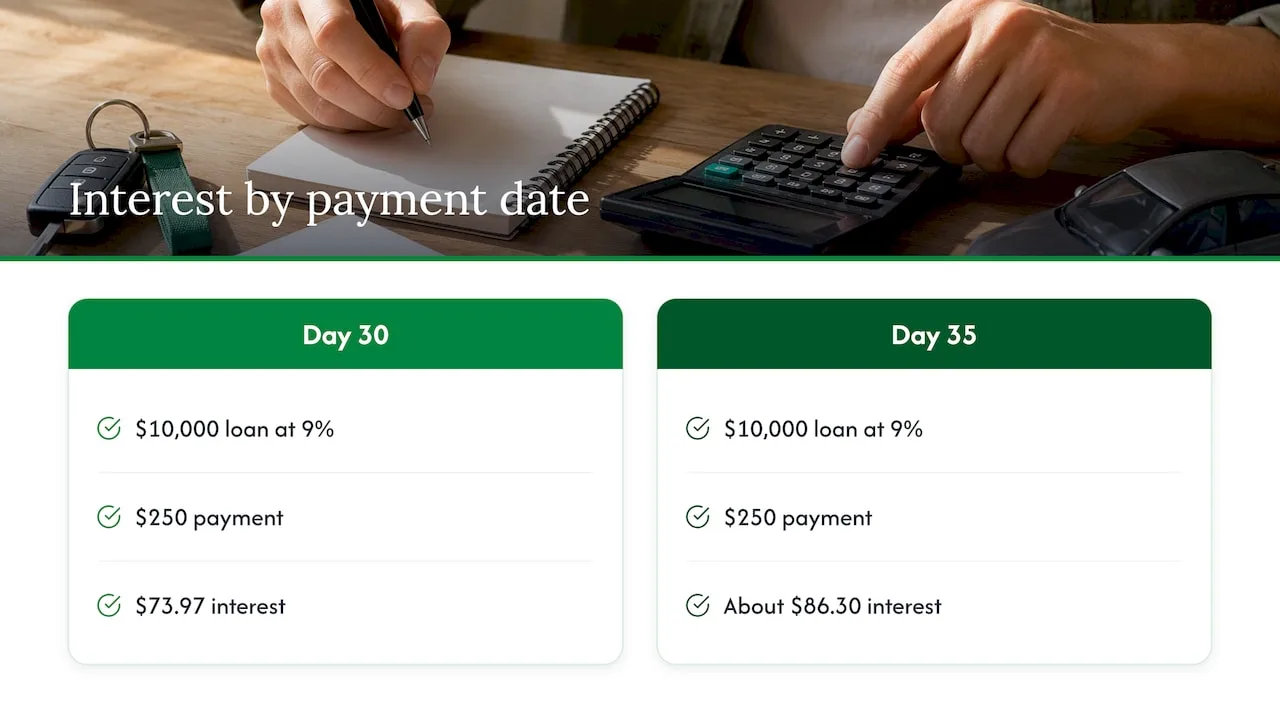
Using the Wells Fargo numbers, here is what that looks like by our own arithmetic. If the $250 payment on the $10,000, 9% loan arrives on day 35 instead of day 30, about $86.30 goes to interest rather than $73.97. That is roughly $12 more interest and $12 less principal from five days. Small once. Over a habit of late payments, it adds up, and the late fee comes on top.
What to do about it
- Set up autopay for a date a few days after payday, and confirm the lender counts the payment on the day it is received.
- If you pay by mail or from a different bank, allow time for it to arrive.
- If you can't pay on time, call the lender before the due date, not after.
- Check your contract for the late fee amount and grace period. The CFPB says a Truth in Lending disclosure must list late fees and whether prepayment is allowed without penalty.
Simple interest vs. precomputed interest
Some buyers search for a "precomputed" car loan after seeing the term in a contract. The CFPB says a precomputed loan calculates the total interest at the start for the whole loan and spreads it across the monthly payments. It is uncommon compared with simple interest. Extra payments generally don't recalculate interest from a smaller principal, though an early payoff may earn a refund or deduction of unearned interest.
Experian makes the same distinction: with precomputed interest, the scheduled interest is fixed at origination, so extra payments don't reduce it the way they can on a simple interest loan.
| Simple interest | Precomputed interest | |
|---|---|---|
| When interest is figured | Daily or monthly, on the current balance | Once, at the start, for the full term |
| Effect of paying early | Fewer days of interest, lower total cost | Interest is already scheduled; payoff may bring a rebate |
| Effect of paying late | More days of interest | Usually a late fee; schedule is fixed |
| How common | Far more common | Uncommon |
| Best for | Borrowers who pay early or add extra | Borrowers who will pay exactly as scheduled |
If you only ever make the minimum payment, the gap is small. Bankrate reports that borrowers who pay only the minimum pay the same total interest under either method, but early repayment generally saves more under simple interest. So simple interest is the safer pick for anyone who might pay ahead.
Paying off early
On a precomputed loan, the Federal Reserve says an early payoff should receive a rebate or deduction for unearned interest. It also explains that how interest is allocated over time can still make an early payoff more expensive than under a balance-based method. Ask the lender how the rebate is calculated, and get that answer in writing.
On a simple interest loan, an early payoff is straightforward: you owe the principal plus interest accrued to the payoff date. We cover the details, including prepayment penalties, in our guide on paying off a car loan early without a penalty.
APR is not the same as the interest method
These are two separate questions. The interest method (simple or precomputed) tells you how interest is calculated. The APR tells you what the credit costs per year. The CFPB's Truth in Lending explainer says the APR is the yearly cost of credit, including interest and mandatory fees, so it is not the same number as the stated interest rate.
That is why two loans with the same "rate" can cost different amounts. Always compare APRs. For a sense of where rates sit right now, see our post on what counts as a good car loan rate.
Compare total cost, not just the payment
The CFPB's auto loan guide says total loan cost is the amount financed plus the finance charge. The amount financed can include the vehicle price, taxes, government fees and optional add-ons, minus your down payment and trade-in.
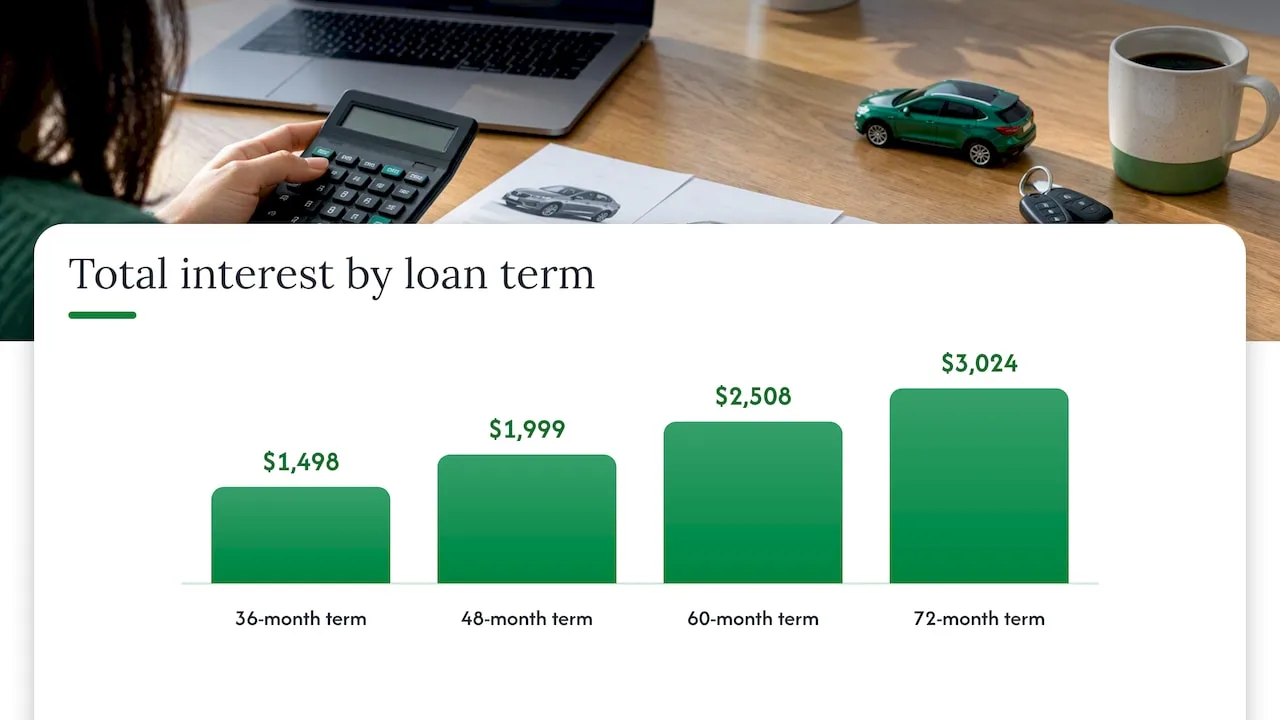
The same guide's sample shows how much the term matters. On a $20,000 loan at 4.75%, total interest is $1,498 over 36 months, $1,999 over 48 months, $2,508 over 60 months and $3,024 over 72 months. A lower payment from a longer term costs more in the end. We break that down further in 60 vs 72 month car loans.
Optional add-ons are worth a second look too, because financing them means paying interest on them. If you're considering something cosmetic like a wrap, find out what a vehicle wrap costs first and decide whether it belongs in the loan at all.
What to check before you sign
- Interest method. Ask, "Is this a simple interest loan?" and get the answer in the contract.
- APR and finance charge. Both appear in the Truth in Lending disclosure. Compare them across offers.
- Amount financed. Look for add-ons you didn't ask for. Our guide to verifying out-the-door costs shows how.
- Total of payments. This is what you will pay if you follow the schedule exactly.
- Prepayment terms. The disclosure should say whether you can pay early without a penalty.
- Late fee and grace period. Know the number before you need it.
- Payment posting. Ask how and when the lender credits a payment.
If one of these answers is vague, walk away or ask again. A lender that is confident in the loan will put the answers on paper.
Our perspective
We are an independent dealer in Clearwater, and the loan paperwork is where we see buyers feel most unsure. A car can be fairly priced and still feel like a bad deal if the financing is a blur.
So we do two things. We show the price on every listing with no hidden fees, and we arrange financing through multiple lenders so you can compare options instead of taking the first one. We also think you should see the numbers before you commit. Run your own estimate with the car payment calculator, then ask any lender, including us, for the APR, finance charge and total of payments in writing.
If you are a first-time buyer, a good habit is to get preapproved before you shop. Our posts on credit union vs. dealer financing and preapproval vs. prequalification explain why. And if you can pay a bit extra each month on a simple interest loan, do it, as long as your contract allows it.
— CL Auto
Financing at Clearwater Largo Automotive
If you are shopping for a used car around Clearwater, Largo or Dunedin, we can walk you through our financing options. A real person answers your questions, we explain how the loan is calculated, and you see every figure before you decide. Not sure what you need yet? Tell us what you want and we'll find the car for you.
What lenders look at also matters. Our rundown of auto loan approval factors can help you prepare.
FAQ
Is a simple interest loan good or bad?
For most borrowers it is good. Interest is charged only on what you still owe, and paying early or paying extra lowers your total cost. The downside is that late payments cost more because interest keeps accruing each day. If you pay on time, it works in your favor.
Can you pay off a simple interest loan early?
Yes, in most cases. You owe the remaining principal plus interest accrued through the payoff date, and you save the interest that would have accrued later. Check your contract for a prepayment penalty, which the Truth in Lending disclosure should address.
What is the difference between APR and simple interest?
Simple interest describes how interest is calculated: on the current balance, daily or monthly. APR is the yearly cost of the loan, including interest and mandatory fees. A loan can be simple interest and still have a high APR, so check both.
Is a car loan simple interest or compound interest?
Most car loans are simple interest, and simple interest is not compounded. Accrued interest isn't added to your principal, so you don't pay interest on interest. Precomputed loans are a separate, less common type, so confirm which one you are signing.
Can I refinance a simple interest auto loan?
Often you can, if the new lender approves you. Compare the new APR and the total of payments against what you would still pay on the current loan, and watch for fees. If you plan to trade or sell the car, see our guide on selling a car with a loan.
Sources
- CFPB: Simple interest vs. precomputed interest on an auto loan
- CFPB: What is a Truth in Lending disclosure for an auto loan?
- CFPB: Take control of your auto loan guide
- Wells Fargo: Auto loans FAQs
- American Financial Services Association: Simple Interest fact sheet
- Experian: What Is Precomputed Interest on a Car Loan?
- Bankrate: What Is A Precomputed Interest Car Loan?
- Federal Reserve: Leasing vs. Buying, early payoff
- NJ Vinyl Wrapz: What a Vehicle Wrap Costs