Highway Miles vs. City Miles: Which Are Better on a Used Car?
Highway miles are usually easier on a used car than city miles. Steady speeds, a warm engine and very little braking add up to less wear per mile. But the odometer can't tell you which kind of miles a car has, and a careless owner can wear out a car on any road. Below, we explain what each type of driving does to a car, how to read a used car's history, and what to check in person before you pay.
TL;DR
- Mile for mile, highway driving is gentler on the engine, transmission, brakes and suspension than stop-and-go city driving.
- A car with 50,000 highway miles can be a better bet than one with 30,000 city miles, but only if the maintenance records back it up.
- Driving style matters as much as road type. Hard acceleration and hard braking wear parts on any road.
- Electric vehicles flip the rule: they tend to be more efficient in the city than on the highway.
- Ask for the service history and a VIN report, then inspect the brakes, tires, suspension and transmission yourself.
Table of Contents
- Why the odometer only tells half the story
- What city driving does to a car
- What highway driving does to a car
- Highway miles vs. city miles side by side
- When highway miles are not the safe bet
- What about fuel economy?
- The electric vehicle exception
- How to tell which kind of miles a used car has
- What to inspect, in order
- Our perspective: ask about the miles, not just the number
- Find the right miles, not just fewer miles
- How this fits the rest of your decision
- FAQ
- Sources
Why the odometer only tells half the story
An odometer counts distance. It doesn't count how many times the engine started cold, how often the brakes were pressed or how many times the transmission shifted. Two cars that both read 60,000 miles can have very different histories.
Think of a sales rep who drives 70 miles each way on the interstate and a delivery driver who covers the same distance in a month of short hops across town. The first car has far more cruising hours and far fewer stops. The second has fewer miles but many more brake applications, gear changes and cold starts.
That's why the question "are highway miles better?" gets a yes with some conditions. Let's look at why, one system at a time.
What city driving does to a car
City driving is a loop of accelerate, brake, wait, repeat. Every one of those steps puts a small load on a part.
- Brakes. Stop signs, red lights and traffic jams mean the pads and rotors work constantly. A car that has spent years in town usually needs brake service sooner than one that mostly cruised.
- Transmission. An automatic shifts through its gears over and over in stop-and-go traffic. On the highway it settles into top gear and stays there. Our guide to CVT maintenance cost covers what that means if the car you're eyeing has that type of transmission.
- Suspension and steering. Potholes, speed bumps, curbs, tight turns and driveways all work the shocks, struts, bushings and tires. Highway pavement is generally smoother and straighter.
- Engine temperature. Short trips often don't let the engine reach full operating temperature. Repeated cold starts and short cycles are harder on an engine than hours of steady running.
- Idle time. Sitting in traffic adds engine hours that the odometer never records.
The Department of Energy's gas-saving guide points to the same driving habits, rapid acceleration and hard braking, as ones that cut fuel economy and add wear. Those habits show up most in traffic.
What highway driving does to a car
On the highway, an engine holds a steady speed and a steady temperature. The transmission stays in one gear for long stretches. The brakes get used a few times per hour instead of a few times per minute. The alternator and battery also benefit, because the battery keeps charging instead of being drained by repeated starts.
The GoodCar guide to city vs. highway miles makes this same argument: with two otherwise identical cars, one at 50,000 highway miles and one at 30,000 city miles, the highway car is often the more reliable pick because it went through fewer mechanical cycles.
Highway driving does have its own costs:
- Tires. Long hours at speed build heat, so tire pressure matters more. NHTSA recommends checking pressure monthly and replacing tires once the tread is down to 2/32 of an inch. On a highway-heavy car, ask how old the tires are, not just how deep the tread is.
- Stone chips and paint. High speed means more rock hits on the hood, bumper and windshield. Look at the front end carefully.
- Fuel use at high speed. This is a running cost, not a wear issue, but it matters to your budget. We cover it below.
- Accident risk. Highway crashes tend to be more serious. A clean VIN report and a look for repaired panels help here.
Highway miles vs. city miles side by side
| What you're checking | Mostly highway | Mostly city |
|---|---|---|
| Brakes | Longer pad and rotor life | Pads and rotors wear faster |
| Transmission | Fewer shifts, less strain | Constant shifting, more heat cycles |
| Suspension | Smoother, fewer impacts | More shock from potholes and curbs |
| Engine | Steady temperature | More cold starts and short trips |
| Tires | Even wear, but heat and age matter | Scrubbing in turns, curb damage |
| Front-end cosmetics | More stone chips | More door dings and bumper scuffs |
| Odometer | Climbs fast | Climbs slowly |
The table shows trends, not guarantees. A well-kept city car can beat a neglected highway car, and the next section explains why.
When highway miles are not the safe bet
Road type is only one input. These situations can flip the usual advice:
- An aggressive driver. The Department of Energy says smooth driving avoids the jack-rabbit starts and hard braking that waste fuel and wear parts, and it estimates that aggressive driving can cut gas mileage by 15% to 30% at highway speeds. A car driven hard on the interstate is not a gentle car.
- Skipped maintenance. Oil changes, transmission fluid and coolant matter more than the type of road. A highway car with no records is a gamble. A city car with every service stamped is a known quantity.
- Towing or heavy loads. Highway miles pulling a trailer are not the easy miles the rule assumes.
- A very high number. At some point the sheer count of miles catches up with any car. Chase's guide to buying a high-mileage car notes that how the miles were driven matters, but it doesn't cancel out age and total use.
- Age and sitting. A car with very low mileage that sat for years can have dried seals, old tires and stale fluids. Low miles aren't always good miles.
In short, a highway car with records beats a city car with records. A highway car with no records is no better than a mystery.
What about fuel economy?
The city/highway split on a window sticker is about fuel economy, not wear, and the two get mixed up. Gas cars usually score better on the highway rating, but highway efficiency isn't a flat number.
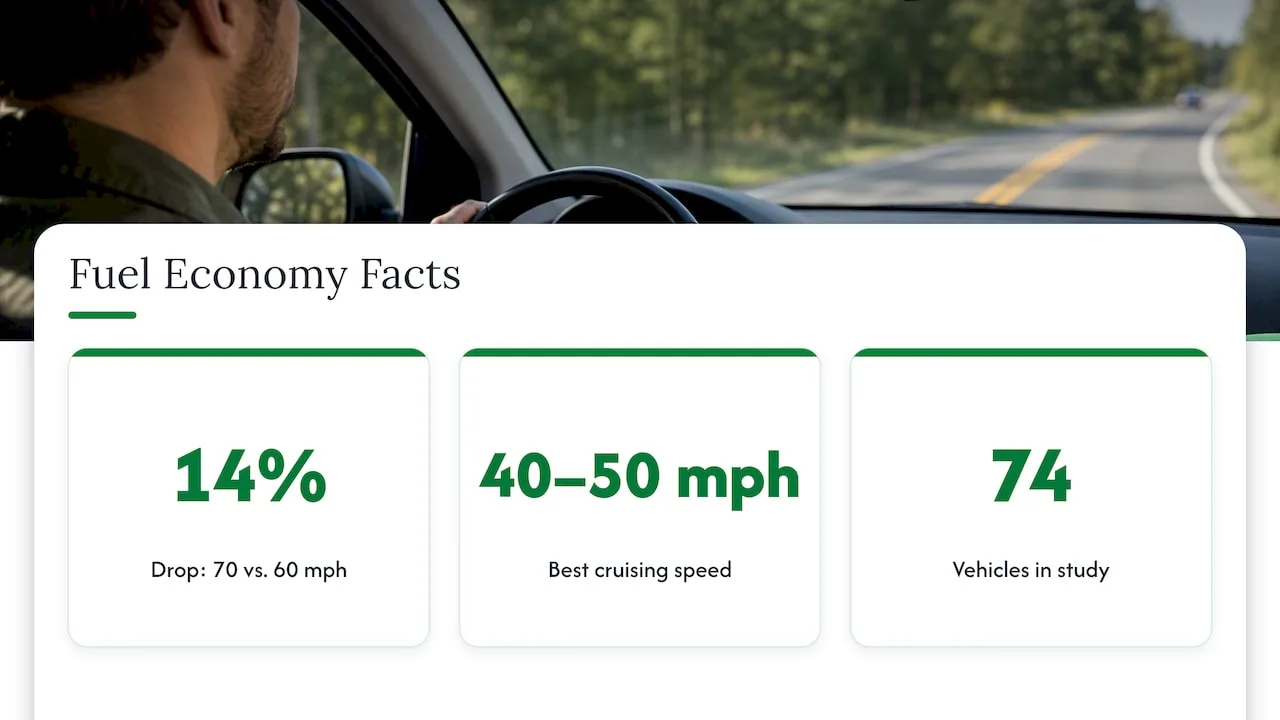
According to the Department of Energy, fuel economy drops about 14% when you go from 60 mph to 70 mph. Its research also puts the best cruising speed for most cars and light trucks between 40 and 50 mph, based on a study of 74 vehicles. In practice, a car that has spent its life doing 80 on the interstate has used more fuel per mile than one that cruised at 65.
This is useful for budgeting. If you'll be commuting on Tampa Bay's highways every day, the number that predicts your gas bill is your cruising speed, not just the sticker rating. We go deeper on running costs in our hybrid vs. gas cost-first comparison.
The electric vehicle exception
If you're shopping for a used EV or a hybrid, the usual rule bends. EVs don't have a multi-gear transmission, and regenerative braking recovers energy when you slow down. Freeway Insurance's driving guide notes that EVs can be more efficient in town than on the highway, where speed and air resistance drain the battery faster.
The EPA reflects this in how it tests them. Its EV label test procedures use separate city and highway driving cycles for range and efficiency. For a used EV, a city-heavy history is not a red flag the way it is on a gas car. The battery's health is the bigger question, so ask for a battery report.
How to tell which kind of miles a used car has
No one number gives you the answer. You build it from clues.
- Ask the previous owner or the seller. Where did they live and work? What was the commute? Our team asks this on every car we take in.
- Do the math on age. Divide the miles by the years. The U.S. average is often quoted as about 12,000 miles a year, but treat that as a loose benchmark. A five-year-old car with 90,000 miles was probably commuted on the highway. A ten-year-old car with 40,000 miles was probably used for short trips.
- Read the VIN report. Look at where it was registered, how many owners it had, and the dates and mileage at each service or inspection. Evenly spaced readings point to steady commuting.
- Read the service records. Brake jobs every two years suggest a lot of braking. Oil changes at regular intervals suggest a careful owner.
- Look at the car. Heavy stone chips across the front suggest highway use. Door dings, curb-rashed wheels and a worn driver's seat bolster suggest a lot of getting in and out.
- Check the pedals. Rubber worn smooth on the brake pedal points to many stops, but compare it to the odometer. Worn pedals on a low-mileage car deserve a question.
Our 9 things to check before you pay lists more of what to look at on the lot.
What to inspect, in order
Whatever the history says, verify it with your eyes and a test drive.
- Brakes. Look at the pad thickness through the wheel spokes if you can. Listen for squeal or grinding. Feel for pulsing in the pedal. Brake wear is the quickest way to spot a hard-working city car.
- Transmission. On the test drive, accelerate gently and firmly. Shifts should be smooth with no flare, slip or clunk. Check the fluid condition if the car has a dipstick.
- Suspension. Drive over a rough patch. Listen for knocks and look for bounce that continues after a bump. Push down on each corner and watch how it settles.
- Tires. Check the date code, the tread depth and whether wear is even. Uneven wear can point to alignment or suspension trouble. The NHTSA's 2/32-inch tread limit is the legal-minimum style marker, but if the tires are close to it, budget for new ones.
- Engine. Start it cold if you can. Watch for smoke, rough idle or warning lights. Check the oil color and level.
- Battery and charging. A slow crank can mean a tired battery, which is common on cars used for lots of short trips.
- Underneath. Around Clearwater, look for rust and corrosion on the underbody, brake lines and suspension parts. Coastal air and humidity are hard on metal, and you can't tell from the odometer.
- Cosmetic condition. Interior wear that doesn't match the mileage is a useful warning. For a look at how daily use shows up on paint and surfaces, see this overview of daily wear on vehicles.
If a seller won't let you take it for an independent inspection, that tells you something too. Walk away.
Our perspective: ask about the miles, not just the number
We're an independent used car dealer in Clearwater, and we've learned that buyers get fixated on one number on the dash. We'd rather you ask better questions.
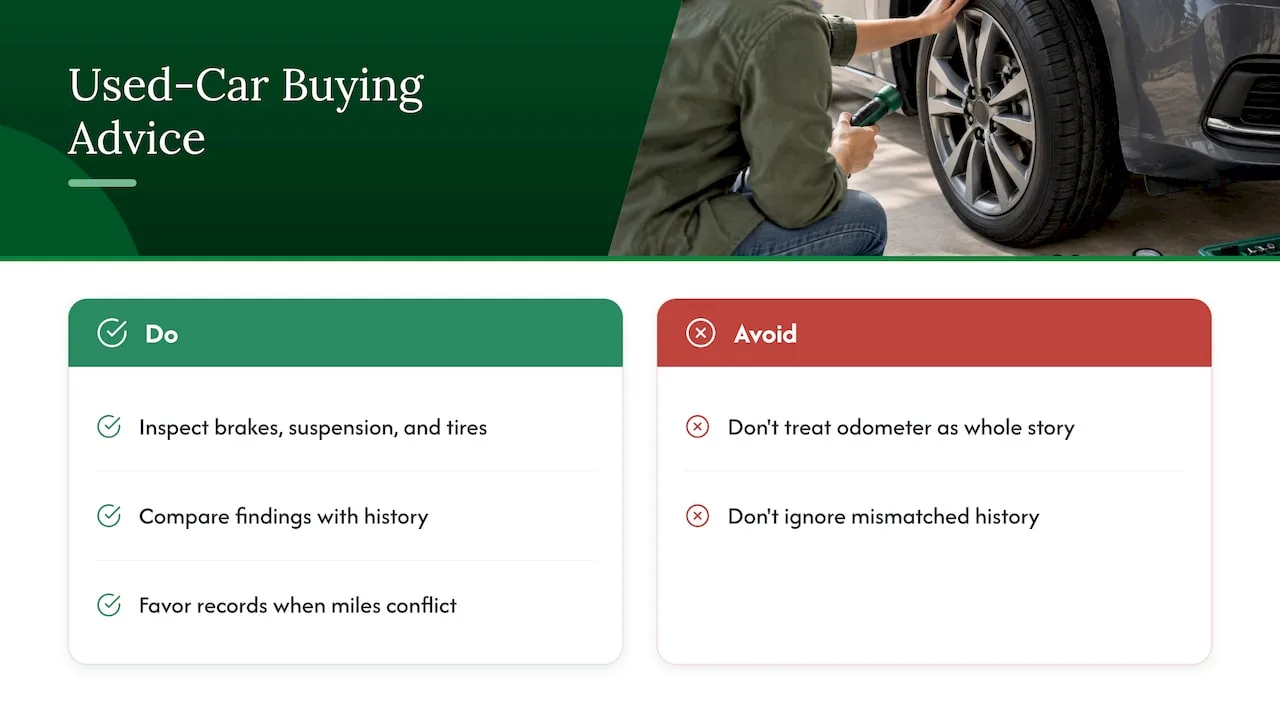
Here's how we think about it. Before we list a car, we inspect it by hand and run a history report. We don't use the odometer as the whole story. We look at the brakes, the suspension and the tires, and we compare what we see to what the car's history says. If the two don't match, we want to know why before it ever reaches the lot.
We also think price should be simple. Every listing shows the price, with no hidden fees, so you can compare a lower-mileage city car and a higher-mileage highway car on the same footing. And when you call or message us, a real person answers, someone who can tell you what we know about that specific car's history.
Our honest advice: if two cars are close in price and condition, lean toward the one with steady highway use and good records. If the highway car has no paperwork and the city car has all of it, the paperwork wins. And if you want help comparing two cars you've found elsewhere, we're glad to talk through it, even if you don't buy from us.
— CL Auto
Find the right miles, not just fewer miles
If you want a car that fits how you'll actually drive, whether that's short hops around Largo or a daily run across the bay, start with our hand-picked used cars. Each one is hand-inspected and comes with a history report.
Can't find what you want? Tell us what you're after on our vehicle sourcing page, and we'll look for a car that matches, so you only see cars that fit. If you're working out a monthly budget first, our car payment calculator is a good place to begin, and our financing page explains the options.
How this fits the rest of your decision
Mileage type is one factor among several. Drivetrain, body style and age all change the picture. If you're still deciding, these may help:
- Our guide to FWD vs. AWD for used car buyers explains where repair costs can climb.
- Our list of the most reliable used cars in Clearwater shows how we vet models.
- If you're on the other side of the deal, read when to sell your car before the miles pile up, or see our we buy cars page.
FAQ
Are highway miles better than city miles?
In most cases, yes. Steady speeds mean fewer shifts, fewer brake applications and a more stable engine temperature. That said, the owner's driving style and maintenance habits matter as much as the road. A highway car with no service records can be a worse buy than a well-kept city car.
Is a car with high highway mileage a good buy?
Often, yes, if the price reflects the mileage and the records are solid. A high-mileage car still has aging parts like belts, hoses, tires and fluids, so budget for maintenance. Have it inspected before you commit.
How can I tell if a used car has mostly city miles?
Compare the mileage to the car's age, since low miles on an older car often mean short trips. Then check the VIN report, the service records and the wear on the brakes, suspension, tires and interior. Worn brake components and door dings on a low-mileage car point to city use.
Is driving at 60 mph more efficient than 70 mph?
Yes. The Department of Energy reports that fuel economy falls about 14% when you move from 60 mph to 70 mph. The exact amount depends on the vehicle, but slowing down is one of the easiest ways to cut fuel costs.
Do electric cars follow the same rule?
No. Electric vehicles are typically more efficient in city driving thanks to regenerative braking, and they lose range at sustained highway speeds. For a used EV, the battery's condition matters more than whether the miles were highway or city.
Sources
- Highway Miles vs. City Miles: What Is Best for Your Car's Health (GoodCar)
- Gas-Saving Tips (U.S. Department of Energy, AFDC)
- Tire Safety Ratings and Awareness (NHTSA)
- New Driver Tips: City vs. Highway Driving (Freeway Insurance)
- EV Test Procedures Overview (U.S. EPA)
- Buying a High-Mileage Car (Chase)