

Most dealer add-ons are optional, overpriced, or both. Nitrogen tire fills, VIN etching, paint and fabric coatings, rustproofing and theft-deterrent packages are the ones we'd say no to first. You can decline any of them, negotiate their price, or buy something similar later for less. The trick is spotting them before you sign, because they often show up at the very end of the visit.
We sell used cars in Clearwater, so we've watched buyers walk in with a good price in mind and get surprised by a contract full of extras. This guide covers what to skip, what to compare first, and what to say.
TL;DR
- Add-ons are optional extras. The CFPB says they are not required and their prices are negotiable.
- The usual ones to skip: nitrogen tire fill, VIN etching, paint sealant, fabric protection, rustproofing, and theft-deterrent packages.
- Ask for the out-the-door price in writing before you visit, then check every line of the contract against it.
- Some products, like GAP coverage or a service contract, can make sense for some buyers. Price them against outside options first.
- If an add-on is on the paperwork and you didn't agree to it, have it removed before you sign.
Table of Contents
- What dealer add-ons are, and why they cost so much
- The add-ons we'd say no to
- Add-ons worth pricing before you say no
- How add-ons end up on your contract
- What to do before you visit
- What to do at the desk
- Our perspective
- Looking for a car without the extras?
- FAQ
- Sources
What dealer add-ons are, and why they cost so much
A dealer add-on is an extra product or service sold on top of the car. The FTC describes them as optional items that cost extra, such as rustproofing, fabric protection, GAP insurance and service contracts, and says you can say no or wait. The CFPB's list is longer: window etching, security items, accessories, extended warranties, tire, dent, paint and fabric protection.
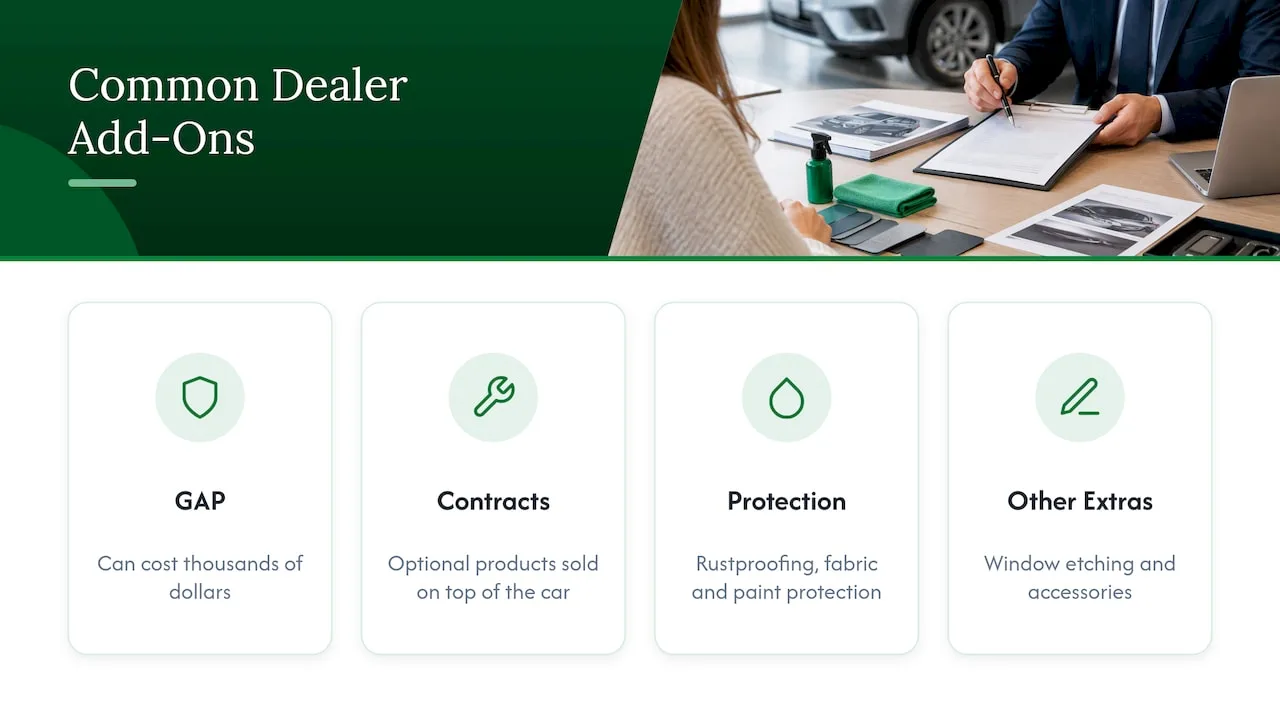
The price is where buyers get hurt. The FTC's used-car guide warns that products like GAP, VIN etching and rustproofing can cost thousands of dollars and may be offered at the end of a long visit or included without your knowledge or approval. An FTC staff report found add-ons were the single greatest area of confusion it saw in its auto-financing research, with costs from hundreds to thousands of dollars.
Pricing is also all over the map. A study by the National Consumer Law Center found that dealers charged widely varying prices for the same add-ons. If two dealers can charge very different amounts for the same product, the price on your contract is a starting point for a conversation, not a fact of life.
The add-ons we'd say no to
These are the products we'd skip or push back on first. Dollar figures come from Consumer Reports' look at dealer extras, and they vary by dealer.
Nitrogen-filled tires. Ordinary air is already mostly nitrogen, and all tires lose pressure over time no matter what is in them. Consumer Reports notes dealers have charged about $400 for nitrogen fills. So, is nitrogen worth it? For a daily driver, no. Check your tire pressure monthly and top off with plain air at any gas station. If a car already has nitrogen in it and the dealer wants to charge you for it, that's a line to question.
VIN etching. This engraves the vehicle identification number on the windows to deter theft and help with recovery. Consumer Reports calls it unnecessary because cars already have VINs stamped in multiple places, and it puts the cost at $200 to $300. AAA gives the same range and suggests calling your insurer to ask whether etching would lower your premium at all. If your insurer won't discount for it, the etching is paying for nothing. Many buyers who still want it can find a DIY kit for a fraction of the dealer price.
Paint sealant and paint protection. Consumer Reports puts dealer paint protection at around $600. Paint on a modern car already has a clear coat, and regular washing and wax do most of the work. If you do want a coating, you can add one after the purchase, from a detailer you choose, at a price you can compare. Mobile paint protection options let you get quotes from local pros instead of accepting the first number.
Fabric and interior protection. This is a spray-on treatment for seats and carpet. The CFPB lists it among the common tire, dent, paint and fabric protection products. A can of fabric guard from an auto parts store does a similar job for the cost of an afternoon. If you have kids or pets, this is the one buyers feel most tempted by. Compare first.
Rustproofing and undercoating. Consumer Reports lists rustproofing at about $800. The FTC specifically names it as an add-on that can run into thousands of dollars. Ask what exactly is applied, who does the work, and whether anything is covered if rust appears. If nobody can answer, don't pay for it. On a used car, a better move is to inspect the underbody yourself or have a mechanic look at it.
Theft-deterrent packages, alarms and trackers. The CFPB names alarms among the optional add-ons that are not required. Many cars already have factory immobilizers and keyless-start security. Before paying for a dealer alarm, ask your insurer whether it changes your rate.
Wheel and tire packages. These cover road hazards, sometimes with curb and cosmetic coverage. Manufacturers sell their own versions, such as Nissan's tire-and-wheel plans. AAA says this protection is usually unnecessary because most cars don't have especially vulnerable low-profile tires and alloy wheels. If you do drive on low-profile tires, read what the plan actually covers and compare it before deciding.
Key replacement plans. Modern keys and remotes are expensive to replace, so the pitch sounds sensible. Manufacturer programs, like Nissan's, cover broken, destroyed or stolen keys and remotes. Still, ask how much a spare key costs and whether your insurance or roadside plan already helps. A spare key bought up front can beat a plan you may never use.
Window tint added to the invoice. Tint isn't a scam, but it shouldn't appear on a bill you never asked for. In its 2024 warning about Coulter Motor Company, the FTC said the dealer allegedly added unwanted theft protection, paint coating, nitrogen tires and tinted windows, and stressed these add-ons were not required.
Credit-related products. The CFPB includes credit-related products on its list of optional extras. If you're offered credit insurance on your loan, treat it like any other add-on: ask for the price, ask who the provider is, and take your time deciding.
Add-ons worth pricing before you say no
Not every extra deserves a flat no. Two deserve a closer look because they can protect real money.
GAP coverage. If you finance most of a car's price, the loan can be larger than what the car is worth for a while. GAP is meant to cover that difference if the car is totaled. The question isn't whether GAP exists, it's what it costs and where you buy it. We wrote a separate guide on how to run your loan numbers before the finance desk, including how to tell whether a big down payment makes it unnecessary.
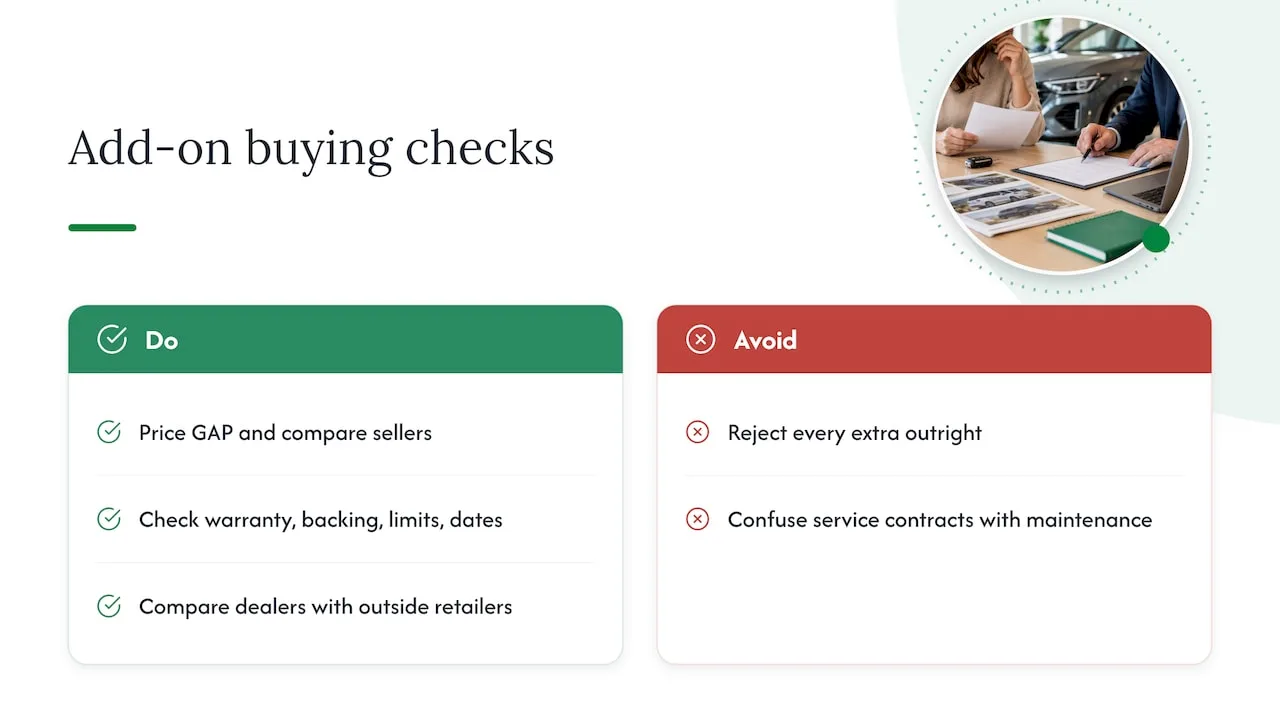
Service contracts and warranties. The Minnesota Attorney General makes a useful distinction: service contracts are different from maintenance packages. Before you buy, check any manufacturer warranty still in effect, who actually backs the contract, what the coverage limits are, and the start and end dates. If you want to see how these stack up against buying a car that's been carefully inspected first, read our comparison of used car warranty providers and hand-inspected cars.
The same Minnesota guidance tells shoppers to compare dealership offerings with cheaper outside retailers. That rule works for everything in this section.
How add-ons end up on your contract
It helps to know the playbook so you recognize it.
The FTC staff report explains that late presentation during financing, quoting by monthly payment, bundled pricing and unclear disclosures can make buyers believe add-ons are free or mandatory. Here's how that looks in practice:
- You're quoted a monthly payment, not a price. An add-on of a few hundred dollars is easy to hide inside a payment that changes by a few dollars a month.
- The add-on is pre-installed, and you're told the car "comes that way."
- You're asked to sign a screen or a stack of pages quickly after a long day.
The CFPB reminds buyers that financed add-ons increase both the monthly payment and the total amount repaid. A $600 coating rolled into a loan costs more than $600 by the time you pay it off. Our guide to simple interest auto loans shows how interest builds on whatever balance you carry.
Enforcement actions show this isn't rare. The FTC said that in the Coulter case, some customers were told they had to buy the products. We also point readers to our breakdown of how U.S. car buyers beat hidden fees after the FTC's warning letters to dealers.
What to do before you visit
Ask for the out-the-door price in writing. The FTC advises requesting written out-the-door prices before visiting a dealer so you can confirm the advertised price and spot add-ons or last-minute charges. Our walkthrough on how to estimate your payment and verify out-the-door costs takes it step by step.
Research the add-ons you might be offered. The FTC says you may find you don't need them, or can get them later for a better price. Decide ahead of time which, if any, you want.
Get financing preapproval. The FTC advises focusing on total cost rather than only the monthly payment, getting the complete amount in writing, and shopping banks and credit unions for preapproval. You can try our car payment calculator to see how an add-on changes the numbers.
Know what's negotiable. Add-on prices are negotiable, and so is the car price. If you're shopping locally, see how to negotiate a used car price in Florida. Fees are part of the conversation too, so read up on dealer doc fees.
What to do at the desk
Read both contracts. The FTC says to read the sales contract and the financing contract, ask for a printed copy, and verify the agreed terms match.
Question every line you don't recognize. Ask what it is, who provides it, what it covers, and what it costs. If the answer is vague, that's your answer.
Say it plainly. "I'm not interested in that. Please take it off." You don't owe an explanation. The FTC's position is that you can have unwanted add-ons removed before signing.
Check for pre-installed items. If an item is already on the car, ask whether it's listed as a separate charge. If it is, ask for a version of the deal without it. Your price, your decision.
Take your time. The CFPB advises considering products rather than deciding under pressure. If you feel rushed, ask to take the paperwork home. A deal that is good on Monday will still be good on Tuesday.
Walk away if needed. If the dealer insists you must buy something optional, that's a sign to leave. There are other cars and other dealers.
Also keep in mind the dealership service department. Not every extra needs to come from the seller. For ordinary maintenance after you buy, see how dealership versus quick lube service compares so you can choose where to spend your money.
Our perspective
We think a used car price should mean the price. When we list a car, the price is on the listing and we say there are no hidden fees. Every car is hand-inspected and comes with a history report before it's listed, so you can judge the car on facts rather than a sales pitch.
That's why we're wary of add-on culture. If a car is worth buying, the price and the inspection should carry it. You shouldn't have to hunt through a contract for a coating or an etching you never asked for.
Every inquiry here is handled by a real person, not a call center. Ask us anything about a car, a fee or a loan. If you want something specific, tell us and we'll look for it, so you only see cars that fit what you asked for.
CL Auto
Looking for a car without the extras?
At Clearwater Largo Automotive, we're an independent used car dealer in Clearwater, FL. We display the price on every listing, and our cars are inspected and come with a history report before they're listed. Browse our hand-picked used cars to see for yourself.
Can't find the right one? Tell us what you want through vehicle sourcing and we'll search for it. If you'd like to see financing options with multiple lenders, start with our financing page. And if you're selling a car, we also buy cars directly from individuals, so see how we buy cars.
FAQ
Are dealer add-ons required?
No. The CFPB says optional add-ons are not required and their prices are negotiable. The FTC has also stressed in its 2024 warnings that the add-ons at issue in those cases were not required. If a salesperson says you must buy one, ask to see that in writing, and be ready to walk away.
Are nitrogen tires worth it?
For most drivers, no. Consumer Reports points out that regular air is mostly nitrogen already, and all tires lose pressure over time. Dealers have charged around $400 for nitrogen fills. Checking your pressure regularly does more for your tires than paying for a different gas.
Is VIN etching worth it?
Usually not. Consumer Reports says it is unnecessary because cars already have VINs in multiple places, and dealer pricing of $200 to $300 is common. AAA suggests calling your insurer to ask if etching lowers your premium. If it doesn't, you can skip it.
Can I get add-ons removed after I've signed?
It's much easier before you sign. The FTC advises checking your contracts and having unwanted add-ons removed before signing. If you spot something afterward, contact the dealer right away with your paperwork, and consider reaching out to your state attorney general's consumer protection office if you don't get a response.
Sources
- Understanding Car Add-ons, FTC
- Servicemembers, arm yourself with basic car buying skills, CFPB
- What things can I negotiate when shopping for a car or auto loan, CFPB
- Buying a Used Car from a Dealer, FTC
- Buying a Used Car From a Dealer, FTC consumer advice
- Buckle Up: Navigating Auto Sales and Financing, FTC staff report
- Did you ask for all those add-ons? FTC consumer alert
- Car dealerships can't charge you for add-ons you don't want, FTC
- Just Say No to These Car Dealership Extras, Consumer Reports
- Are Car Dealer Add-Ons Worth the Cost? AAA
- Car Dealers Sold Add-Ons at Widely Varying Prices, Consumer Reports
- Buying Optional Car Products, Minnesota Attorney General
- Extended Protection Plan, Nissan
- Standard Paint Protection listing
- Quick Lube vs Dealership Differences