Dealer Doc Fees Explained: What You'll Pay and How to Negotiate

A dealer documentation fee, commonly called a doc fee, is a charge the dealership adds to cover the administrative work of processing your purchase paperwork, including title transfer, registration filing, and lender documents. It is legal in every U.S. state, but how much a dealer can charge, and whether you can push back, depends entirely on where you buy.
Here are three things to do right now:
- Check the out-the-door (OTD) price, not just the sticker price. The doc fee, taxes, and registration all stack on top of the sale price, and that final number is what you actually pay.
- Look up your state's cap or disclosure rule before you walk into any dealership. The FTC recommends getting an itemized price and warns buyers to watch for fees that appear only at signing.
- Ask every dealer for a written, itemized OTD quote before you negotiate anything. That single step gives you the clearest comparison between dealers and the most leverage at the table.
Key Takeaways
Dealer doc fees are legal everywhere in the U.S., but capped states, OTD comparison shopping, and written negotiation scripts give buyers real leverage to reduce what they pay.
| Point | Details |
|---|---|
| Doc fees are legal but variable | Fees range from under $200 in capped states to $800-plus in uncapped markets like Florida. |
| OTD price is the only number that matters | Compare out-the-door totals across dealers, not individual line items, to find the real best deal. |
| Taxable fees cost more than they appear | A $599 doc fee at 7% sales tax adds $641 to your OTD total, and raises your financed loan balance. |
| State caps have enforcement teeth | Overcharges above a state cap can be disputed in writing; state licensing boards and the AG's office have issued refunds and fines. |
| Clearwaterlargoauto discloses fees upfront | Every listing shows the price; written OTD quotes with itemized fees are available before you visit. |
Table of Contents
- What do dealer doc fees actually cover?
- How much are doc fees, and how do they change your out-the-door price?
- Which states cap doc fees, and where are buyers most exposed?
- Are doc fees legal, and what disclosure rules protect you?
- How to spot hidden fees in the sales contract before you sign
- Concrete negotiation tactics and sample scripts to reduce doc fees
- If you already signed: how to dispute an improper doc fee
- How Clearwater Largo Automotive handles doc fees
- Real cases where buyers reduced or waived doc fees
- Why fee transparency matters more than you might think
- Clearwaterlargoauto is the transparent alternative for Clearwater buyers
- Sources
What do dealer doc fees actually cover?
Dealers typically describe the documentation fee as covering a bundle of administrative tasks: preparing the title application, submitting registration paperwork to the DMV, completing lender financing documents, storing records in a secure system, and handling state-required compliance forms. On paper, that list sounds reasonable.
The reality is more complicated. The actual staff time and processing cost for those tasks is modest. Consumer finance guides consistently note that the true administrative cost is often well under $50, while the fee charged to buyers can run several hundred dollars. The gap between cost and charge is dealer margin, plain and simple.
Here is how a doc fee typically appears on a purchase contract:
| Line Item | What the Dealer Calls It | What It Actually Covers |
|---|---|---|
| Documentary service charge | "Doc fee" or "processing fee" | Title prep, DMV filing, lender paperwork |
| Records/compliance fee | "Admin fee" or "compliance charge" | Secure document storage, state forms |
| Electronic filing fee | "E-filing" or "DMV submission" | Electronic title/registration submission |
That third line is worth watching. Some dealers break out an "e-filing" charge on top of the doc fee, even though electronic submission is already part of what the doc fee is supposed to cover. If you see both on the same contract, ask the finance manager to explain the difference before you sign.
How much are doc fees, and how do they change your out-the-door price?
Doc fees vary widely. According to OTDCheck's state-by-state tracker, fees in capped states tend to cluster below $200, while uncapped states regularly see fees of $400–$800 or more at franchise dealers. Florida, for example, is an uncapped state where fees above $700 are not unusual at larger dealerships.
| Transaction Type | Typical Doc Fee Range |
|---|---|
| New car, franchise dealer (capped state) | $100–$200 |
| New car, franchise dealer (uncapped state) | $400–$800 |
| Used car, franchise dealer | $200–$700 |
| Used car, independent dealer | $50–$400 |
How a doc fee changes your OTD number — a worked example:
- Sale price: $22,000
- Doc fee: $599
- Taxable subtotal (in states where the doc fee is taxable): $22,599
- Sales tax at 7%: $1,582
- State registration and title fees: $250
- OTD total: $24,431
Without the doc fee, that same car at the same tax rate would cost $23,785 out the door. The $599 fee effectively costs you $641 once tax is applied.
That math matters even more if you finance the car. A higher OTD price means a larger loan balance, which raises your monthly payment and the total interest you pay over the loan term. Use a car payment calculator to see exactly how a doc fee shifts your monthly number before you agree to anything.
Which states cap doc fees, and where are buyers most exposed?
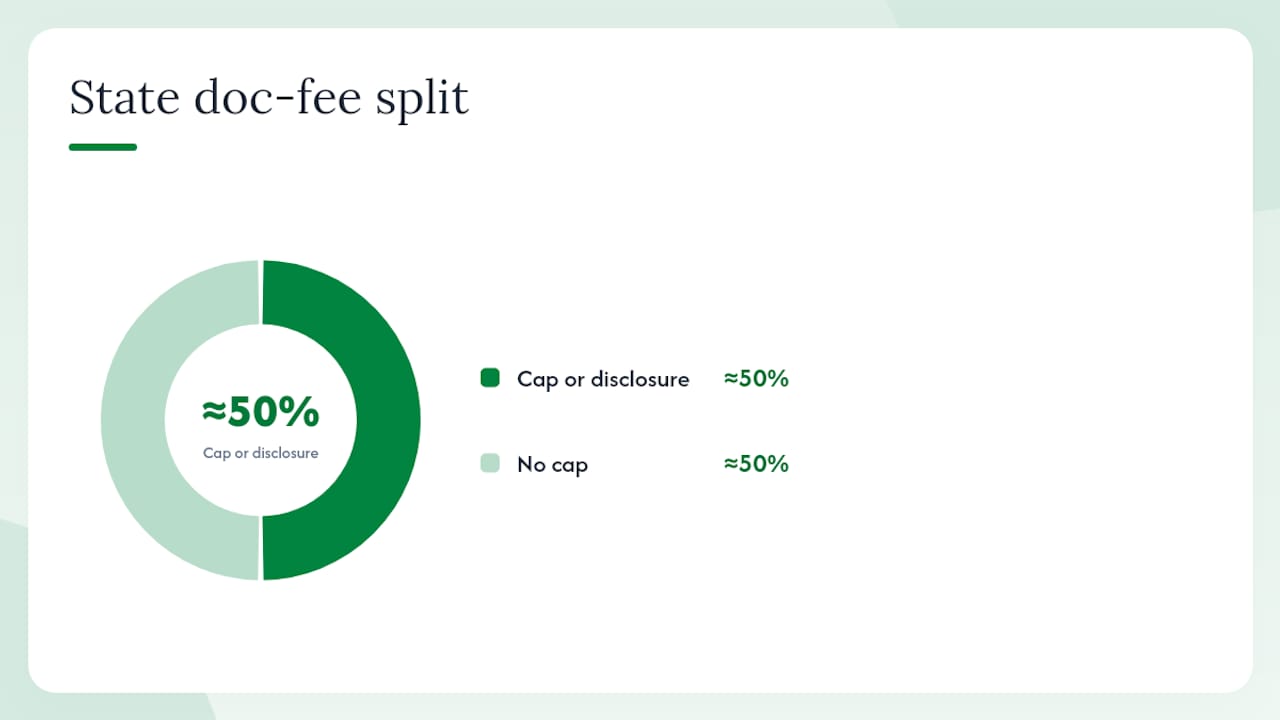
Roughly half of U.S. states impose a cap or formal disclosure requirement on doc fees; the rest leave the amount entirely up to the dealer. Ohio's dealer licensing page is one of the clearest examples of state-level administrative guidance, spelling out how dealers must present and calculate the documentary service charge.
Here is a representative look at how different states handle the fee:
| State | Cap or Rule | Official Source |
|---|---|---|
| California | Capped (check current limit with CA DMV) | California DMV fee calculator |
| Ohio | Capped; dealer must itemize and follow state formula | Ohio Dealer Licensing |
| New Jersey | Fee schedule published by MVC | NJ MVC vehicle fees |
| Florida | No state cap; fees set by individual dealers | FL HSMV official fees |
| Georgia | No state cap | Verify with GA DOR |
| Pennsylvania | No state cap | Verify with PA DMV |
| Illinois | Capped by state law | Verify with IL SOS |
| Texas | No state cap; disclosure required | Verify with TX DMV |
A few things stand out in that table. California and Ohio both cap the fee, which means a dealer charging above the legal limit is in violation of state rules, not just being aggressive. Florida and Georgia have no cap at all, so the fee is whatever the dealer decides to charge. In those states, your only protection is comparison shopping and negotiation.
Pro Tip: State caps change. Before you buy, confirm the current cap directly with your state's DMV or dealer licensing board rather than relying on a third-party guide, including this one.
Are doc fees legal, and what disclosure rules protect you?
Doc fees are legal in all 50 states. No federal law prohibits them, and no state has banned them outright. What varies is how much dealers can charge and how they must disclose the fee to buyers.
Here are the disclosure rules you should expect at any reputable dealership:
- Itemized contract. The doc fee must appear as a separate, named line item on your purchase agreement. A dealer who buries it inside a lump-sum "dealer charges" line is not following standard practice and may be violating state advertising rules.
- Advertised price consistency. If a dealer advertises a vehicle at a specific price, most states require that the doc fee either be included in that price or disclosed clearly alongside it. A price that looks great online but jumps $600 at the desk is a red flag.
- Pre-signing disclosure. The FTC's guidance on buying a car specifically recommends that buyers request a full itemized price before signing anything, and warns that fees added late in the process are a common deceptive practice.
Watch for these specific patterns that signal a problem:
- A "dealer prep" or "lot fee" charge that duplicates what the doc fee is supposed to cover.
- A "processing" or "handling" fee listed separately from the doc fee with no explanation of what it covers differently.
- A doc fee that appears for the first time in the finance office, after you have already verbally agreed to a price.
How to spot hidden fees in the sales contract before you sign
Before you put pen to paper, go through the contract line by line. Here is what to check:
- OTD total. Confirm the final number matches what you discussed. If it is higher, ask for an explanation of every new line.
- Doc fee line. It should be named clearly and match the amount the dealer quoted you earlier in the process.
- Destination charge (new cars only). This is a manufacturer fee, not a dealer fee, and it should not appear on a used car contract.
- Add-on products. Look for paint protection, fabric guard, tire-and-wheel coverage, or GAP insurance. These are optional. You did not agree to them unless you specifically said yes.
- Finance charges. Check the APR and loan term against what you were quoted. A small rate change on a five-year loan adds up fast.
- Taxes and government fees. These are non-negotiable. Registration, title, and sales tax are set by the state and county, not the dealer.
Red-flag phrasing to watch for: "dealer prep," "market adjustment," "handling fee," or any line that uses vague language without a dollar amount already filled in. If a line is blank or says "TBD," do not sign until it is completed.
Pro Tip: Always compare OTD totals between dealers, not individual line items. A dealer with a lower doc fee but a higher sale price may cost you more overall. The only number that matters is what you actually pay to drive the car home.
For a broader checklist on what to verify before buying locally, the used car buying guide from Clearwaterlargoauto walks through nine things to check before you pay.
Concrete negotiation tactics and sample scripts to reduce doc fees
MotorTrend's analysis of doc fees makes the point clearly: the fee is legitimate, but it frequently contains significant dealer margin. That margin is your negotiating room.
Follow these steps in order:
- Research your state's cap or typical range before you contact any dealer. If the fee exceeds the cap, you have a legal argument. If it is simply high for your market, you have a market argument.
- Get itemized OTD quotes from at least two dealers for the same or comparable vehicle. This gives you a real comparison and signals to each dealer that you are shopping.
- Open every negotiation on the OTD price, not the doc fee. Dealers are more flexible on the sale price than on a fee they apply uniformly. Asking for a lower OTD total sidesteps the "we can't waive the doc fee" response.
- Offer a trade-off. If the dealer won't move on the OTD, ask them to reduce the sale price by the amount of the doc fee. The result is the same for you.
Phone or email script to request an itemized OTD quote
That last sentence is important. It signals that you are a serious buyer who is also shopping elsewhere, which motivates the dealer to give you their best number upfront.
In-person script to ask for a doc fee reduction or sale-price offset
Pro Tip: In states where the doc fee is taxable, reducing the sale price by the fee amount saves you more than waiving the fee would. A $500 fee waiver saves you exactly $500. Always ask for the sale-price reduction first.
If you already signed: how to dispute an improper doc fee
Discovering a problem after signing is frustrating, but you have options. Move through these steps in order:
- Gather your paperwork. Pull the purchase agreement, any written quotes you received, and any advertising or email correspondence showing the price you were quoted.
- Request an itemized bill. Ask the dealership's finance manager to provide a written breakdown of every charge. Compare it against your state's cap or the amount you were quoted.
- Contact the dealer's general manager. Most billing errors and overcharges are resolved at this level without escalation. Be specific: cite the dollar amount, the state cap if one applies, and the discrepancy.
- Escalate if needed. If the dealer does not respond or refuses to correct the error, contact your state's DMV or dealer licensing board, your state attorney general's consumer protection office, and the FTC's consumer complaint portal at reportfraud.ftc.gov.
Realistic expectations: state licensing boards can investigate and sanction dealers, but refunds through that channel take time. Small claims court is often faster for amounts under $1,000–$2,500 (limits vary by state).
Here is template language you can adapt for a written complaint or small-claims demand:
I purchased a [year/make/model] from [Dealership Name] on [date]. The purchase agreement includes a documentation fee of $[amount charged]. Under [State] law, the maximum allowable documentary service charge is $[cap amount]. I am requesting a refund of $[overcharge amount] within 14 days. If I do not receive a response, I will file a complaint with [State] DMV/dealer licensing board and pursue the matter in small claims court.
How Clearwater Largo Automotive handles doc fees
At Clearwaterlargoauto, we post the price on every listing, and we tell you what the doc fee is before you ever set foot in the dealership. No surprises in the finance office.
Here is what our process looks like in practice:
- Disclosed fee on every listing. The price you see on our inventory page is the sale price. We tell you the doc fee separately and in writing before you come in.
- Itemized OTD quotes on request. Ask us for a written OTD quote and we will send you a breakdown of every charge: sale price, doc fee, taxes, registration, and any optional add-ons you choose.
- Pre-listing inspections and vehicle history reports. Every car we sell goes through a thorough inspection before it hits our lot. The vehicle history report is available to you before you buy.
- A real person answers every inquiry. You will not reach a call center or an automated system when you contact us. Every question gets a direct, honest answer.
- Vehicle sourcing on request. If you do not see what you want in our current inventory, we can source a specific vehicle for you with the same transparent-fee approach.
We are located in Clearwater, FL. Reach us directly through the contact page on our website or by calling the number listed on our homepage.
Real cases where buyers reduced or waived doc fees
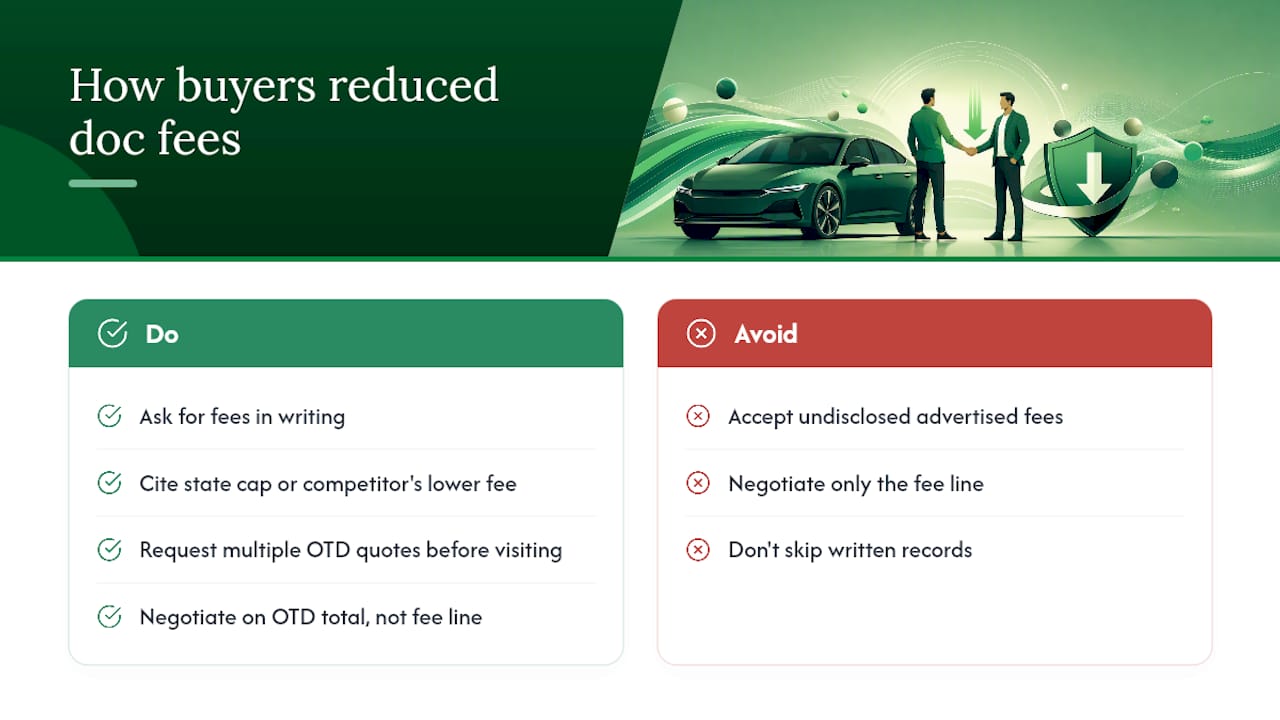
Documented consumer complaints and forum reports show a consistent pattern: buyers who ask in writing, cite a specific state cap or a competing dealer's lower fee, and negotiate on OTD price rather than the line item are the ones who see results.
The Consumer Financial Protection Bureau's complaint database includes cases where buyers reported being charged doc fees above their state's legal cap. In several of those cases, dealers issued partial refunds after the buyer cited the cap in writing and copied the state licensing board on the correspondence. The refunds were not large, but they were real, and they came from a single letter.
State attorney general offices in California and Illinois have both taken enforcement actions against dealers who charged fees above the state cap or failed to disclose the fee in advertised prices. Those actions resulted in dealer fines and, in some cases, consumer restitution. The practical lesson: state caps have teeth when buyers report violations.
On the negotiation side, buyers who request OTD quotes from multiple dealers before visiting any of them consistently report that dealers will lower the sale price to match a competitor's lower OTD total, even when the doc fee itself stays fixed. The fee line does not move; the sale price does. That is the same outcome, and it is the more common path to savings.
Why fee transparency matters more than you might think
Most buyers focus on the monthly payment or the sticker price. The doc fee feels like a small line item by comparison, and dealers know that. A $600 fee spread across a 60-month loan adds only about $10 to your monthly payment, which is easy to overlook in the moment.
But that framing misses the bigger picture. A dealer who is willing to add $600 in margin through a doc fee is also likely to add margin elsewhere: in the trade-in offer, the financing rate, or the add-on products. Transparency on the doc fee is a signal about how the dealer operates across the whole transaction. When a dealer discloses the fee clearly and early, it usually means the rest of the deal is handled the same way. When the fee appears for the first time in the finance office, treat that as a signal about everything else on the contract.
The buyers who get the best deals are not the ones who negotiate the hardest on a single line item. They are the ones who compare OTD totals, ask questions early, and walk away from dealers who are not straight with them from the start.
Clearwaterlargoauto is the transparent alternative for Clearwater buyers
Tired of finding fees you never agreed to buried in the contract? Clearwaterlargoauto lists every vehicle with the price shown upfront, discloses the doc fee before you visit, and provides a written OTD quote on request. No vague "dealer prep" lines, no last-minute surprises in the finance office.
Every car on our lot has been inspected and comes with a vehicle history report you can review before you buy. If you need financing, our in-house financing options connect you with multiple lenders so you can compare rates without pressure. And if you do not see the right car in our current inventory, we will source it for you with the same upfront fee structure.
Browse our current inventory or visit Clearwaterlargoauto to request a written OTD quote today.
Sources
- Understanding Dealer Documentation Fees and What's Negotiable | Capital One Auto Navigator
- Vehicle registration fee calculator | California DMV
- Dealer Doc Fee by State 2026: Free Calculator + Negotiation Scripts (All 51 Caps)
This article is general information, not a substitute for advice from a qualified financial advisor. Consult a qualified financial professional about your own circumstances before acting on anything here.