
The right engine depends on how much you tow and how many miles you drive each year. Diesel trucks pull more and use less fuel per mile, but they cost thousands more to buy. Gas trucks cost less up front and are simpler to keep running. If you tow heavy trailers often or rack up big mileage, diesel can earn its premium. For most daily drivers, weekend haulers and first-time truck buyers, a well-inspected gas truck is the smarter buy. Below we walk through the numbers, so you can decide before you walk onto a lot.
TL;DR
- Diesel adds roughly $8,000 to $11,000 to a new pickup's price, and more on heavy-duty models.
- Diesel trucks tow more and get better mpg, but fuel and maintenance cost more, so the payback usually takes 100,000 miles or more.
- If you tow under about 15,000 pounds or drive mostly around town, gas is usually the better fit.
- Used diesels hold their value well, which also means you pay more for them on the used lot.
- Tell us what you tow and how far you drive, and we will find the truck that matches.
Table of Contents
- The real differences, in plain terms
- What diesel adds to the sticker price
- Fuel economy: better mpg, pricier fuel
- Towing and payload: where diesel earns its keep
- Maintenance and repair costs
- Resale value and which lasts longer
- How to choose: five questions
- Find the right truck without the guesswork
- FAQ
- Sources
The real differences, in plain terms
A gas engine ignites a fuel and air mixture with a spark plug. A diesel squeezes air so tightly that the fuel ignites on its own. The result is an engine that makes much more torque (the twisting force that gets a heavy load moving) at low RPM. That is why diesels feel effortless with a trailer on the hitch.
The tradeoffs show up in four places:
- Purchase price. Diesel is a pricey option.
- Fuel. Diesel gets better mpg, but the fuel costs more per gallon.
- Towing and payload. Diesel tows more but often carries less in the bed.
- Upkeep. Diesel has more systems to maintain, including emissions equipment.
The sections below take each one in turn.
What diesel adds to the sticker price
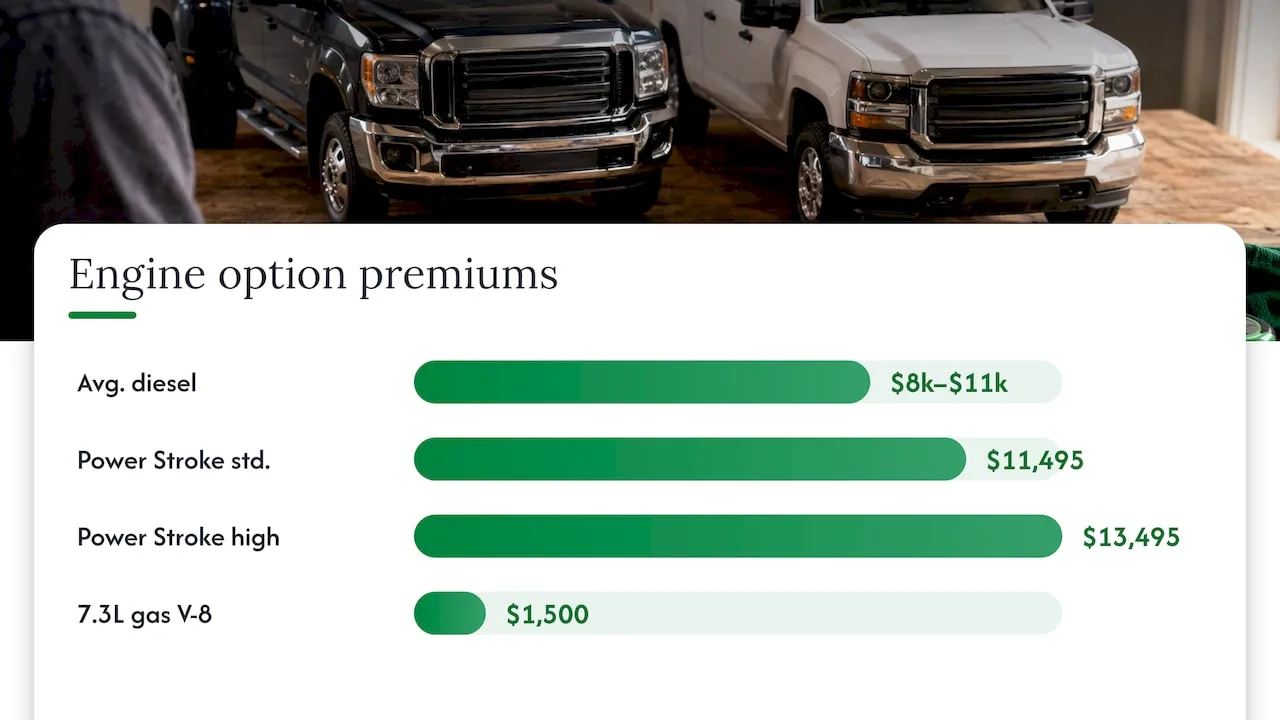
Jalopnik, citing Cox Automotive data, reported that the average new pickup cost nearly $60,000 in early 2025, and a diesel added $8,000 to $11,000 on top of a gas truck.
On heavy-duty trucks the gap can be wider. Car and Driver reports that the 6.7L Power Stroke diesel adds $11,495 (standard output) or $13,495 (high output) to a Ford F-250 Lariat compared with the base gas engine. The 7.3L gas V-8 costs just $1,500 over the 6.8L. Gas Super Duty trucks carry a 60,000-mile warranty, versus 100,000 miles for the diesels.
That is the reason many budget-minded shoppers look at used. You skip the steepest depreciation, and the premium you pay for an engine option is smaller in dollars. If you want to see how the cost side adds up beyond the sticker, our guide to total cost of ownership shows the math step by step.
Fuel economy: better mpg, pricier fuel
Diesel does go farther on a gallon. The U.S. Department of Energy figure cited by Jalopnik says diesel vehicles can travel 20% to 35% further per gallon. In Car and Driver's 75-mph highway test of 22 heavy-duty pickups (April 2024), diesels averaged 18 mpg and gas models 15 mpg, which is 20% better.
The catch is that diesel fuel usually costs more per gallon, which narrows the savings. In The Fast Lane Truck's April 2026 Denver loop test, a gas Silverado HD returned 16.1 mpg and cost $31.42 for the trip, with 87-octane at $4.18 a gallon. The 6.6L Duramax diesel returned 20.9 mpg and cost $28.92, with ultra-low-sulfur diesel at $4.99. That is $2.50 cheaper per trip. Against a $9,500 diesel option, the test put the fuel-only payback at roughly 460,000 miles. Pump prices move weekly, so treat those as a snapshot of that month, not a forecast.
AutoZone puts the typical highway advantage at 10% to 15% and says recouping the purchase premium usually takes 100,000 miles or more. High-mileage drivers and fleets are the ones who tend to come out ahead.
A quick way to run your own numbers: divide the price premium by your yearly fuel savings. If a diesel saves you a few hundred dollars a year, a $9,000 premium is a very long wait.
Towing and payload: where diesel earns its keep
Towing is the strongest case for diesel. DrivingLine compared GM and Ram heavy-duty trucks:
| Truck | Gas max tow | Diesel max tow |
|---|---|---|
| Silverado HD | 14,500 lbs | 18,500 lbs |
| Ram | 17,540 lbs | 19,980 lbs |
The Duramax diesel makes 445 hp and 910 lb-ft of torque, against 401 hp and 464 lb-ft for the gas engine. The same report notes that the Ram diesel has less payload (3,160 lbs versus 4,010 lbs) because the engine is heavier. Payload is what you can carry in the bed and cab, so a diesel that tows more can haul less gear and fewer passengers.
At the top end the gap grows. TrailerPlace lists the 2026 Ram 3500 Cummins at up to 37,100 lbs and the Ford F-350 Power Stroke near 40,000 lbs, while gas versions typically cap around 15,000 to 22,000 lbs. It also lists diesel 3/4- and 1-ton trucks at 15 to 18 mpg empty and 10 to 13 mpg towing heavy loads, versus 7 to 10 mpg for gas under the same conditions.
A simple rule of thumb comes out of this. If your trailer is a fifth wheel or a loaded equipment hauler pushing past 15,000 pounds, diesel is the natural match. If you tow a boat, a small camper or a utility trailer, a gas truck with the right tow package handles it. Our F-150 vs. Silverado comparison shows how much towing capacity half-ton trucks really offer, which is plenty for most Florida boat owners.

If you are weighing Super Duty engines specifically, this look at Ford F-250 engine options compares gas and diesel pricing, warranties and operating costs.
Maintenance and repair costs
Gas engines are the simpler machine. Diesels add a turbocharger, a high-pressure fuel system and an emissions system that uses diesel exhaust fluid (DEF, a urea solution you top off like washer fluid) and a particulate filter.
Government Fleet reports that fleet managers see diesel vehicles lose 2.5 to 4.5 more days a year to downtime than gas ones. Managers cite parts availability, a shortage of qualified technicians, emissions-system upkeep, turbocharger maintenance and higher hard-parts costs.
Three habits protect any diesel you buy:
- Ask for the service records. Fuel filters, oil changes and emissions-system work should be documented.
- Look at how it was driven. Long highway runs are easier on a diesel than short stop-and-go trips, which is why a work truck with a steady commute history is a good sign.
- Fuel it carefully. Put diesel in a diesel and gas in a gas truck, and double-check at the pump.
A gas truck asks less of you. Oil, plugs, filters and fluids at the intervals in the owner's manual cover most of it.
Resale value and which lasts longer
Diesel engines have a reputation for long life, and the used market prices that in. A CarBuzz report (2026) shows diesels at around 150,000 miles listing for thousands more than gas twins:
| Truck | Diesel | Gas |
|---|---|---|
| 2015 Ram 2500 SLT 4WD | $27,550 | $18,070 |
| 2011 F-250 | $14,860 | $10,175 |
| 2011 Silverado 2500 4WD | $15,600 | $11,180 |
A 2016 F-250 diesel retained 51% of its value after 10 years versus 49% for gas, still commanding a $5,900 premium.
An older University of Michigan study found that 11 of 12 diesel vehicles held value better than comparable gas models over three years. Most three- and five-year ownership savings fell between $2,000 and $6,000.
But a high resale price is not the same as a good deal for you. Government Fleet points out that a $7,800 diesel premium paid today, at a 3% cost of money, equals more than $9,500 in future value the resale premium has to cover. And in the used market the same strength works against a budget: you pay that premium up front on a used diesel too.
For a shopper with a fixed budget, a gas truck of the same age and mileage leaves several thousand dollars for a cleaner example, a better trim or a safety cushion for repairs.
How to choose: five questions
- What is the heaviest thing you tow, and how often? Over 15,000 pounds on a regular basis points to diesel. Under that, gas is enough.
- How many miles will you drive each year? The payback on diesel runs from 100,000 miles up, and some tests put it much higher.
- Is most of your driving short trips? Around-town driving suits gas. Long highway miles suit diesel.
- What is your real budget? Count the purchase price, fuel, insurance and a repair buffer, not just the monthly payment.
- Do you know the truck's history? Whatever engine you pick, ask for the vehicle history report and the inspection results before you sign.
If most of your answers land on the gas side, you will save money and keep ownership simple. If they land on the diesel side, you have a clear reason to pay for it.
We handle truck questions from first-time buyers every week, and the pattern is consistent. Most people ask about diesel because of towing numbers they have seen online, then find that their real trailer is well within what a gas truck pulls.
Our approach is to start with your use, not the engine. Tell us what you tow, how far you drive and what you want to spend. Every vehicle we list is hand-inspected and comes with a history report before it goes online, and the price on the listing is the price, with no hidden fees.
When the truck you want is not on the lot, you do not have to scroll through listings that miss the mark. Our vehicle sourcing means we look for the specific truck you described, and you only see the ones that fit. A real person answers every inquiry, so you can ask the awkward questions about mileage, service history and towing before you visit.
CL Auto
Find the right truck without the guesswork
If you have decided between gas and diesel, or you want a second opinion, start with what we have in stock on our used cars in Clearwater, FL page. Every listing shows its price, and each vehicle is inspected by hand with a history report before it is listed.

Don't see the engine, cab or towing setup you want? Use our vehicle sourcing service and tell us the specs. We look for it and you see only matches. If you need to spread out the cost, our financing page covers the options we arrange with multiple lenders. And if you are trading up, we also buy cars directly from individuals.
FAQ
Do diesel or gas trucks last longer?
Diesel engines have a reputation for high-mileage durability, and an Automotive Fleet report on auction data found that diesel resale values hold up better as mileage climbs. Longevity for either type depends heavily on maintenance, so service records and a history report matter more than the fuel type.
Is a diesel pickup worth the extra money?
It is when you tow heavy loads often or drive high mileage. AutoZone says recouping the premium usually takes 100,000 miles or more. For lighter use, the same money is better spent on a cleaner, lower-mileage gas truck.
How much can a gas truck tow compared with a diesel?
On heavy-duty models, DrivingLine lists the Silverado HD at 14,500 pounds with gas versus 18,500 with diesel, and the Ram at 17,540 versus 19,980. Half-ton gas trucks handle most boats and mid-size campers. Always check the specific truck's tow rating and payload before you buy.
Are diesel trucks more expensive to maintain?
Generally yes. Fleet managers cited turbocharger upkeep, emissions-system service and higher parts costs in a Government Fleet report. A gas truck has fewer systems to service, which keeps routine costs lower.
Can you help me find a specific truck?
Yes. Tell us the engine, cab style, budget and towing needs through our vehicle sourcing page, and a real person will follow up.
Sources
Car and Driver: heavy-duty pickup highway fuel economy test
Car and Driver: 2026 Ford F-250 7.3-liter V-8
Jalopnik: diesel vs. gas for towing
The Fast Lane Truck: Silverado HD gas vs. diesel test
AutoZone: choosing diesel vs. gas engines
DrivingLine: gas versus diesel trucks
TrailerPlace: diesel vs. gas truck for towing
Government Fleet: gas vs. diesel
CarBuzz: used diesel truck values
University of Michigan: total cost of ownership, gas vs. diesel
Automotive Fleet: diesel truck residual values
Ford F-250 Super Duty engine guide