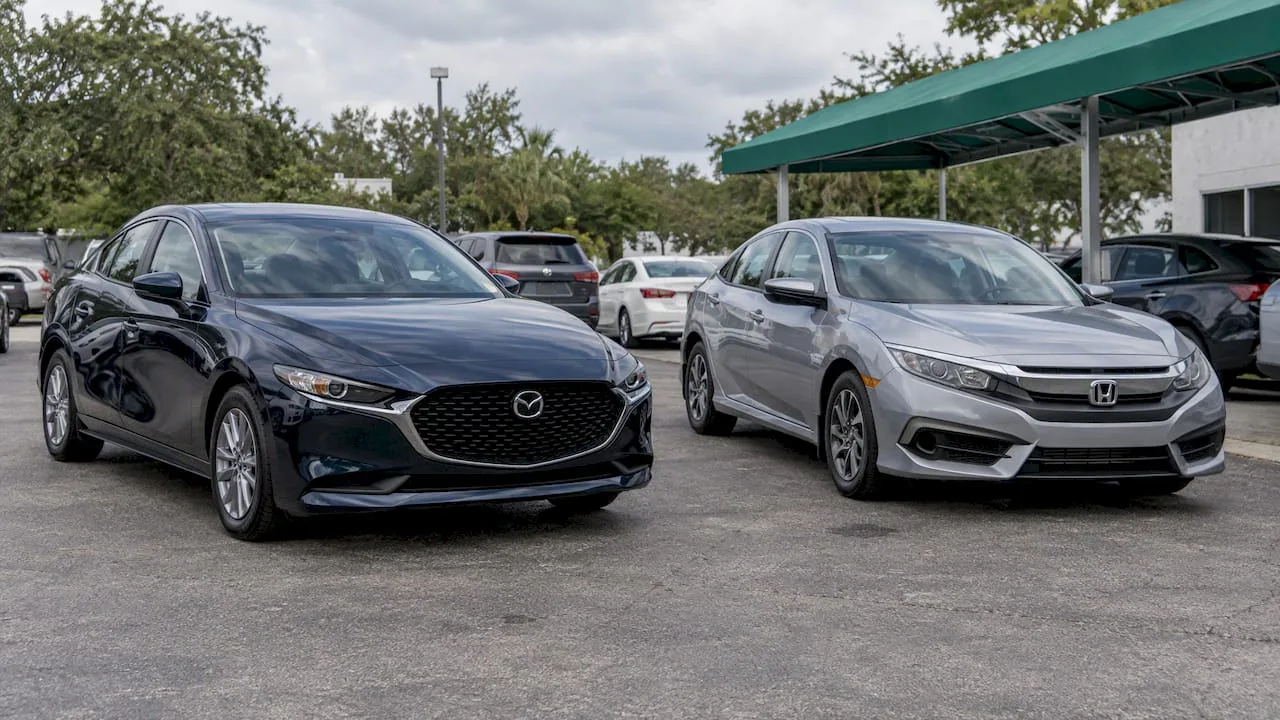
Mazda3 vs Civic: Five Buyer Profiles Point to the Better Fit
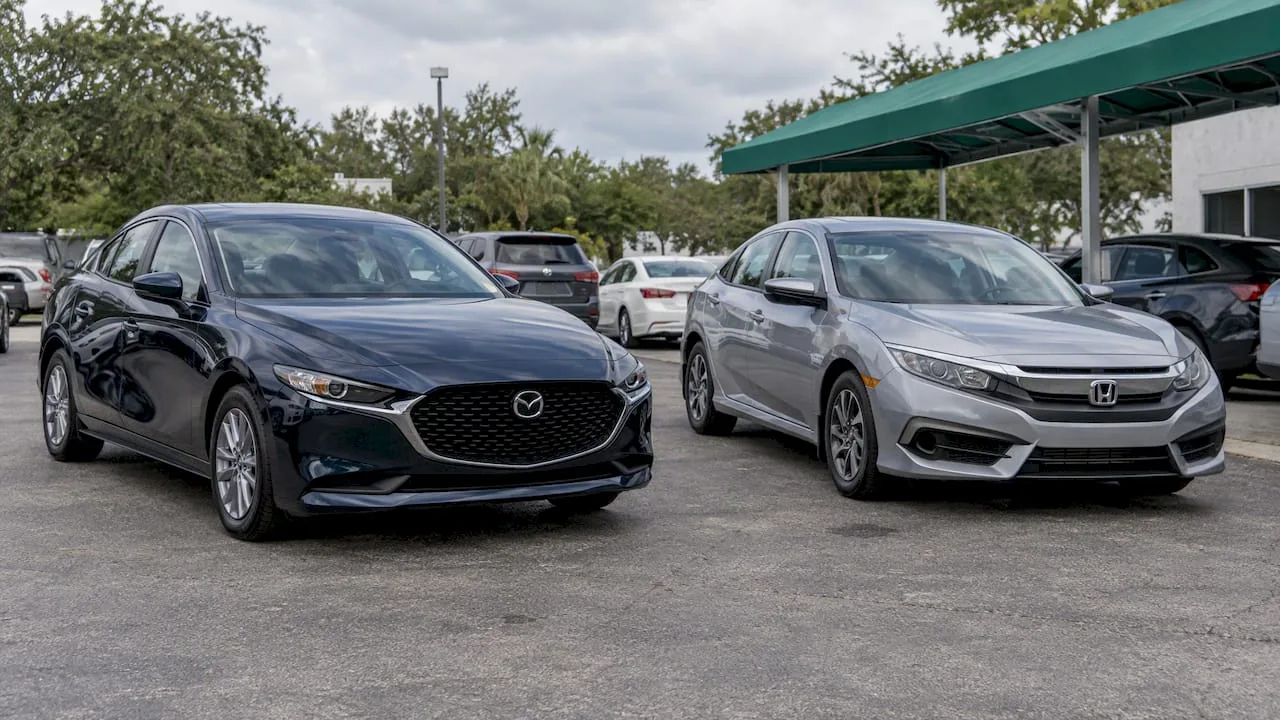
The Honda Civic is generally the better pick for buyers who prioritize fuel economy, passenger space, and resale value, while the Mazda3 is the better pick for drivers who want a richer cabin, sharper handling, and the option of all-wheel drive. Trim choice changes the math: a turbocharged Mazda3 or a hybrid Civic can shift which car makes more sense for your budget and driving style.
TL;DR:
- 2026 Civic hybrid trims reach roughly 48 to 50 mpg combined, while AWD and turbocharged Mazda3 versions trade fuel economy for traction or quicker acceleration.
- The Civic generally offers more rear seat and cargo space, while the Mazda3 has richer cabin materials and a rotary dial that takes practice.
- Used buyers should compare age, mileage, trim, accident history, service records, and remaining factory coverage, then obtain a written inspection report before negotiating.
- Civic resale value historically remains stronger, but AWD or turbo Mazda3 models may retain value better than base trims and can cost more to maintain.
Table of Contents
- Mazda3 vs Civic at a glance
- Price, trim ranges, and what you'll pay new or used
- Performance, handling, and what it feels like to drive each one
- Fuel economy and what it costs you at the pump
- Interior space, cargo room, and daily comfort
- Safety ratings and what that means for long-term reliability
- Ownership costs: insurance, maintenance, and resale value
- Which should you buy: five buyer profiles
- How we help buyers choose between similar compact cars
- What actually matters when you're choosing between these two
- Making the switch to a Mazda3 or Civic easier
- FAQ
- Sources
Mazda3 vs Civic at a glance
Before you dig into specs, here's where these two compact cars actually diverge. Both start in the mid-$20,000s, but how you spend above that base price looks very different depending on which badge you choose.
- Starting MSRP: both models typically start around the mid-$20,000s depending on trim and body style, according to Kelley Blue Book's comparison.
- Fuel economy: Civic hybrid trims can achieve combined fuel economy near the upper 40s to 50 mpg range, while non-hybrid trims have comparatively lower ratings, per Fueleconomy.
- Power and drivetrain: the Mazda3 typically offers stronger base horsepower and available AWD, while the Civic counters with a CVT tuned for efficiency.
- Cabin feel: Mazda's interior tends to read more upscale; the Civic tends to offer more usable rear-seat and cargo room.
Price, trim ranges, and what you'll pay new or used
Shopping new, both the Mazda3 and the Civic start in a similar bracket, with KBB and U.S. News placing typical MSRPs somewhere between the mid-$24,000s and $27,000 depending on body style and trim. From there, the gap widens. Adding AWD or a turbocharged engine to a Mazda3 pushes the price up noticeably compared to a base trim, and Civic hybrid or Si variants carry their own premiums over the standard lineup.
Used pricing depends heavily on a few variables you can check before you ever sit in the driver's seat:
- Mileage and age: a three-year-old compact with under 36,000 miles typically commands a stronger asking price than one with 60,000-plus.
- Trim and options: AWD Mazda3s and turbocharged variants tend to hold value better than base trims, but they also cost more to begin with.
- Accident and service history: a clean history report matters more than a shiny exterior.
- Remaining factory warranty: a used car still under its original bumper-to-bumper coverage reduces your near-term repair risk.
When you're negotiating on a used lot, ask for the inspection report and the vehicle history before you talk price. A car that looks great in photos can hide a swapped suspension component or a poorly documented repair, and you want that information in hand before you make an offer.
Pro Tip: Always request a pre-purchase inspection report in writing before negotiating, not after, so the numbers on the page match what the mechanic actually found.
Performance, handling, and what it feels like to drive each one
The base Mazda3 typically ships with more standard horsepower than the base Civic, and Mazda offers a turbocharged engine option that sedan and hatchback shoppers can step up to for noticeably quicker acceleration. Honda's lineup takes a different approach: naturally aspirated power in standard trims, a hybrid system aimed at highway efficiency, and dedicated performance variants like the Si and Type R for drivers who want speed without giving up the Civic badge.
Where the two cars split further is drivetrain layout. The Mazda3 offers available all-wheel drive on select trims, giving it a real traction advantage in rain or snow that the Civic lineup doesn't match, according to Autoblog's comparison of the 2026 hatchback versions. If you live somewhere winters get serious, that's not a small detail.
On the road, the differences show up in feel more than numbers. The Mazda3 is tuned for a firmer, more connected ride that rewards a driver who enjoys back roads. The Civic leans toward a smoother, quieter ride that prioritizes comfort over cornering feedback, though the Si trim sharpens that character considerably.
A few practical takeaways for everyday driving:
- Daily commuting: the Civic's ride comfort and CVT smoothness make stop-and-go traffic less tiring.
- Winter or rural roads: the Mazda3's available AWD gives you more confidence on slick pavement.
- Weekend driving enjoyment: the Mazda3's standard handling tune and manual availability on some trims appeal to enthusiasts.
- Maintenance planning: turbocharged and AWD configurations carry different service needs than naturally aspirated front-wheel-drive versions, a distinction we break down in our guide to turbo versus naturally aspirated ownership costs.
Fuel economy and what it costs you at the pump
This is where the Civic pulls ahead for most buyers. EPA fuel-economy data shows 2026 Civic hybrid trims reaching roughly 48 to 50 mpg combined, a figure the standard Mazda3 engine lineup doesn't approach.
The gap matters over time. Commuters driving a typical annual mileage will see real savings at the pump with a hybrid Civic compared to a standard Mazda3, simply because fewer gallons are needed to cover the same distance.
A few factors shift this picture depending on which trims you're comparing:
- Hybrid Civic trims deliver the best fuel economy in either lineup, making them the pick for high-mileage commuters.
- Turbocharged Mazda3 trims sacrifice some efficiency in exchange for quicker acceleration.
- AWD Mazda3 configurations typically return lower mpg than front-wheel-drive versions due to added drivetrain weight.
- Standard non-hybrid Civic trims still tend to edge out comparable Mazda3 trims on highway mpg, though the gap is smaller than against the hybrid.
If your daily routine is mostly highway miles and you're trying to minimize fuel spend, the hybrid Civic is worth prioritizing on your test-drive list.
Interior space, cargo room, and daily comfort
Rear-seat room and cargo space consistently favor the Civic, according to Kelley Blue Book's spec comparison, which notes the Civic offers more passenger and cargo room across comparable trims. That difference shows up quickly if you regularly carry rear-seat passengers or need to load bulky cargo.
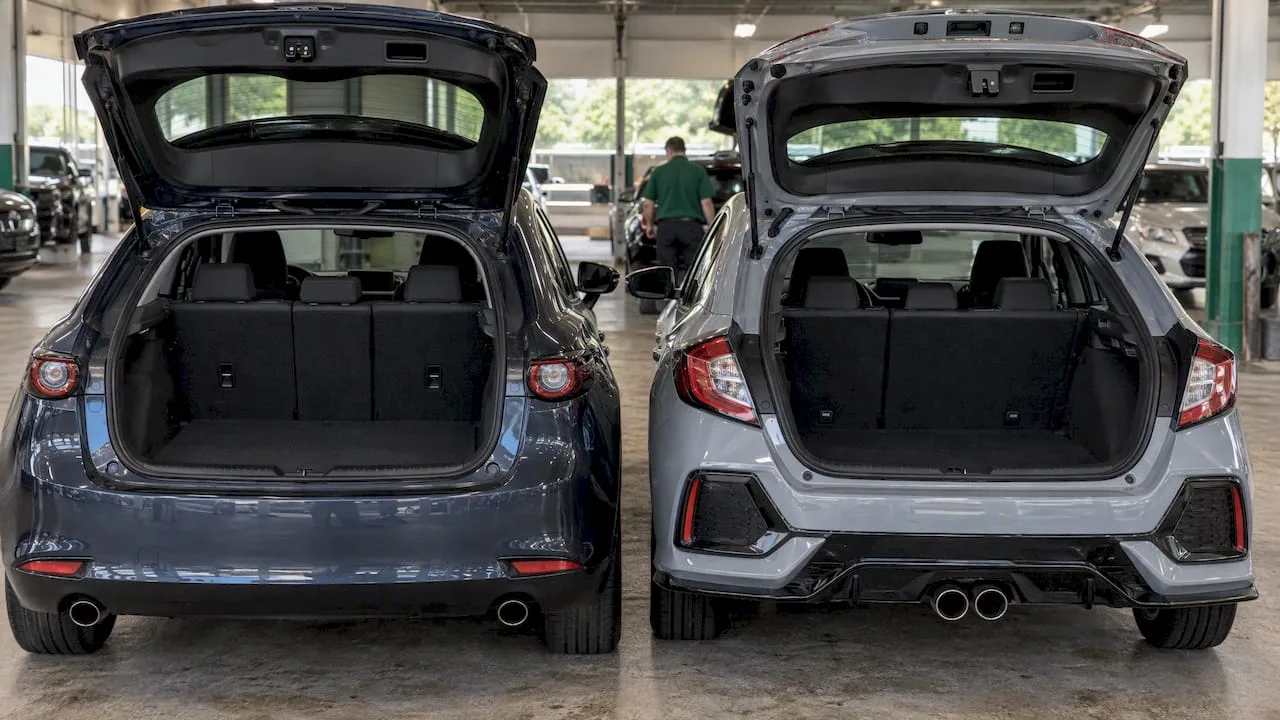
What the Mazda3 gives up in outright space, it tends to make up in material quality. Soft-touch surfaces, tighter panel gaps, and a more deliberate dashboard layout give the Mazda3 cabin a feel that punches above its price point, a trade-off Autoblog highlights as one of the clearest differences between the two.
Infotainment layouts differ too. Honda's touchscreen interface leans toward straightforward menus that are easy to learn quickly, while Mazda's rotary-dial controller takes a little getting used to but keeps your eyes closer to the road once you're familiar with it.
Here's how to think about which matters more for you:
- Families or carpoolers: the Civic's extra rear legroom and cargo volume make a real difference on longer trips.
- Solo commuters or couples: the Mazda3's cabin ambiance may matter more than the last few inches of space.
- Hatchback shoppers: both models offer a hatchback body style with more flexible cargo configurations than their sedan counterparts.
Safety ratings and what that means for long-term reliability
Both the Mazda3 and the Civic come with a strong set of standard driver-assist features, including forward collision warning, lane-keeping assistance, and adaptive cruise control on most trims. Consumer Reports' side-by-side evaluation covers how these systems perform in real-world testing alongside crash-test context from IIHS and NHTSA.
Resale value tends to favor the Civic, a pattern KBB's comparison notes as historically consistent across recent model years, which matters directly if you plan to sell or trade in within five to seven years.
A few points worth knowing before you shop:
- Standard safety tech on both models covers the essentials most buyers expect in 2026, without major gaps between brands.
- Optional upgrades like blind-spot monitoring and rear cross-traffic alert are worth checking trim-by-trim rather than assuming they're standard.
- Reliability reputation has generally leaned toward the Civic over multiple generations, which can translate into fewer unexpected repair bills.
- Used-market demand for the Civic tends to stay strong, keeping resale prices more stable than some competitors.
Ownership costs: insurance, maintenance, and resale value
Warranty coverage on new models from both brands follows the compact-car industry standard, and the specific terms are worth confirming directly with the dealer or manufacturer before you buy. For used cars, what matters more is how much of that original coverage remains and what maintenance has already been performed.
Routine maintenance costs track fairly closely between the two models for standard, naturally aspirated trims. Where costs diverge is with turbocharged or AWD variants, which can carry more involved service intervals and parts costs, something we walk through in more detail in our comparison of turbo versus naturally aspirated ownership.
A few practical notes for budgeting:
- Resale value has historically favored the Civic, which can offset a slightly higher purchase price over time.
- Insurance costs tend to run a bit higher on performance trims like the Civic Si or turbocharged Mazda3 configurations.
- Maintenance records matter more on AWD and turbo models, so ask for documented service history before buying used.
Which should you buy: five buyer profiles
Matching the right car to your actual driving habits beats chasing spec-sheet bragging rights. Here's how we'd map common buyer types to the better choice:
- The daily commuter chasing low fuel costs should prioritize a hybrid Civic trim and test the CVT's behavior in stop-and-go traffic.
- The winter-weather driver should look at an AWD Mazda3 trim and test how it handles on wet or gravel surfaces during the test drive.
- The family hauling kids and gear should favor the Civic for rear-seat room and cargo space, checking child-seat fit during the test drive.
- The driving enthusiast should test a turbocharged Mazda3 or a Civic Si back to back on the same stretch of road to compare steering feel.
- The budget-conscious first-time buyer should compare a base Civic LX against a base Mazda3, focusing on total out-the-door price rather than features alone.
Pro Tip: If you're genuinely torn between the two, drive them on the same day, back to back, over the same roads. The differences in ride and cabin feel are much clearer in direct comparison than in memory a week later.
If you're still undecided after test drives, let fuel economy or cargo space break the tie. Those two factors tend to matter most in daily use, long after the initial excitement of a new car fades.
How we help buyers choose between similar compact cars
Comparing a Mazda3 against a Civic gets a lot easier when you're working from real inspection data instead of guesswork. Every vehicle we list comes with a price shown upfront and no hidden fees, plus a detailed inspection report and vehicle history so you can understand the condition before you test drive it.
If you're deciding between a specific Mazda3 trim and a specific Civic trim, we can also search for the exact configuration you want through our vehicle-sourcing service, rather than asking you to choose from whatever happens to be on a lot. That matters most with AWD or turbocharged trims, where maintenance history varies more between individual cars than the spec sheet suggests.
What actually matters when you're choosing between these two
Most comparison guides treat this decision like a spreadsheet exercise: horsepower here, mpg there, pick the higher number. That approach misses the point. The Civic and Mazda3 are both competent compact cars, and the real decision usually comes down to what kind of driving you do most days, not which car wins more spec categories on paper.
The conventional advice to "test drive both and see which feels right" is fine, but it skips a step. Test drive them on the roads you actually drive every week, loaded the way you'd actually load them, whether that's two kids and a stroller or a set of golf clubs. A Mazda3 that feels sporty on a quiet backroad might feel cramped on your actual commute.
If you take one thing from this comparison, let it be this: fuel economy and cargo space matter more over three years of ownership than horsepower numbers do over three minutes of a test drive.
— CL Auto
Making the switch to a Mazda3 or Civic easier
Whichever model fits your driving style, buying it shouldn't mean guessing about hidden fees or unknown mechanical history. Every car in our hand-picked inventory carries transparent pricing and a full inspection report before it's listed, so you can compare a Mazda3 and a Civic side by side with real condition data, not just a sticker.

If you have a specific trim, engine, or AWD configuration in mind, our vehicle-sourcing service can track it down rather than leaving you to sort through whatever's currently on a lot. Reach out and tell us what you're looking for, and we'll handle the search.
FAQ
Are Mazdas as reliable as Hondas?
Mazda's reliability reputation has generally been solid in recent model years, though Honda has historically held a slight edge in long-term dependability and resale value, according to Kelley Blue Book's comparison. Both brands perform well above average compared to the broader compact car segment.
Is the Mazda3 a reliable car overall?
The Mazda3 has a generally solid reliability record within the compact class, though it has trailed the Civic slightly in resale value and long-term dependability reputation historically. Checking a specific used example's service history matters more than the model's general reputation.
Is a used Mazda3 a good car to buy?
A used Mazda3 can be a strong choice, especially if you value its cabin quality and handling, but confirm the service history closely if the car has a turbocharged engine or AWD. Those configurations carry different maintenance profiles than a standard front-wheel-drive model, so a documented history matters.
Is the Mazda3 the same size as a Honda Civic?
The two are close in overall footprint, but the Civic generally offers more rear legroom and cargo space according to Kelley Blue Book's spec comparison. Both are available in sedan and hatchback body styles, which also affects cargo capacity.
Which one holds its value better, Mazda3 or Civic?
The Civic has historically held stronger resale value than the Mazda3, which matters if you plan to sell or trade in within a few years of ownership. That resale advantage can offset a slightly higher purchase price over the life of the car.
Sources
- Fueleconomy
- Kelley Blue Book — Mazda3 vs. Honda Civic comparison
- Consumer Reports — Honda Civic vs Mazda 3 comparison
- Autoblog — 2026 Honda Civic Hatchback vs Mazda 3 Hatchback: 3 major differences