
Gap Insurance: Run Your Loan Numbers Before the Finance Desk

Gap insurance is worth it if you leased your vehicle, put down a smaller down payment, financed for a longer term, rolled over negative equity from a trade-in, or bought a car that depreciates fast. If you made a solid down payment or you're a few years into a shorter loan, you can probably skip it. Just watch where you buy it, because a dealer add-on can cost two to four times more than the same coverage from your insurer.
TL;DR:
- Gap insurance is most beneficial if you financed a long-term, low-down payment, leased, or rolled over negative equity, which prolongs being underwater on your loan.
- It generally costs between $40 and $150 annually if purchased through an insurer, but dealer or lender packaged options can be significantly more expensive due to financing fees.
- Gap coverage does not pay your deductible, overdue loan payments, negative equity from previous loans, or repair costs, making it a focused safety net for specific situations.
- Running your own calculations by comparing current loan payoff and estimated car value helps determine whether gap insurance is necessary for your circumstances.
- Most lenders cannot require gap insurance, and buyers should verify requirements before signing, as options for cancellation and refunds exist if your situation changes.
Table of Contents
- What Gap Insurance Covers and How It Works
- Who Typically Benefits From Gap Coverage
- Costs and Where to Buy Gap Coverage
- Where Gap Insurance Falls Short
- How to Calculate Your Own Gap and Decide
- Canceling, Refunds, and Confirming What Your Lender Actually Requires
- How Clearwater Largo Automotive Handles Financing Add-Ons
- When Gap Insurance Saves You Money (and When It Doesn't)
- Ready to Find Your Next Car and Compare Financing?
- Where to Verify This Guidance
- Sources
- FAQ
What Gap Insurance Covers and How It Works
Standard collision and comprehensive coverage pays your car's actual cash value (ACV) after a total loss, minus your deductible. ACV is what your car is worth right now, not what you paid for it or what you still owe. That distinction is where gap insurance earns its name.
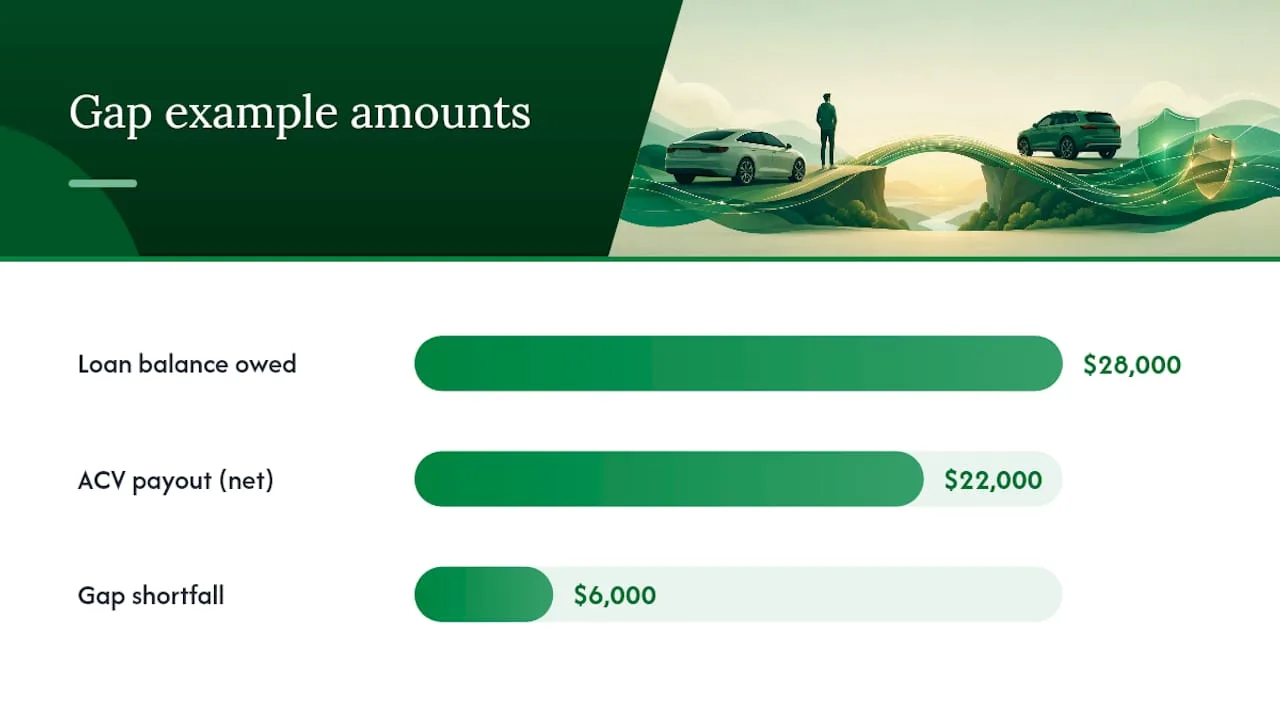
The moment your loan balance exceeds ACV, you have a gap. It shows up after a total loss or an unrecovered theft, when your insurer cuts a check based on market value while your lender still expects the full payoff.
Here's a simple example. Say you owe $28,000 on your loan. Your insurer's ACV estimate on the totaled car comes back at $23,000, and your deductible is $1,000. Your insurer pays $22,000 to the lender, leaving a $6,000 shortfall. According to NerdWallet, gap insurance is built specifically to cover that leftover balance:
- Loan balance owed: $28,000
- ACV payout minus deductible: $22,000
- Gap left for you to pay out of pocket: $6,000
Without gap coverage, you'd owe that $6,000 with no car to show for it.
Who Typically Benefits From Gap Coverage
Gap insurance earns its cost fastest for buyers whose loan balance drops slower than their car's value. A few patterns make that gap wider and longer lasting.
- Leased vehicles. Most lease contracts require gap coverage anyway, since leasing companies carry the depreciation risk and want it covered.
- Down payments under 20%. Less money down means a higher starting balance relative to the car's real worth on day one.
- Loan terms of 60 months or more. Stretching payments out slows down how fast your balance shrinks, extending the window where you're underwater.
- Rolled-over negative equity. If you traded in a car you still owed money on and added that balance to your new loan, you started underwater before you even drove off the lot.
- Fast-depreciating vehicles. Some luxury models and certain EVs lose value quicker than the average new car, widening the gap in the first year or two.
MoneyGeek points out that these conditions all share one trait: they keep you underwater longer than a typical buyer. It could easily owe $2,000 to $4,000 more than it's worth for the first two years. Compare that to a used car bought with 20% down and a 48 month loan, where the balance and value usually cross within the first year, making the coverage far less useful.
Costs and Where to Buy Gap Coverage
Where you buy gap insurance changes the math more than most buyers realize. Insurer-sourced gap coverage typically runs $40 to $150 a year as an add-on to your existing policy, according to NerdWallet. Dealer and lender versions are usually sold differently: a flat one-time fee that can range in the hundreds of dollars, rolled straight into your loan principal.
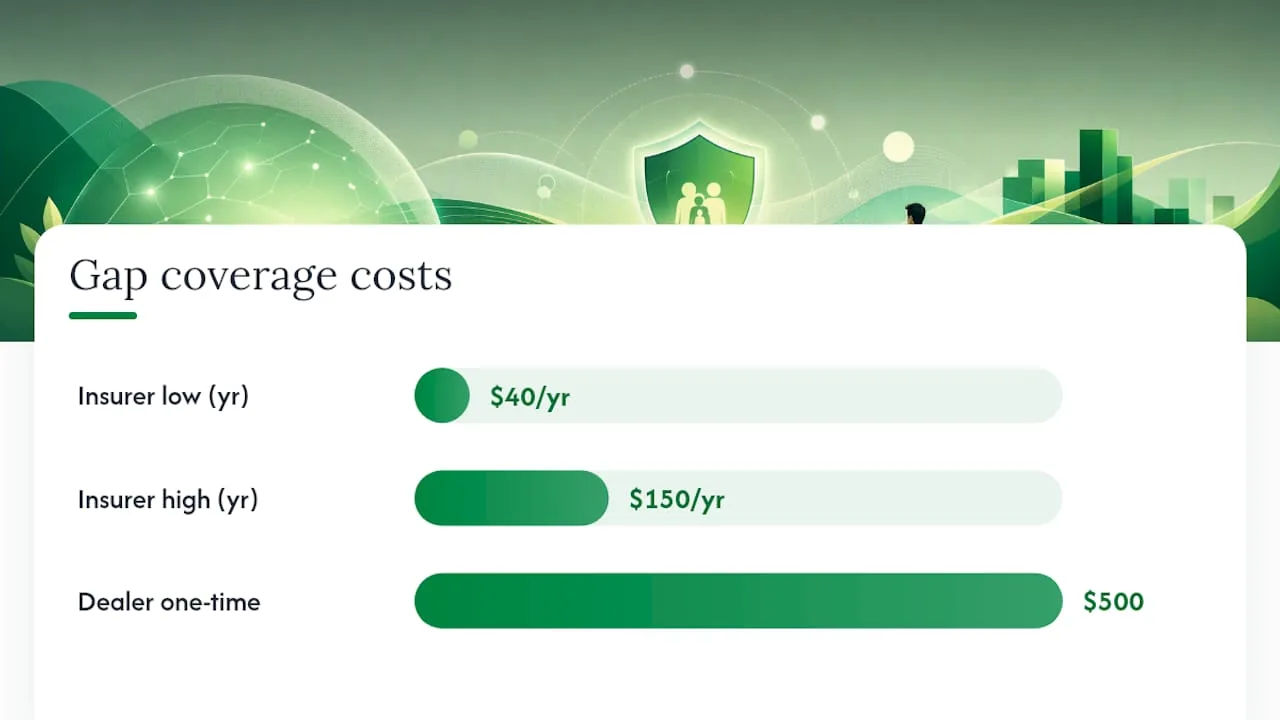
That rolled-in fee is the catch. You're not just paying $500 for gap insurance, you're financing $500 at your loan's interest rate for years, which quietly inflates the real cost. Dealer-sold gap packaged this way can end up significantly more expensive over the life of the loan than the same protection bought through your insurer.
A few habits protect your wallet here:
- Always ask for a written quote before you agree to anything at the finance desk.
- Ask directly whether the fee is refundable or prorated if you pay off the loan early.
- Check your existing auto insurer first. Many offer gap as a cheap monthly add-on, and it's worth comparing that against the payment calculator before you decide how to finance it.
Where Gap Insurance Falls Short
Gap insurance solves one specific problem, and it's easy to assume it covers more than it does. It generally won't pay your insurance deductible, any loan payments you were already behind on, or negative equity carried over from a previous car loan, according to State Farm. It also doesn't touch mechanical repairs or extended warranty costs, since those are separate products entirely.
- Deductibles: still your responsibility
- Overdue payments: not covered
- Prior rolled-over negative equity: usually excluded
- Repair or warranty costs: outside the scope of gap coverage entirely
Eligibility rules matter too. Some dealer-sold gap products aren't structured as regulated insurance in every state, which affects your recourse if a claim gets denied, according to the Texas Department of Insurance.
Pro Tip: Before you sign anything, read the policy for appraisal rights, payout caps, and time windows on filing a claim. A policy that caps payouts at 25% of ACV won't help much on a car that's lost 40% of its value.
How to Calculate Your Own Gap and Decide
You don't need a finance degree to figure out whether gap insurance makes sense for your situation. Run through this checklist:
- Get your current loan payoff amount directly from your lender. This is the exact balance you'd owe if the car were totaled today, not your last statement balance.
- Get an ACV estimate from Kelley Blue Book, NADA, or Edmunds using your car's mileage, condition, and location.
- Subtract ACV from your payoff amount. Whatever's left is your potential gap right now.
- Weigh that number against the cost of coverage. Multiply an annual insurer premium by how many years you expect to stay underwater, and compare that total against your gap and your emergency savings.
- Make the call. If the potential gap is bigger than your savings could comfortably absorb, insurer-sourced gap coverage is the cheaper safety net. If the gap is small or you're already past the underwater period, you can reasonably skip it and revisit later if your loan terms change.
You're not locked into a permanent decision. If you skip gap coverage now and your situation shifts, most insurers let you add it later.
Canceling, Refunds, and Confirming What Your Lender Actually Requires
Gap insurance is an optional add-on, and the CFPB is clear that no lender can lawfully require it as a condition of financing. If a mandatory add-on is bundled into your deal, it has to be disclosed within your finance charges, not buried as a silent extra.
- Ask your lender directly whether gap is required, and get the answer in writing.
- Reread your loan contract for the specific clause naming gap insurance and its cost.
- If you sell, refinance, or pay off your loan early, you may be entitled to a prorated refund on unused premium, per CFPB guidance.
- Contact your dealer's finance office, your lender, or your gap provider directly to start a cancellation or refund request.
How Clearwater Largo Automotive Handles Financing Add-Ons
We list our prices upfront, and that same transparency carries over to financing conversations. When a customer asks about gap coverage, we walk through insurer quotes alongside any dealer or lender options so you can see the real cost difference for yourself, not just the number on a finance sheet.
Our financing team works with multiple lenders, which means you get to compare terms instead of accepting whatever's placed in front of you. If you want a written quote or a breakdown of what's optional in your deal, just ask. That's the whole point of doing this in person, with someone who'll actually answer the question.
When Gap Insurance Saves You Money (and When It Doesn't)
The advice that gets repeated most often, "just buy gap insurance to be safe," misses the actual math. Gap coverage isn't a universal safety net; it's a tool that solves one specific problem: a loan balance that outpaces your car's value. For a buyer with 20% down and a 48 month loan, that problem often resolves itself within a year, making the coverage a low-value purchase.
Where conventional advice really falls short is on sourcing. Plenty of buyers who genuinely need gap coverage end up overpaying for it because nobody told them insurer-sourced gap is usually a fraction of the dealer price. The coverage decision and the purchase decision are two separate questions, and treating them as one is how buyers end up financing an inflated add-on fee for five years.
If you take one thing from this, prioritize running your own numbers before you sit down at a finance desk. Know your likely gap, know roughly what insurer coverage costs, and walk in with a number in mind instead of reacting to whatever's pitched to you.
— CL Auto
Ready to Find Your Next Car and Compare Financing?
Clearwater Largo Automotive gives you a way to shop and finance without the pressure to accept whatever add-on lands on the paperwork. Every vehicle in our inventory carries a hand-inspection and history report before it's ever listed, and our in-house financing team works with multiple lenders so you can actually compare terms instead of taking the first offer.
If a specific make, model, or budget is what you're after, our vehicle sourcing service finds it without the runaround of browsing lots that don't have what you need. Before you sign for financing anywhere, run your numbers through our payment calculator to see how a rolled-in fee actually affects your monthly cost and total interest. Browse our current inventory in Clearwater, or reach out and a real person, not a call center, will help you compare your financing and coverage options directly.
Where to Verify This Guidance
For direct confirmation of your rights around optional add-ons, read the CFPB's guide to GAP requirements. For state-specific policy rules, check your state insurance department's consumer guidance.
Sources
- CFPB — Am I required to purchase an extended warranty or Guaranteed Asset Protection (GAP) from a lender or dealer to get an auto loan?
- NerdWallet — What Is GAP Insurance and How Does It Work?
- MoneyGeek — Do I Need Gap Insurance on a Used Car?
- Texas Department of Insurance — Do you need gap insurance for your car? How does it work?
FAQ
What Are the Cons of Gap Insurance?
Its biggest downside is cost when bought the wrong way: a dealer fee rolled into your loan can run two to four times more than the same coverage from your insurer, and it still excludes deductibles and overdue payments.
When Would You Not Need Gap Insurance?
You likely don't need it if you made a down payment of 20% or more, chose a loan term under 60 months, or you're far enough into your loan that your balance is already below the car's market value.
What Does Dave Ramsey Say About Gap Insurance?
Ramsey's general advice centers on avoiding being underwater on a car loan in the first place, by making a larger down payment and choosing a shorter loan term, which reduces or eliminates the need for gap coverage.
Why Do Dealers Push Gap Insurance?
Dealers often earn a commission on financing add-ons sold at the finance desk, and bundling a one-time gap fee into your loan is more profitable for them than if you bought the same coverage separately from your insurer.
Is Gap Insurance Worth It on a Used Car?
It depends on your down payment and loan length: a used car bought with little down and a long loan term can carry a real gap risk, while a used car with a solid down payment usually clears that risk within the first year, according to MoneyGeek.