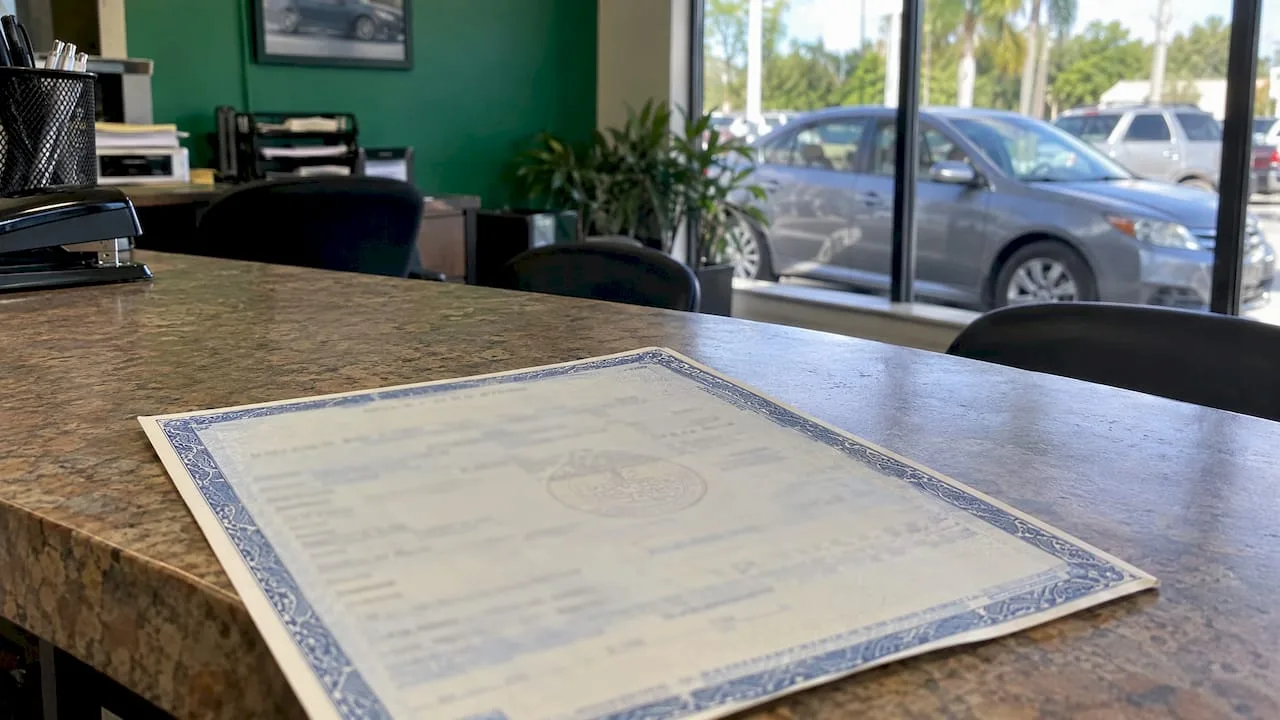
A lemon buyback title means the manufacturer took the car back from its first owner because a defect could not be fixed after a reasonable number of repair attempts, and the state recorded that on the title. It is not automatically a bad car. But the brand stays with the vehicle, it lowers what the car is worth, and some states never put it on the title at all. So you check the history yourself before you pay. Here is how we would do it.
TL;DR
- A "manufacturer buyback" or "lemon law buyback" brand tells you the maker repurchased the car under a state lemon law because a defect was not fixed.
- Florida requires the title to read "Manufacturer's Buy Back" and requires written disclosure before the sale is completed.
- Fewer than a third of states require the brand, so a clean title alone does not prove a car was never bought back.
- Buybacks are commonly priced well below clean-title cars, but the same brand lowers your resale value later.
- Run a title-history check by VIN, read the repair records and get an independent inspection before you sign.
Table of Contents
- What a lemon buyback title actually says
- What Florida requires
- Why a clean title is not proof
- What a buyback does to price and resale
- How to check a car before you buy: 6 steps
- Red flags that mean walk away
- Can the brand be removed?
- Promo: skip the guesswork
- Our perspective
- FAQ
- Sources
What a lemon buyback title actually says
Every state has a lemon law. When a new vehicle can't be repaired after a set number of attempts, or stays in the shop too long, the owner can ask the manufacturer to take it back and refund or replace it. The manufacturer then owns a car with a known history, and in many states it must tell the next buyer about it.
The wording on the title differs by state. Wisconsin's DMV describes its "Manufacturer Buyback" brand as applying to a vehicle bought back because a defect was not corrected after a reasonable attempt to repair it. California uses "Lemon Law Buyback" for vehicles repurchased on or after January 1, 1996, according to the California DMV. Utah stamps its titles with "Manufacturer Buyback Nonconforming Vehicle". Oklahoma has required a permanent "Lemon Law Buyback" brand since August 25, 2024.
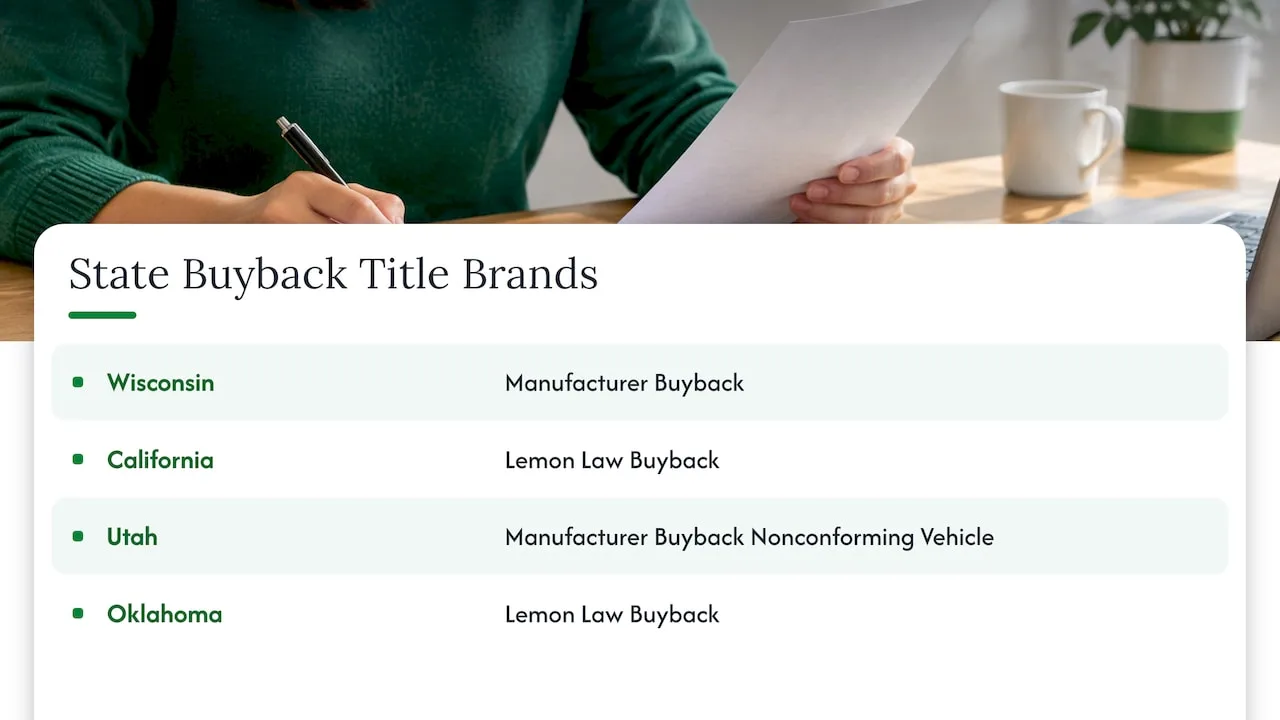
So if you see "buyback," "repurchased," "nonconforming vehicle" or something similar in the title brands box, it is the same event with a local name.
What Florida requires
You are buying in Florida, so Florida's rules are the ones that matter most. Under Florida Statutes §319.14, nobody may knowingly sell a vehicle repurchased by a manufacturer under Chapter 681 until the title is stamped "Manufacturer's Buy Back" in a conspicuous place. The brand carries forward on later titles and registrations for the life of the vehicle. The same statute requires written disclosure to the buyer before the sale is completed.
The state's own title procedures add two points worth knowing. Florida cannot remove a brand applied by another state, and the brand cannot be removed from NMVTIS, the national title database. (NMVTIS stands for National Motor Vehicle Title Information System. It pulls together title, brand and salvage records from state motor vehicle agencies.)
In plain terms: if a Florida dealer or seller knows a car is a buyback, you should be handed a written disclosure and see the brand on the title. If you are not, stop and ask why.
Why a clean title is not proof
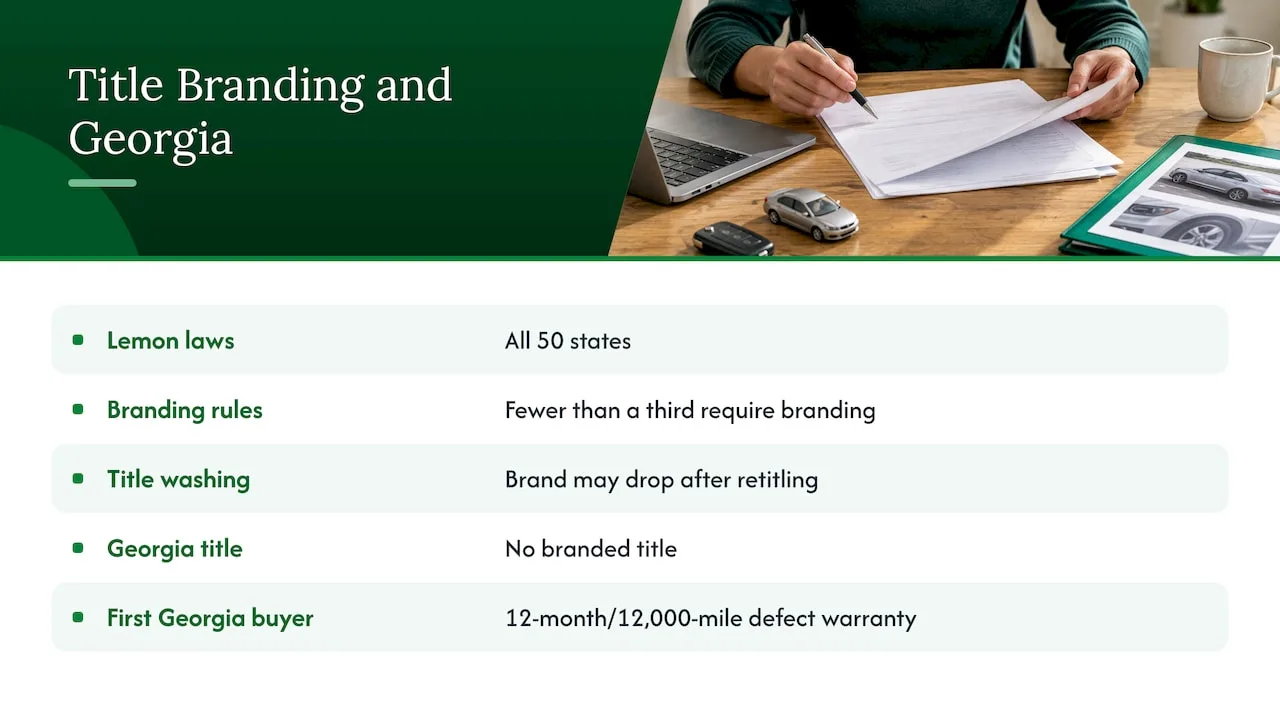
This is the part that surprises first-time buyers. Road & Track reports that all 50 states have lemon laws, but fewer than a third require title branding for repurchased vehicles. Some states use softer wording than "lemon." And when a car is retitled in a state that does not brand, the designation can drop off the title itself. That practice is called title washing, and Utah's DMV points buyers to NMVTIS for title history for that reason.
Georgia is a good example of a state that does it differently. Its consumer agency explains that a Georgia-registered reacquired vehicle is not given a branded title. Instead, the first buyer after the manufacturer's repair gets a non-transferable 12-month/12,000-mile warranty on the repaired defect, and a brand from another state may remain until the car is retitled in Georgia.
The same Road & Track piece notes that history-reporting companies may describe a repurchase as a simple auction sale by the manufacturer. That is why we read the ownership line, not just the "no brands" summary.
What a buyback does to price and resale
The discount is real, and so is the penalty when you sell. Published estimates vary by source:
| Source | Typical discount vs. a clean-title twin | Resale effect |
|---|---|---|
| CarWhere (August 2026) | 10% to 30% below | Smaller hit than salvage or flood titles, since the defect is usually repaired before resale |
| Allen Stewart P.C. (June 2026) | Not stated | Permanent hit of 20% to 40%, and trade-ins can be difficult |
The takeaway is simple. If you pay 20% less today and lose 20% more when you resell, you have saved nothing over the time you own the car. The deal only works when the discount is wide and the original problem was minor. A buyback returned for a glitchy infotainment screen is a very different car from one returned for repeated transmission trouble, and you should price them differently.
CarWhere also suggests comparing the asking price with actual clean-title sale prices, not asking prices, to confirm the discount is real. We agree.
Insurance and financing
Buybacks are generally easier to insure and finance than salvage or rebuilt cars, and many insurers and lenders offer close-to-normal terms, according to CarWhere. Policies differ, so give your insurer the VIN and the title brand before you commit, and ask your lender the same question. Do it before you sign, not after.
How to check a car before you buy: 6 steps
First-timers often skip straight to the test drive. Do these in order instead.
Get the VIN and run a title-history report. The VIN is the 17-character number on the dash and the driver's door jamb. An NMVTIS-based report shows title brands from every state, not just the one where the car is now. Our guide to verifying a clean title with NMVTIS walks through it. Where it goes wrong: relying on a one-line "no brand" summary and never reading the ownership timeline.
Read the ownership history for a manufacturer. A car that went from its first owner to the manufacturer and then to an auction is a buyback pattern, even when the report doesn't say "lemon." Our page on how to read a vehicle history report shows what each entry means.
Compare the title state to where the car has lived. A car titled in a state that doesn't brand buybacks, then moved to another state, is the classic washing route. If the title state and the car's history don't match, ask for an explanation in writing.
Ask for the written disclosure and the repair orders. In California, a dealer selling a known buyback must give a signed disclosure listing the year, make, model, VIN, title marking, reported defects and repairs made, per the California DMV. Florida requires written disclosure before the sale closes. Ask for the manufacturer's repair orders too, so you can see what broke, how often, and what was replaced. Two or three repeat repairs for the same problem is the pattern that triggers a lemon claim.
Check recalls and warranty status. Look up the VIN on NHTSA's recall lookup. Then confirm in writing what warranty is left. In Georgia, for instance, the special 12-month/12,000-mile warranty goes to the first buyer after repair only, and after it ends repairs are on you.
Have an independent mechanic inspect the car. The inspection should focus on the system that caused the buyback. A shop that does mobile diagnosis and repair can look at the symptoms and trouble codes without the seller steering the process. Our used car inspection checklist for Florida buyers lists what we look at ourselves.
Red flags that mean walk away
We keep this list short, because it is the part that saves buyers real money.
- The seller says the title is "clean" but can't explain a gap where the manufacturer owned the car.
- The price is far below the market with no written reason.
- The defect was in the engine, transmission, brakes, airbags or steering, and there is no repair paperwork.
- The seller won't put the disclosure in writing.
- The car arrived from another state and the title was issued very recently.
If a seller hides a buyback and you find out later, most states offer legal remedies such as undoing the contract or a fraud claim, and the clock on fraud often starts when you discover the concealment, according to LegalClarity. If that is your situation, talk to a consumer protection attorney in your state. Our guide to used car lemon law claims covers the basics.
Can the brand be removed?
No. Florida can't remove another state's brand, and NMVTIS keeps the record, as the Florida DHSMV procedure states. Federal law treats title washing as a crime, so anyone offering to "clean up" a lemon brand is selling you a problem. If you plan to keep the car for years and the repair history is solid, the brand matters less. If you trade every two or three years, it matters a lot.
Promo: skip the guesswork
If you would rather not decode titles yourself, that is what we do for a living. Every car we list is hand-inspected, we pull a history report before listing it, and the price is on every listing with no hidden fees. Browse our hand-picked used cars.
Want a specific make, model and budget, with no branded title in the picture? Tell us what you are after on our vehicle sourcing page and you only see cars that meet your list. A real person answers every inquiry. If you need to spread the cost, our financing works with multiple lenders.
Our perspective
We hear the same worry from first-time buyers: "How do I know what I am not being told?" With a lemon buyback, the honest answer is that the paperwork can hide it, so the job is to make the history visible before you pay.
That is why we inspect each car by hand and review its history report before it is listed. It is also why we put the price on every listing and keep fees out of the surprise column. A buyer who knows the full picture decides better, and stays with a car longer.
If a car has a long list of questions, you do not have to chase it. Ask us to find the exact vehicle you want, and we will do the looking. A real person, not a call center, answers.
CL Auto
FAQ
What does manufacturer buyback on a title mean?
It means the carmaker repurchased the vehicle under a state lemon law because a defect was not fixed after a reasonable number of attempts. The exact wording varies by state. In Florida, the brand reads "Manufacturer's Buy Back."
Is buying a lemon buyback car a good idea?
It can be when the discount is wide, the original defect was minor and well documented, and you plan to keep the car a long time. It is a poor fit if you trade often, because the brand lowers resale value too. Read the repair orders and get an independent inspection first.
Can you insure and finance a lemon buyback car?
Usually yes. Buybacks are typically easier to insure and finance than salvage titles, but terms vary by company. Give your insurer and lender the VIN and the brand before you buy.
Can a car be a buyback with a clean title?
Yes. Fewer than a third of states require branding, and a car retitled in a non-branding state can lose the brand on paper. An NMVTIS-based history report and a look at the ownership timeline are your best checks.
Sources
- Wisconsin DMV: title brand FAQs
- California DMV: lemon law buybacks and warranty returns
- Utah DMV: salvage vehicles and branded titles
- Oklahoma Administrative Code § 670:20-35-14
- Florida Statutes §319.14 (2025)
- Florida DHSMV title procedures
- Road & Track: what happens to lemon law cars
- Georgia Consumer Ed: purchasing a manufacturer buyback vehicle
- CarWhere: lemon law buyback explained
- LegalClarity: is buying a lemon law buyback car worth the risk
- Eagle Transmission & Auto Repair: mobile diagnosis and repair