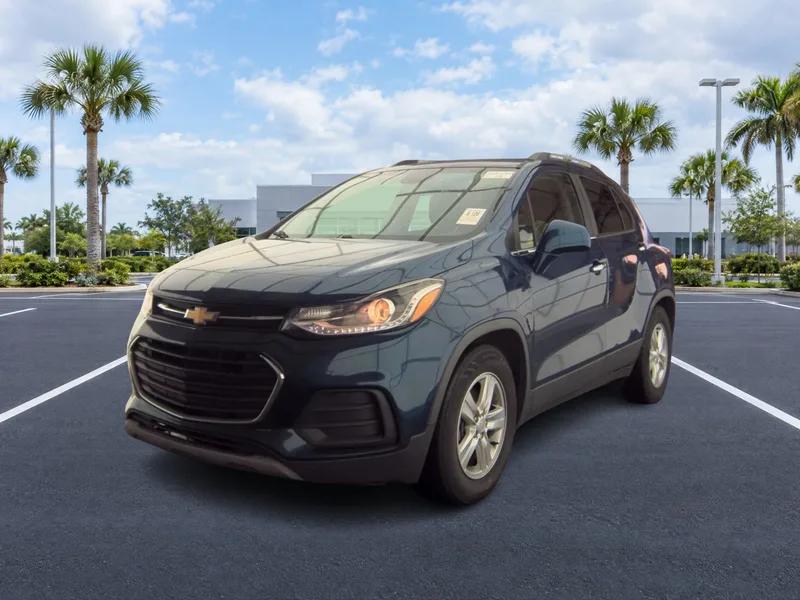
A VIN (vehicle identification number) is a 17-character code that works like the car's fingerprint. Positions 1 to 3 say who built it, positions 4 to 8 describe it, position 9 is a math check, and positions 10 to 17 give the model year, plant and serial number. Reading it takes two minutes. Knowing what it can't tell you is what protects your wallet, and that is where we help: every car we list is hand-inspected and has its history report reviewed before it goes online.
TL;DR
- Every car sold in the U.S. since the 1981 model year carries a 17-character VIN, and the letters I, O and Q never appear in it.
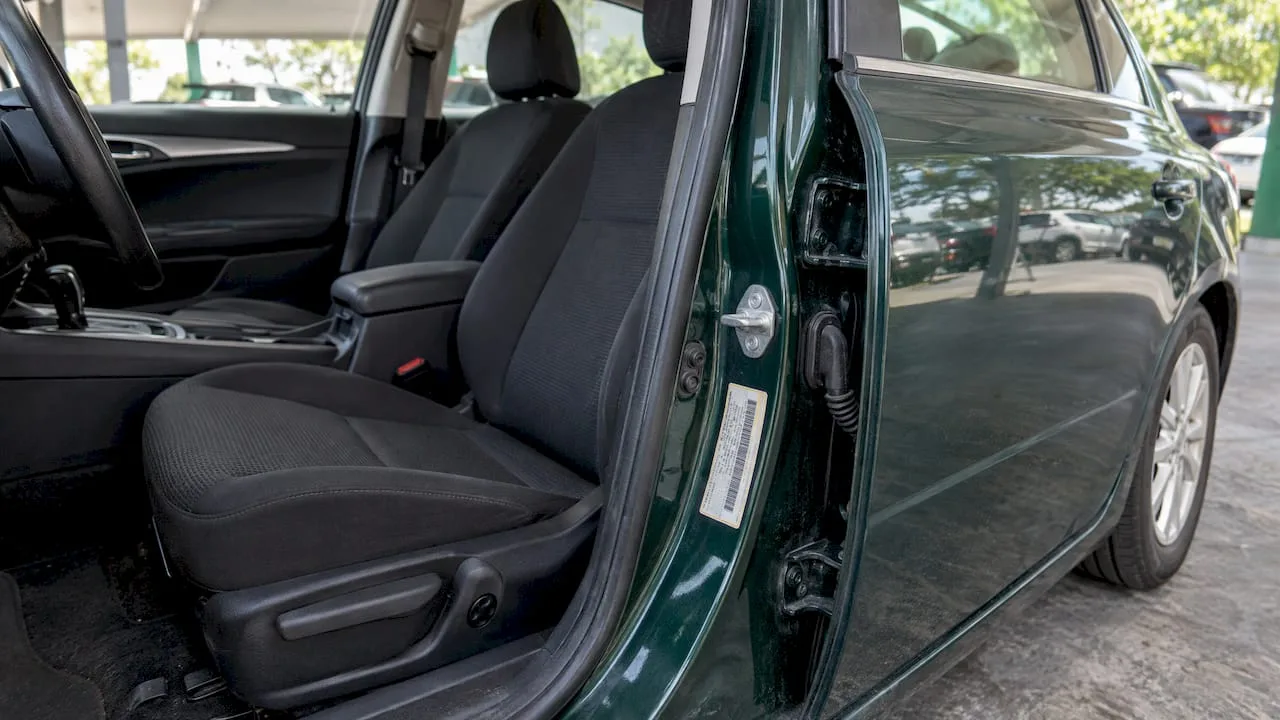
- Look for it at the lower-left corner of the windshield, on the driver's doorjamb label, or on the title, registration and insurance papers.
- The code splits into manufacturer (1 to 3), attributes (4 to 8), check digit (9), model year (10), plant (11) and serial number (12 to 17).
- A VIN shows how the car left the factory. It does not show crashes, repairs or current condition, so pair it with a history report and an inspection.
Table of Contents
- Where to find the VIN
- The 17 characters, section by section
- A quick worked example
- Decode it for free
- What a VIN can't tell you
- Older cars are different
- Red flags when you read a VIN
- Why buy where the VIN is already checked
- See cars with the VIN details up front
- FAQ
- Sources
Where to find the VIN
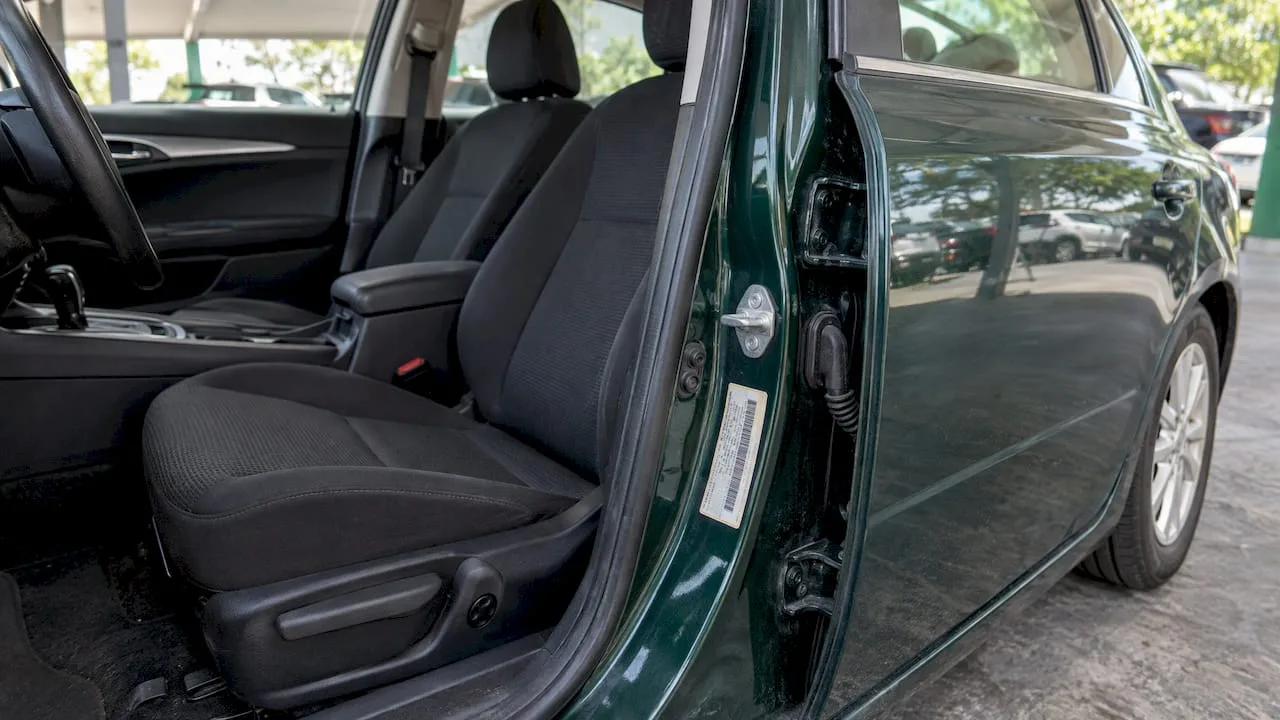
NHTSA, the federal vehicle safety agency, tells consumers to look for the VIN in the lower-left corner of the windshield, on the driver's side doorjamb label, or on registration and insurance documents. Consumer Reports adds that it is also printed on the window sticker and the title.
When you shop, check the VIN in at least two places on the car and compare them with the paperwork. If the dashboard number and the doorjamb number differ, or either differs from the title, stop and ask why. A real person answers that question for you at our dealership, not a call center.
The 17 characters, section by section
The layout is set by federal rule. Under 49 CFR 565.15, the structure is:
Positions 1 to 3: the manufacturer and vehicle type. This is the World Manufacturer Identifier. The first character usually tells you where the car was assembled. Consumer Reports lists 1, 4 and 5 for the U.S., 2 for Canada, 3 for Mexico, J for Japan, W for Germany and L for China. Since 2024, NHTSA lets automakers use a U.S.-issued code on vehicles built abroad if certain criteria are met, so a leading 5 doesn't always mean a U.S. factory. Position 11 names the actual plant.
Positions 4 to 8: the vehicle attributes. For passenger cars, these make the make, line, series, body type, engine type and restraint devices decipherable. Each maker uses its own codes here. Position 8 has no universal meaning, so a chart that says "the 8th digit is the engine" can mislead you. Use a decoder instead of guessing.
Position 9: the check digit. It is computed from the other characters by a formula. It exists to catch typos and fakes, and you don't need to calculate it. A decoder will flag an invalid VIN.
Position 10: the model year. It is a letter or number, not the year itself. NICB's identification manual lists 2023 as P, 2024 as R, 2025 as S, 2026 as T, 2027 as V and 2028 as W, as shown in its manual. NHTSA notes that year codes skip U, Z and 0.
Position 11: the assembly plant. Each maker assigns its own plant codes.
Positions 12 to 17: the production number. This is the car's serial number as it came down the line. For low-volume makers, positions 12 to 14 also help identify the manufacturer.
Why the missing letters? I, O and Q are excluded so they can't be mistaken for 1 and 0. If you see one in a 17-character VIN, something is wrong, often a misread or a doctored number.
A quick worked example
Say a VIN begins with 1. You know it was assembled in the U.S. Say the tenth character is T. You know it is a 2026 model year. Say the eleventh character is a plant code. You can't read it alone, but the decoder will name the factory. That is the whole routine: first character for country, tenth for year, then let the decoder fill in the rest.
Decode it for free
Skip the charts and use NHTSA's free VIN decoder. Consumer Reports describes the steps: enter the VIN, click Decode VIN, then choose Show All Vehicle Details. A blank field means NHTSA has no data on that feature.
Compare what comes back with the ad. Check that the year, trim, engine and body style match what the seller says. A mismatch, such as a base trim listed as a higher one, is worth a direct question.
The decoder shows what the manufacturer reported, so questions about its data go to the maker. It describes the car at the factory, not its life since.
What a VIN can't tell you
This is where first-time buyers get caught. The VIN opens the door to a car's records, but it isn't a record itself.
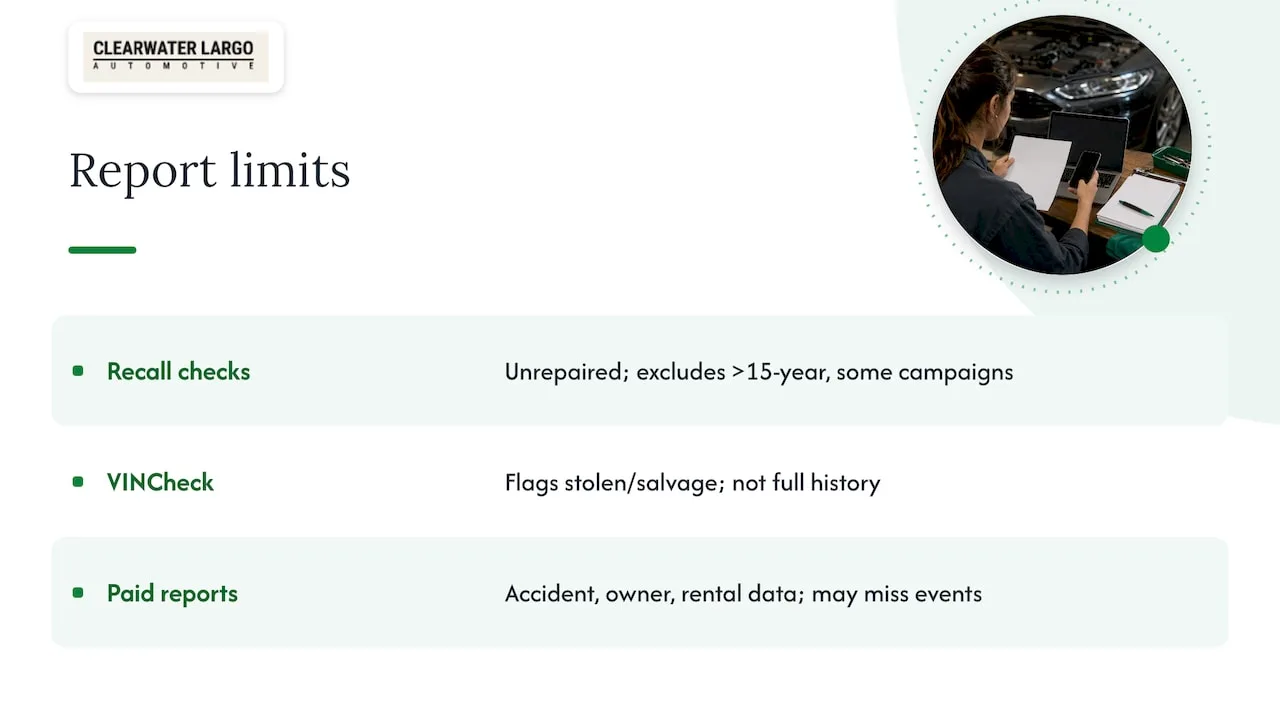
Recalls. You can search the VIN on NHTSA's recall page. Know its limits: it shows only unrepaired recalls, and leaves out recalls older than 15 years and some small-maker campaigns.
Theft and salvage. The National Insurance Crime Bureau's VINCheck tool flags stolen and salvage records. Consumer Reports notes it is not a full history report.
Crashes, owners and service. Paid reports add accident, owner count and rental history, but they depend on insurance and police data. AAA lists what they can miss: unreported accidents, DIY or small-shop maintenance, hidden flood or hail damage, and delayed data. AAA's advice is to treat the check as one input next to a visual inspection, record review, an NMVTIS report and a test drive.
For the next step, see our guide on how to read a vehicle history report, and how to verify a clean title with NMVTIS. Then walk through our used car inspection checklist for Florida buyers and the test drive checklist.
Florida adds its own risk. Flood damage is a real concern near the Gulf, and it may not appear on any report. That is one reason we inspect each car by hand before listing it.
Older cars are different
The 17-character format began with the 1981 model year. NHTSA's decoder is intended for 1981 and newer vehicles, so it can't decode a 1970s car. Before 1981, each maker used its own shorter format. If the VIN has fewer than 17 characters, don't use a modern chart.
Red flags when you read a VIN
- The VIN differs between the dashboard, doorjamb and title.
- The plate or sticker looks tampered with, glued or scratched.
- The VIN has an I, O or Q.
- The decoded year, engine or trim doesn't match the listing.
- The seller won't let you photograph the VIN before you visit.
Any one of these is a reason to walk away or to ask hard questions first.
Why buy where the VIN is already checked
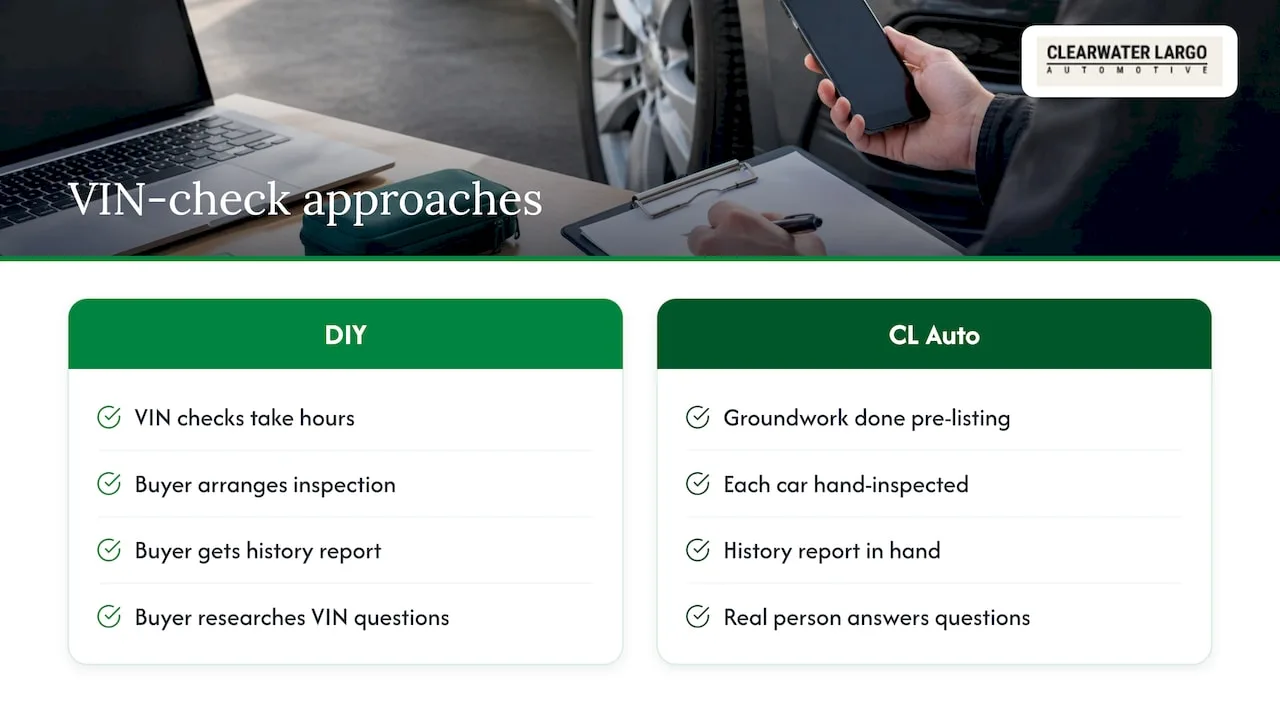
Reading a VIN yourself is a good habit. Doing the whole job alone, on every car, with a decoder, a recall search, a theft check, a history report and an inspection, takes hours. Most people shopping on a work schedule don't have them.
We do that groundwork before a car is listed. Our price is on every listing with no hidden fees, each car is hand-inspected, and history reports are in hand before listing. When you ask a question, a real person replies.
Our view on VINs
We treat the VIN as the first page of a car's story, not the whole book. It tells you what the factory built. It takes an inspection and a history report to tell you what happened afterward.
That's why we don't list a car until it has been hand-inspected and its history checked. We'd rather you ask us about a VIN than guess at one. You'll get an answer from a person, with the price shown plainly on the listing.
If you want a specific car, we can source it for you, so you only see vehicles that match what you asked for.
CL Auto
See cars with the VIN details up front
Browse our used cars in Clearwater, FL, each with its price displayed and no hidden fees. Looking for something specific? Tell us what you need and we'll find it. If you need a loan, we arrange financing through multiple lenders.

FAQ
What does a VIN tell you about a car?
It tells you the manufacturer, assembly region, model attributes such as body and engine type, model year, plant and serial number. It does not tell you the car's accident, repair or ownership history. For that you need a history report and an inspection.
Why does a VIN have 17 characters?
NHTSA standardized the format in 1981, and all road vehicles sold in the U.S. since then must carry a 17-character VIN. Older cars used each maker's own shorter formats.
Is the 8th digit always the engine?
No. Many makers use position 8 for the engine, but others use it for restraint or series codes. Run the VIN through NHTSA's decoder rather than relying on a chart.
Can I run a VIN before visiting a dealership?
Yes. Ask for the VIN, photograph it on the car when you visit, and compare it to the paperwork. Decode it and check for recalls on NHTSA's site, then review the history report.
Sources
- NHTSA VIN Decoder
- NHTSA Vehicle Safety Resources
- eCFR 49 CFR 565.15
- Consumer Reports: Decoding a Car's VIN
- NICB Passenger Vehicle Identification Manual
- NHTSA Manufacturer Handbook
- NHTSA vPIC about page
- Wisconsin DMV vehicle info FAQs
- AAA: Vehicle History Reports
- PlainVIN: How to Read a VIN
- RunThatVIN: Free VIN Check